
Key Takeaways
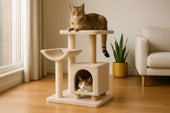
- A good cat tree is a welfare tool, not just furniture. Vertical space supports natural climbing, perching, hiding and scratching behaviours, which can reduce stress and household conflict—particularly in multi-cat homes.
- Stability and anchoring matter as much as height. Tall trees should be placed on a flat surface, assembled correctly, checked regularly, and secured to a wall where practical to reduce tip-over risk.
- Match the design to the cat, not the trend. Kittens, seniors, large breeds, anxious cats, and multi-cat households benefit from different layouts, platform sizes, entry points, and access (ramps/steps).
- Materials influence safety, comfort and longevity. Look for robust bases, thick posts, and durable scratching surfaces (often sisal). Avoid strong chemical odours and flimsy coverings.
- Placement is part of the “product”. A well-placed cat tree can redirect scratching away from furniture, increase exercise, and provide a safe vantage point without blocking walkways or creating fall hazards.
- Maintenance extends the life of the tree and protects your cat. Tighten bolts, replace worn rope, and monitor for loose fabric, staples, splinters, and instability.
PetCareShed’s Handpicked Cat Comforts
Introduction
Cat trees are often described as “enrichment”, but in practical terms they are in-home infrastructure—a vertical habitat that helps cats do what cats are built to do: climb, stretch, scratch, perch, hide, observe, and rest. For many Australian households, particularly those keeping cats indoors or contained to a cat run/catio, a cat tree is one of the most direct ways to support healthy behaviour without needing large indoor spaces.
The challenge is that “best cat trees in Australia” can mean different things depending on the cat and the home. A compact apartment in Sydney, a Queenslander with limited wall anchoring options, a family home with two dogs and a timid cat, or a multi-cat household with social tension will each need a different solution.
This guide explains how to choose a cat tree that is safe, stable, and genuinely useful for your cat’s daily life. It focuses on Australia-specific considerations—such as indoor living, heat and humidity, floor types common in Australian homes, and the practicalities of delivery, assembly, and ongoing maintenance.
What “Best” Really Means for a Cat Tree (Function Over Looks)
A cat tree can look impressive and still fail the simplest test: does your cat actually use it? Cats consistently choose places that help them feel secure, in control, and comfortable. A well-designed tree gives them:
- Height variety (so they can observe and retreat)
- Choice of routes (so they are not forced to pass another cat or the dog)
- Scratching options (vertical scratching at full stretch is particularly valuable)
- Resting zones (platforms, hammocks, cubbies) in positions that feel safe
- Predictable stability (no wobble, no unexpected movement)
International Cat Care highlights the value of vertical space (shelves, perches, platforms) in homes and multi-cat environments, and recommends providing scratching posts as tall as possible to enable vertical scratching at full stretch, with steps/ramps for cats who may struggle with height access.
In other words: “best” is not a single product—it is the best fit between structure, cat behaviour, household layout, and safety.
The Welfare Case for Cat Trees: Why Vertical Space Matters
A cat tree is a practical way to add vertical territory. This matters because cats do not experience a home only in square metres; they also experience it in levels.
Vertical space helps cats feel secure
Cats often cope better when they can observe from above, especially in busy homes or where there are visitors, children, or other animals. Providing elevated resting areas and high sleeping spots can offer a predictable refuge.
International Cat Care notes that vertical space allows cats to “enjoy their own space” and can be particularly helpful when introducing cats or managing shared living arrangements.
Vertical space reduces multi-cat tension
Multi-cat homes can be harmonious, but they can also become quietly stressful when cats are forced into narrow pathways or limited resting zones. Adding height creates extra “traffic lanes” and resting options. International Cat Care also emphasises distributing resources across the home and across different levels (and providing access support, such as steps), which aligns well with thoughtful cat-tree placement.
Scratching is not misbehaviour—it's a biological need
Scratching supports claw maintenance, stretching, and scent marking. Cat trees that include tall, stable scratching posts and preferred textures can redirect scratching away from furniture. RSPCA Queensland includes scratching posts as a core environmental enrichment item and stresses the importance of variety and safety in enrichment.
Indoor and contained cats especially benefit
Many Australian councils and welfare organisations support or encourage cat containment for safety and wildlife protection. When cats spend more time indoors or in enclosed spaces, owners need to supply exercise and stimulation opportunities. A well-chosen cat tree contributes to daily movement, jumping practice, and resting choice.
Your Cat Deserves the PetCareShed Touch
Understanding Cat Tree Types Common in Australia
Australian pet owners will encounter a mix of designs. The best choice depends on your cat’s age, size, confidence, and the home environment.
1) Compact cat towers
These are smaller footprints with 2–4 levels.
Best for: apartments, single cats, seniors who still like height but need shorter steps.
Common strengths: easy to place, quicker assembly, lower fall risk.
Common limitations: may be too small for large cats or multi-cat homes.
2) Multi-level trees with cubbies and hammocks
These add hideaways and lounging points.
Best for: cats that alternate between social time and retreat, timid cats needing a hide.
Considerations: ensure cubby entrances are large enough; hammocks must be well-stitched and firmly supported.
3) Floor-to-ceiling tension pole trees
These use a pressure fit between floor and ceiling.
Best for: homes where wall anchoring is difficult and the ceiling is suitable.
Considerations: ceiling type matters. Plasterboard and decorative cornices may be unsuitable for heavy pressure or may mark. If you choose this style, follow manufacturer guidance closely.
4) Wall-mounted modular climbing systems
These are shelves, steps and perches fixed to studs or masonry.
Best for: maximising vertical space without using floor area; multi-cat routes.
Considerations: requires careful installation; renters may need permission.
5) Outdoor cat runs with climbing features
Not a “cat tree” in the living room sense, but highly relevant in Australia.
Best for: contained cats with access to a secure outdoor enclosure.
Considerations: weathering, UV exposure, and the need for shade and safe materials.
How to Choose the Right Cat Tree: A Step-by-Step Framework
Choosing becomes simpler when you treat it like fitting a piece of equipment to a specific animal.
Step 1: Measure your cat (and be realistic about adult size)
A common disappointment is a tree that looks large online but has platforms too small for the cat to lie comfortably.
Practical guidelines:
- Platform size: your cat should be able to lie in a relaxed “sprawl” without limbs hanging off.
- Cubbies: entrances should allow easy entry without squeezing whiskers or compressing the body.
- Post thickness: larger cats need thicker posts to prevent flex and wobble.
Step 2: Match the layout to mobility and confidence
Cats vary widely in how they climb.
- Confident jumpers will use open ledges and higher platforms.
- Cautious or timid cats often prefer enclosed cubbies and “covered” routes.
- Senior cats benefit from lower steps and stable ramps.
International Cat Care specifically mentions providing small steps or ramps for cats with mobility limitations so they can still access preferred resting spots.
Step 3: Choose the right height for your home
High is not automatically best.
- If you have ceiling fans, leave safe clearance.
- If your cat is a reckless jumper or you have slippery floors, extremely tall trees can raise fall risk.
- If your cat is timid, a mid-height tree placed near a secure location (like a quiet corner) may see more use.
Step 4: Pick materials that cope with Australian conditions
In Australia, humidity and heat can affect adhesives, fabric, and particleboard.
- Humidity (coastal areas): can loosen joints over time and encourage mould in dense fabrics.
- Heat and sun: direct sun through windows can degrade coverings.
Choose structures with sturdy frames and coverings that do not trap odour or moisture. If a new tree has a strong chemical smell, allow it to air out in a ventilated area before introducing it to your cat.
Step 5: Decide what “job” the cat tree must do
A single tree can be asked to do too much. Be specific.
Common “jobs” include:
- Redirect scratching away from furniture
- Provide a safe retreat from a dog or busy household
- Add vertical territory in a multi-cat home
- Encourage movement for an indoor cat
- Create a window perch for visual stimulation
Once the job is clear, the right design becomes easier to identify.
Safety First: Stability, Anchoring, and Placement in Australian Homes
Cat trees can become unstable for simple reasons: incorrect assembly, uneven floors, over-ambitious height for the footprint, or wear over time. Safety is central to welfare.
Why stability matters
A wobble may look minor to humans, but it is significant for cats. Cats learn quickly. If a tree feels unsafe, many will avoid it—or jump off in panic, risking injury.
Veterinary guidance and product safety advice commonly recommend anchoring tall trees and performing regular maintenance checks to ensure screws are tight and structures are stable.
Anchoring recommendations
Where practical, anchoring is one of the most effective ways to reduce tip-over risk.
Practical approaches:
- Place tall trees against a wall or in a corner to limit lateral movement.
- Use a wall anchor strap/bracket when the design allows.
- If you have multiple large cats, consider anchoring even mid-height trees.
A veterinary Q&A source specifically advises ensuring correct assembly and anchoring to a wall if needed for added stability. Product safety guidance from a manufacturer also recommends securing taller cat furniture with a suitable anti-tip device.
Australian floor types and slip risks
Many Australian homes feature:
- polished timber floors
- tiles
- floating floorboards
These can be slippery under a heavy, top-loaded tree.
Risk reduction tips:
- Place the cat tree on a non-slip mat or rug.
- Avoid positioning where the base straddles uneven grout lines or transitions.
- Check that the base sits flush with no rocking.
Safe placement (behaviour + practical use)
Positioning affects use.
- Near a window can increase daytime use, especially if birds are visible (ensure blinds cords are safely managed).
- Away from the litter tray: most cats prefer distance between toilet areas and resting places.
- Not in a busy hallway: cats may avoid using a tree if it feels exposed.
- Near the scratching “problem area”: if the goal is to redirect scratching, place the tree near the targeted furniture first.
Key Features That Separate a High-Quality Cat Tree From a Short-Lived One
Base weight and footprint
A wide, heavy base is the foundation of safety.
Look for:
- thick base board
- non-slip feet or compatibility with non-slip mats
- a footprint that matches the height (taller trees should have proportionally wider bases)
Post thickness and internal structure
Posts should resist flex.
- For average cats, thicker posts improve stability.
- For large cats, look for reinforced structures and broad platforms.
Scratching surfaces
Cats often prefer durable, grippy textures. Sisal is widely used.
A practical checklist:
- enough scratching length for full stretch
- multiple posts to reduce competition in multi-cat homes
- posts positioned where cats naturally pass
International Cat Care recommends scratching posts “as tall as possible” for full-stretch vertical scratching.
Platform size and edge security
Platform edges should not feel unstable. If your cat likes kneading and turning before settling, platforms need enough room for that ritual.
Consider:
- raised lips for loungers that like to curl
- stable joints that do not sway
- safe distance between platforms to avoid awkward leaps
Cubbies and hiding zones
A cubby should feel like a refuge, not a trap.
- Ensure the entrance is wide enough.
- In multi-cat homes, avoid a design where the cubby has only one exit if conflict is likely.
Washability and hair management
Cat trees inevitably collect fur.
Look for:
- removable cushions where possible
- fabrics that vacuum easily
- coverings that do not pill quickly
Cat Trees for Different Cats: Tailored Recommendations
Best cat trees for kittens
Kittens need safe climbing practice, but they also test the limits.
Prioritise:
- low-to-mid height
- multiple levels close together
- stable base and soft landings
- easily cleaned surfaces
Avoid very tall trees until the kitten’s judgement improves.
Best cat trees for senior cats
Older cats may still love height, but arthritis or reduced flexibility can make jumping painful.
Prioritise:
- wide steps
- ramps or stair-like levels
- lower hammocks and beds
- very stable platforms
International Cat Care advises providing steps/ramps so cats with mobility limitations can access preferred resting areas.
Best cat trees for large cats
Large cats need more than “extra height”; they need engineering.
Prioritise:
- extra-wide platforms
- thick posts
- heavy base
- high weight rating
- minimal wobble (anchoring strongly recommended)
Best cat trees for anxious or timid cats
For anxious cats, the tree must feel safe.
Prioritise:
- at least one enclosed hide
- placement in a quiet area
- predictable routes (not exposed on all sides)
- a vantage point where the cat can watch without being watched too closely
Best cat trees for multi-cat households
Competition is often about access and control. A single “throne” can create tension.
Prioritise:
- multiple routes up and down
- at least two high resting points
- more than one scratching post
- enough platform area to avoid crowding
International Cat Care recommends providing multiple scratching surfaces to accommodate individual preferences in multi-cat homes.
Where to Put a Cat Tree: Room-by-Room Placement Guidance
Living room
Often the best social vantage point.
- Place near a window if possible.
- Ensure the cat can retreat without being cornered.
Bedroom
Good for cats who sleep near owners.
- Choose a quieter design (less wobble, fewer dangling toys).
- Avoid blocking wardrobe access.
Home office
Helpful for cats who seek proximity during work.
- Place near (but not on) the desk to reduce keyboard interruptions.
- Provide a nearby scratching post to prevent chair scratching.
Laundry or utility rooms
Usually not ideal due to noise and traffic, but can work if it is calm.
- Avoid near loud appliances.
- Watch for lint build-up.
Balcony or enclosed outdoor area
Only suitable if the area is secure and shaded.
- Ensure the cat tree is designed for the conditions.
- Provide shade and heat management.
Indoor Enrichment Beyond the Cat Tree (So It Doesn’t Become “Just a Stand”)
A cat tree works best as part of a broader enrichment plan.
RSPCA Queensland recommends a variety of enrichment options, including scratching posts, cubby houses, soft bedding in high places, and rotating items to prevent boredom.
Practical complements that pair well with a cat tree:
- Toy rotation: keep only a few out at once and rotate weekly
- Interactive play: short sessions that end with a “catch”
- Puzzle feeding: encourages foraging behaviour (particularly useful for indoor cats)
- Safe resting zones: a quiet bed away from household activity
If you are using a cat tree to reduce unwanted scratching, combine it with:
- placing the tree near the scratched item initially
- rewarding use of the scratching post
- making the old target less appealing (temporary covers, texture change)
Assembly and Maintenance: How to Keep a Cat Tree Safe Over Time
Assembly checklist
Before letting your cat climb:
- assemble on a flat surface
- tighten all bolts firmly (without stripping)
- confirm platforms are level
- test with gentle pressure from different angles
- ensure dangling toys are securely attached
Monthly maintenance routine
A simple routine prevents most hazards.
- Tighten screws and bolts.
- Check posts for excessive wear or wobble.
- Inspect fabric for tears, exposed staples, or loose threads.
- Vacuum hair and debris from seams and corners.
Veterinary advice on wobbly cat trees commonly includes regular maintenance checks and tightening screws.
When to replace a cat tree
Replace (or heavily refurbish) if:
- the base is cracked or warped
- the frame flexes under normal use
- posts are loose and cannot be tightened
- the tree tips or rocks despite stable flooring
Safety should override sentimental value.
Cleaning and Hygiene (Including Allergy and Odour Management)
Cat trees accumulate fur, dander, and oils. Cleaning is also important for multi-cat homes where scent can influence resource use.
Practical cleaning approach:
- Vacuum weekly using a brush head.
- Spot clean with a mild detergent solution; avoid strong-smelling cleaners.
- Allow complete drying before use.
If your cat begins avoiding the tree after cleaning, the scent of the cleaner may be the reason. Rinse thoroughly and consider unscented products.
A Practical Buying Checklist (Print-Friendly)
Before you buy, confirm:
- Footprint fits the intended location (and does not block walkways)
- Height suits your cat’s confidence and mobility
- Platforms suit your cat’s size
- Posts are sturdy and numerous enough for your household
- Materials are durable and low-odour
- Anchoring is possible if the tree is tall or used by multiple cats
- Maintenance is realistic (replaceable parts, easy vacuuming)
Comparison Guide: Choosing the Right Cat Tree by Household Type
| Household / Cat Type | Best-Suited Cat Tree Style | Key Features to Prioritise | Common Mistake to Avoid |
|---|---|---|---|
| Apartment, single cat | Compact tower | Stable base, window placement, tall scratch post | Buying tall but narrow (wobble) |
| Multi-cat household | Wide multi-level tree | Multiple routes, multiple scratch zones, more than one high perch | Single “throne” creating competition |
| Large cat | Heavy-duty tree | Thick posts, oversized platforms, anchoring option | Small platforms and thin posts |
| Senior cat | Low-to-mid tree with steps | Short gaps between levels, ramps, soft bedding | High jumps that strain joints |
| Timid/anxious cat | Tree with enclosed cubby | Quiet placement, hide + perch, stable structure | Placing in a busy corridor |
Recommended Related Products from PetCareShed
The right accessories can make a cat tree safer, more attractive to your cat, and more effective as part of an enrichment plan. The following recommendations use generic product categories available from PetCareShed and are intended as practical guidance.
- Non-slip pet mats: helpful under cat trees on tiles, polished timber, and floating floors to reduce base movement and protect flooring.
- Cat grooming brushes and de-shedding tools: reduce hair build-up on tree platforms and can lower the load on vacuuming.
- Interactive cat toys (wand toys, rolling toys): support daily activity so the tree becomes part of a play circuit rather than a static ornament.
- Puzzle feeders and slow feeders (cat-suitable): encourage foraging and movement, particularly for indoor cats.
- Cat beds and washable mats: useful for adding a familiar scent and comfortable surface to platforms or cubbies.
- Cat harnesses and leads: for owners working on safe, supervised outdoor time (where appropriate), complementing indoor enrichment.
Common Cat Tree Buying Mistakes Seen in Australian Homes
- Choosing height without checking footprint. Tall + narrow is a wobble risk.
- Ignoring platform size. Many adult cats will not lounge on cramped shelves.
- Underestimating multi-cat dynamics. One tree can become a contested resource.
- Placing the tree in the wrong location. If the cat feels exposed, it may not use it.
- Skipping anchoring when needed. This is a key safety control for tall or heavily used trees.
- Assuming dangling toys are enough enrichment. Most cats benefit more from structured play and variety.
How to Introduce a New Cat Tree So Your Cat Uses It
Some cats climb immediately. Others take days or weeks. A gradual introduction is normal.
- Place the tree where your cat already spends time.
- Rub a soft cloth on your cat’s cheeks (where friendly facial pheromones are deposited) and wipe it lightly on the tree to make it smell familiar.
- Use treats or a small amount of catnip (if your cat responds to it).
- Encourage exploration with a wand toy that moves up the levels.
- Avoid placing the cat onto the top platform immediately; allow choice.
If your cat refuses the tree entirely, reassess stability first. A subtle wobble can be the deciding factor.
FAQ: Best Cat Trees in Australia
Are cat trees necessary for indoor cats in Australia?
Cat trees are not strictly “necessary” in every home, but they are one of the most efficient ways to provide vertical space, scratching opportunity, and resting choice, particularly for indoor or contained cats. Australian welfare guidance commonly emphasises enrichment for confined cats, and RSPCA Queensland lists scratching posts and high resting areas as valuable enrichment components.
How tall should a cat tree be?
Choose height based on the cat and the room. Many cats enjoy height, but stability is more important than maximum elevation. For seniors or timid cats, a mid-height tree with easy steps can be more usable than a very tall tower.
Should I anchor my cat tree to the wall?
Anchoring is strongly recommended for tall trees, narrow-footprint trees, or homes with large or multiple cats. Veterinary advice on wobbly cat trees commonly suggests checking assembly and anchoring to a wall if needed to improve stability.
What is the best cat tree material for Australian conditions?
Look for sturdy frames, durable scratching surfaces, and coverings that do not retain moisture. In humid coastal areas, avoid materials that stay damp or develop odour. If a tree has a strong chemical smell, air it out before use.
How do I stop my cat tree from wobbling on tiles or floorboards?
Start by confirming all bolts are tight and the base sits flat. Then:
- use a non-slip mat under the base
- move the tree to a flatter section of floor
- place it against a wall or in a corner
- anchor it if wobble persists
What size platforms does my cat need?
Your cat should be able to lie comfortably without feeling unstable. Larger cats typically need wider, deeper platforms and stronger supports. If your cat regularly avoids a platform, it may be too small or too exposed.
Are cat trees safe for kittens?
Yes, if the tree is stable, not excessively tall, and has close-set platforms. Avoid leaving kittens unattended on very tall structures until you are confident in their coordination.
Are hammocks suitable for all cats?
Many cats love hammocks, but they must be well-supported and appropriately sized. Large cats may outgrow small hammocks, and seniors may prefer flatter, firmer beds.
How many cat trees do I need for two cats?
It depends on the cats’ relationship and your home layout. In many cases, one large tree with multiple resting points and multiple scratching surfaces can work. If there is tension, two smaller trees in different rooms can be more effective than one shared structure.
Where should I place a cat tree for the best use?
Commonly successful placements include:
- near a window (for visual stimulation)
- in a living area where the cat can observe the household
- in a quiet corner for timid cats
Avoid placing it beside noisy appliances or in busy corridors.
Can a cat tree help reduce scratching on furniture?
Often, yes—especially if the tree includes tall scratching posts and is placed near the current scratching target initially. Reward your cat for using the post and make the old target less appealing during the transition.
How do I clean a cat tree?
Vacuum weekly and spot clean with mild, low-scent solutions. Ensure it dries fully. Strong-smelling cleaners can deter cats.
When should I replace a cat tree?
Replace it when safety is compromised—persistent wobble, cracked base, loose posts that cannot be tightened, or exposed sharp components. Safety should be treated as non-negotiable.
Is a wall-mounted system better than a free-standing tree?
Wall-mounted systems can be excellent for stability and floor-space saving, especially in small Australian homes. However, they require correct installation into suitable wall structures and may not suit renters without permission.
What if my cat ignores the cat tree?
Check stability first. Then try adjusting placement, adding familiar scent, using treat trails, and encouraging exploration with play. Some cats prefer trees near windows; others prefer quieter locations.