
Key Takeaways
- Fit is the foundation of safety. Most collar problems in Australian dogs (chafing, hair loss, escaping, coughing on lead) trace back to poor sizing, unsuitable width, or hardware that is not matched to the dog’s weight and lifestyle.
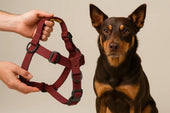
- Choose the collar type for the job. A flat collar suits everyday ID for many dogs, while a martingale is often safer for dogs with narrow heads, and a harness may be safer for brachycephalic breeds or dogs with airway issues.
- Australian conditions change what “best” means. Heat, humidity, saltwater, burrs, grass seeds, and long-distance driving all influence which materials and designs perform best.
- Materials matter. Nylon is light and affordable but can hold odours and wear faster when constantly wet; leather is durable but needs maintenance; waterproof coated webbing (e.g., Biothane-type materials) is often the most practical for beach, rain, and muddy conditions because it wipes clean and does not absorb water or smell easily.
- Hardware quality is a safety feature. For coastal and wet environments, stainless steel hardware is generally the most corrosion-resistant option; plated or cheaper alloys may pit and weaken over time.
- Visibility reduces risk. For early morning and evening walks, reflective collars and leads improve how early drivers and cyclists can see your dog, especially if your dog has a dark coat.
- Know the legal and welfare context. Some Australian jurisdictions regulate certain collars and devices. The Australian Veterinary Association opposes aversive collars (such as prong collars) and supports positive reinforcement training methods.
- Treat collars like equipment, not jewellery. Inspect, clean, and replace collars before they fail, particularly if the collar is used daily, exposed to saltwater, or worn by a strong pulling dog.
Your Dog’s Happiness Starts Here - at PetCareShed
Introduction
A dog collar seems simple: a strap, a buckle, and a place to attach identification. In practice, it is one of the most important pieces of equipment a dog will wear—often for many hours a day, across many years. The “best dog collar” is therefore not a single product or style. It is the collar that fits the dog’s body, supports the dog’s safety, suits the dog’s behaviour, and withstands Australian conditions without causing discomfort.
Australian dog owners also face practical realities that do not always appear in generic buying guides. Summer heat can increase skin irritation and matting beneath thick collars. Coastal living introduces saltwater that can corrode metal hardware. Bushwalking can pack collars with seeds and burrs, and high rainfall can keep nylon collars damp for days. Even the simple act of leaving a collar on overnight can become relevant if a dog scratches, rolls, or gets caught on fencing.
This guide explains how to choose a dog collar in Australia with a focus on comfort, safety, and durability. It covers collar types, sizing and fitting, material performance in Australian environments, hardware and stitching quality, visibility features, special cases (puppies, brachycephalic breeds, escape artists), and when a harness is the safer option. It also includes a practical checklist, maintenance guidance, and an extensive FAQ.
Important note: This article provides general guidance for Australian dog owners. Dogs with respiratory disease, neck pain, tracheal collapse, or severe behavioural issues should be assessed by a veterinarian and/or qualified force-free trainer before changing walking equipment.
Your Dog’s Happiness Starts Here - at PetCareShed
Understanding Dog Collar Types (and When Each Is “Best”)
Different collar styles solve different problems. The most common mistake is buying a collar based solely on looks, then expecting it to work for identification, everyday walking, training, and off-lead control. A better approach is to select the collar type according to its primary role.
Flat buckle collars (everyday ID collars)
A flat buckle collar is the most common everyday collar. It is designed to sit comfortably around the dog’s neck with enough room for normal movement and breathing. For many dogs, a well-fitted flat collar is ideal for:
- holding ID tags and/or an ID plate
- attaching a lead for calm, loose-lead walking (if the dog does not pull)
- quick handling during transfers (car to house, gate to yard)
Flat collars can close using a traditional buckle (metal tongue through holes) or a side-release buckle (often plastic). Metal buckles can be very durable; side-release buckles are convenient but vary widely in quality.
When a flat collar is not ideal:
- for strong pullers (pressure concentrates on the front of the neck)
- for dogs with neck or airway vulnerabilities
- for dogs that can back out of collars due to head shape
Martingale collars (limited-slip collars)
Martingale collars are often recommended for dogs who can slip out of flat collars, especially sighthounds and other breeds with relatively narrow heads. A martingale tightens only to a preset limit, meaning it can provide extra security without the full constriction of a slip chain.
A well-fitted martingale can be “best” for:
- dogs that back out of flat collars
- dogs transitioning to better lead manners
- dogs with slim necks and narrow heads
However, a martingale still places pressure around the neck when the dog pulls. It can improve control and reduce escapes, but it is not a substitute for training or for a harness when neck pressure is contraindicated.
Slip collars and check chains
Slip collars (including chain “check” collars) are designed to tighten when tension is applied. These collars have a long history in traditional training methods. From a safety and welfare perspective, the risk profile is higher than flat or martingale collars, particularly for:
- dogs that lunge suddenly
- dogs with developing neck structures (puppies)
- dogs with airway sensitivity
Many force-free trainers prefer equipment that limits tightening and prioritises teaching loose lead walking through reinforcement.
Head collars (head halters)
A head collar controls the dog by guiding the head rather than the neck. In the right situation—properly fitted, introduced gradually, and used with a double-attachment lead—it can be very helpful for large dogs that pull.
Potential benefits include improved control without relying on neck constriction. The trade-offs are that some dogs find them uncomfortable, and sudden lunges can place torque on the neck if the dog hits the end of the lead at speed.
Tactical-style collars (wide collars with handles)
These collars are often wider, sometimes padded, and may include a handle. Width can improve comfort by distributing pressure across a larger surface area. A handle can be useful for close control in busy environments.
They can be suitable for:
- large, powerful dogs (when well-designed and not overly heavy)
- dogs that require occasional close handling
The risks arise when the collar is bulky, traps heat, or the handle catches on obstacles.
Breakaway collars (safety release)
Breakaway collars are designed to open under force, reducing the risk of snagging injuries when dogs are unattended. This concept is common in cat collars but is less common in dog collars because dogs create higher forces and the collar may release during lead walking.
In practice, for most dogs in Australia:
- a standard secure collar is preferred for supervised walking
- a breakaway-style may be considered only for certain home situations under professional advice
GPS and smart collars
GPS collars can support safety for certain dogs—particularly those that roam on rural properties or escape-prone dogs in large semi-rural blocks. However, they are not a substitute for secure fencing, training, or identification.
When considering GPS collars, pay attention to:
- battery life in real use (not just advertised)
- waterproof rating and salt resistance
- collar weight relative to the dog
Tick collars and parasite collars
In Australia, parasite prevention is a high-stakes topic, particularly in paralysis tick regions. RSPCA guidance emphasises that tick paralysis can be prevented through combined strategies including daily checks and preventatives, and that products must be used correctly for the species and size of the animal. RSPCA also warns against using dog products on cats, as some ingredients (including permethrin) are highly toxic to cats.
Tick collars can play a role for some dogs, but they must be chosen and used carefully, and they are not appropriate for every pet or lifestyle (for example, frequent swimming may affect performance depending on product design). Always follow label directions and seek veterinary advice for your region and household.
Comfort First: How a Collar Should Feel on a Dog
Comfort is not a luxury feature. Discomfort changes behaviour. Dogs that are uncomfortable in their collar may scratch, rub their neck on furniture, resist handling, or become reactive on lead. A collar that is too tight can interfere with swallowing and breathing; a collar that is too loose can snag or allow escapes.
The two-finger rule (and its limitations)
The traditional advice is that you should be able to fit two fingers between the collar and the dog’s neck. This is a useful starting point, but it is not universally accurate. Two-finger spacing on a toy breed may be too loose; two fingers on a thick-coated large breed may still be too tight when the coat is compressed.
A more practical approach is:
- The collar should sit high on the neck (not down on the shoulders).
- The dog should be able to pant, swallow, and move freely.
- The collar should not rotate excessively, but it should not compress fur to the skin.
Width, padding, and pressure distribution
Wider collars distribute pressure over a larger surface area and can reduce the risk of pressure points, especially for strong dogs. However, “wider” is not always better:
- On small dogs, overly wide collars can restrict shoulder movement or press on the throat.
- Thick padding can trap heat and moisture in humid Australian conditions.
As a general comfort principle:
- Small dogs often do best with a lighter, narrower collar that does not overwhelm the neck.
- Medium to large dogs often benefit from a moderate to wide collar with smooth edges.
Coat type and skin sensitivity
Australia has many dogs that live outdoors for parts of the day, swim regularly, or have thick double coats. Collar comfort depends heavily on coat and skin.
Common collar-related skin issues include:
- friction alopecia (hair loss where the collar rubs)
- contact irritation from wet nylon or trapped grit
- matting beneath the collar in long-haired breeds
If your dog has sensitive skin, consider:
- smooth, non-abrasive materials
- collars that dry quickly
- removing the collar during long indoor periods (where safe and practical)
- regular grooming and collar cleaning
Safety Fundamentals: What Makes a Collar Safer in Real Life
A “safe collar” is one that remains secure when required, does not create avoidable injury risk, and supports identification and handling. Safety also depends on how the collar is used.
Secure identification in Australia
Dogs can become separated from their owners anywhere: a gate left ajar, a startled reaction to a storm, a slipped lead at the carpark. A collar should make it easy for a member of the public to identify the dog quickly.
Best-practice identification includes:
- an ID tag with phone number
- council registration details if required locally
- microchipping (not a collar feature, but an essential safeguard)
For certain “regulated” dogs, some jurisdictions have prescribed collar requirements. For example, Queensland introduced specific collar standards for regulated dogs, requiring red and yellow reflective stripes from 1 January 2022.
Quick-release buckles: convenience vs reliability
Side-release buckles are popular because they are fast. Reliability varies significantly depending on:
- buckle design
- plastic quality
- exposure to UV (Australian sun is harsh on plastics)
- grit and salt accumulation
For strong dogs, consider a buckle style and hardware rated for higher load, or a traditional buckle that is less dependent on plastic components.
Stitching, rivets, and failure points
Collars often fail at predictable points:
- stitching near the D-ring
- the buckle attachment point
- the D-ring itself (bending or opening)
A durable collar typically has:
- reinforced stitching at stress points
- secure rivets (where used) that do not rub the skin
- a properly sized D-ring
When a harness is safer than a collar
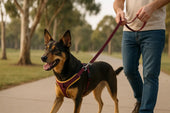
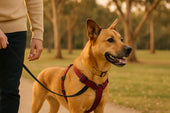
For many Australian households, the “best” solution is not choosing between collars, but pairing a collar for ID with a harness for walking.
A harness is often safer when:
- the dog pulls strongly
- the dog has coughing, gagging, or airway disease
- the dog is brachycephalic (flat-faced)
- the dog is recovering from neck injury
Brachycephalic dogs are at higher risk of overheating and breathing difficulty in warm weather due to airway anatomy. Veterinary and welfare guidance commonly favours harnesses to avoid pressure on the neck for dogs with brachycephalic airway issues.
Australian Conditions That Affect Collar Choice (Often Overlooked)
Collars are used in real environments—not in ideal indoor conditions. In Australia, a collar may be exposed to strong UV, sand, saltwater, humidity, and plant material. These factors change which materials and constructions are truly durable.
Heat, humidity, and skin maceration
In hot or humid regions, moisture trapped under a collar softens the outer skin layer and increases friction. This can lead to redness and irritation, particularly under thick collars or padded designs that do not dry quickly.
Practical strategies include:
- choosing quick-drying materials
- avoiding overly bulky collars for daily wear
- removing the collar at home when safe
- rinsing collars after beach and creek walks
Saltwater and corrosion (coastal Australia)
Saltwater exposure is a common reason collars deteriorate faster than expected. Salt crystals can accumulate in buckles and stitching, and metal components may corrode.
For beach dogs:
- waterproof coated webbing is often more hygienic than standard nylon
- stainless steel hardware is generally preferred for corrosion resistance
Materials comparisons consistently note that coated webbing does not absorb water and wipes clean easily, which helps prevent odour build-up.
Burrs, grass seeds, and bushwalking
Australian bushwalking can introduce prickles, burrs, and grass seeds that wedge between collar and skin. This can create localised inflammation, especially in long-haired breeds.
If your dog regularly walks in scrubby areas:
- choose collars with smooth edges and minimal fabric texture
- check under the collar after walks
- consider a collar that is easy to rinse thoroughly
Long drives and travel
Many Australian dogs spend time in cars—either commuting or on road trips. Collars can snag on crate bars or seatbelt tethers. Good practice is to:
- use a properly designed car restraint system
- avoid attaching tethers to collars for dogs that lunge or twist
- check that tags are not clanging persistently (noise can stress some dogs)
Choosing the Best Collar Material: Nylon vs Leather vs Waterproof Coated Webbing
Material choice is not only about aesthetics. It affects comfort, cleaning, odour, and lifespan.
Nylon webbing
Nylon is widely used because it is lightweight, affordable, and available in many colours. It can be comfortable when dry and smooth, but it tends to:
- absorb water and hold odours
- retain sand and grit in the weave
- fray over time, particularly at the buckle and D-ring points
Nylon may be “best” for:
- indoor dogs with low exposure to water
- owners who replace collars regularly
- puppies that outgrow collars quickly
Leather
Leather has a classic look and can be very durable when cared for properly. Over time it can soften and mould to the dog’s neck. The trade-off is maintenance.
In Australian wet or coastal environments, leather can:
- absorb water and salt
- stiffen or crack if dried rapidly
- grow mould if stored damp
Leather may be “best” for:
- dry climates and low-water lifestyles
- owners who are willing to condition and maintain the collar
Waterproof coated webbing (Biothane-type)
Coated webbing is commonly described as a polyester webbing with a protective coating designed to mimic leather. It is widely used for dogs that swim, hike, or get muddy because it is:
- waterproof (does not absorb water)
- easy to clean (often wipe-clean)
- more resistant to odour build-up
This material is often “best” for:
- beach and river dogs
- dogs walked in wet weather year-round
- owners who prioritise hygiene and low maintenance
Material comparison table (practical Australian use)
| Material | Comfort (typical) | Water / beach suitability | Odour tendency | Maintenance | Best for |
|---|---|---|---|---|---|
| Nylon | Good when dry | Fair | Moderate–high | Wash, dry thoroughly | Everyday ID, low-water homes, puppies |
| Leather | Very good once broken in | Poor–fair | Low if kept dry | Condition, avoid soaking | Dry climates, classic style, long-term wear |
| Waterproof coated webbing | Good–very good | Excellent | Low | Wipe or rinse clean | Beach dogs, wet climates, muddy adventures |
Hardware and Construction: The Hidden Determinants of Durability
Two collars can look similar online yet perform very differently in the real world. Hardware quality is one of the clearest differences.
D-rings and load handling
The D-ring is a critical attachment point. For dogs that pull, lunge, or are simply strong, the D-ring should be thick enough not to bend under force and securely integrated into the collar.
A practical guideline is to choose:
- thicker rings for larger dogs
- welded rings rather than open rings
- hardware that matches the collar width (tiny hardware on a wide collar is often a weak point)
Stainless steel vs plated hardware
In coastal environments, corrosion can weaken metal components. Stainless steel is widely considered the most corrosion-resistant practical hardware choice for pet gear.
If your dog swims in the ocean or the collar is frequently wet:
- rinse hardware after exposure
- inspect for pitting, rust marks, or stiffness
Stitching quality
Stitching should be even and reinforced at stress points. Loose threads are not merely cosmetic; they can be the start of a failure line.
Padding and edge finishing
Padding should be smooth and not create bulky seams. The edge finish matters as much as padding: a collar with sharp or stiff edges can cause rubbing even if it looks “soft”.
Getting the Fit Right: Measuring, Adjusting, and Preventing Escapes
Fit is a process, not a single measurement. Dogs change weight, coats change across seasons, and some materials loosen over time.
How to measure correctly
- Use a soft tape measure.
- Measure around the neck where the collar will sit: high on the neck, just behind the ears.
- Record the measurement snugly, then add a small allowance for comfort.
For dogs with thick coats, measure twice:
- once over the coat
- once with the coat compressed slightly
Escape-prone dogs and collar security
Dogs commonly escape collars by backing out. This is more likely when:
- the collar is loose
- the dog has a narrow head
- the dog panics or reverses suddenly
Practical solutions include:
- a correctly fitted martingale
- a well-fitted harness
- a double-attachment lead system (one clip to harness, one to collar)
Puppies: fast growth, soft tissues
Puppies change size quickly and have developing neck structures. For young dogs:
- choose light collars
- check fit weekly (sometimes more often)
- avoid equipment that tightens strongly on the neck
Visibility and Road Safety in Australia: Reflective and Hi-Vis Collars
In many parts of Australia, dog walking happens at dawn, dusk, or evening—either due to work schedules or summer heat. Low light increases risk, particularly on suburban streets and shared paths.
Reflective gear helps by returning light toward its source (for example, vehicle headlights), making it easier for drivers and cyclists to detect movement. Reflective options are particularly important for dark-coated dogs, which are harder to see.
Recommendations for better visibility:
- reflective stitching or reflective bands on the collar
- reflective leads
- additional reflective accessories for the handler
Australia does not currently have a mandatory standard specifically for dog visibility gear, so quality and reflective coverage can vary.
Collar Safety and the Law in Australia (What Owners Should Know)
Dog equipment is not only a matter of preference. In Australia, some collar types and devices are regulated, and rules differ by state and territory.
Regulated dog collar requirements
Some jurisdictions have specific collar requirements for regulated dogs (such as dangerous or menacing dogs). For example, Queensland introduced prescribed collar standards for regulated dogs, requiring red and yellow angled reflective stripes.
Behaviour-modifying collars (e-collars, prong collars) and welfare guidance
The Australian Veterinary Association (AVA) states that prong collars must not be used due to their highly aversive nature and supports their prohibition. Some jurisdictions restrict or prohibit certain devices.
In Queensland, government guidance lists prong collars as prohibited devices due to welfare concerns.
For electronic collars, legality and conditions vary. Victoria has published a code of practice outlining minimum standards for training dogs and cats to wear electronic collars.
Practical takeaway: If you are considering any aversive or electronic training device, check current laws in your state or territory and seek veterinary and qualified trainer guidance. For most households, humane training combined with well-fitted walking equipment is the safest path.
Matching Collar Choice to Your Dog’s Lifestyle
A collar should suit what your dog actually does day to day. Below are common Australian scenarios and what tends to work best.
The suburban daily walker
For a dog that walks on lead daily in suburban areas:
- a comfortable flat collar for ID
- a harness for walking if the dog pulls or coughs
- reflective elements if walking near roads at dawn/dusk
The beach dog
For dogs that swim or roll in sand:
- waterproof coated webbing collars for easy cleaning
- stainless steel hardware if possible
- rinse and dry after each beach session
The bushwalker
For dogs that hike through scrub:
- smooth, easy-clean collars
- avoid thick fabric that traps seeds
- check under collar after walks
The “escape artist”
For dogs that back out or panic:
- well-fitted martingale or secure harness
- double-clip lead system
- identification that stays on the dog even when equipment fails
The brachycephalic or respiratory-sensitive dog
For flat-faced breeds or dogs with airway problems:
- prioritise a harness for walking to avoid neck pressure
- use a lightweight collar primarily for ID
- avoid overheating risks by walking in cooler parts of the day
A Practical Buying Checklist (What to Look For Before You Add to Cart)
When comparing collars online, product photos do not always reveal quality. Use a structured checklist.
Comfort and fit
- correct size range for your dog’s neck measurement
- appropriate width for the dog’s size and coat
- smooth edges and comfortable feel
Safety
- secure D-ring and attachment construction
- reliable buckle system
- clear place for ID tags
Durability
- reinforced stitching at stress points
- corrosion-resistant hardware if used near water
- material appropriate for wet, heat, or scrub
Visibility (if needed)
- reflective stitching or banding
- compatibility with reflective lead
Maintenance
- easy to rinse and dry
- resists odour build-up
Cleaning and Maintenance: Extending Collar Life Safely
A collar should be inspected like any other piece of safety equipment.
How often to clean
- Beach or mud: rinse after each outing
- Everyday use: wash periodically (every few weeks, or sooner if odour develops)
How to clean common materials
- Nylon: hand wash with mild soap; rinse thoroughly; air dry fully
- Leather: wipe clean; dry naturally away from direct heat; condition as needed
- Waterproof coated webbing: wipe clean or rinse; dry; inspect for cracks or edge wear
Inspection schedule
Check at least monthly (weekly for strong dogs) for:
- fraying or worn stitching
- cracked buckles
- bent D-rings
- corrosion or pitting
Replace the collar before it fails. Collars rarely “warn” dramatically; they often fail under the one moment of force you most need them to hold.
Recommended Related Products from PetCareShed
The following product categories are commonly helpful when selecting and using dog collars in Australian conditions. These are not substitutes for training or veterinary care, but they can improve comfort, safety, and day-to-day practicality.
- Waterproof dog collars (coated webbing styles): helpful for beach dogs and wet climates due to wipe-clean hygiene and reduced odour retention.
- Reflective dog collars and reflective dog leads: useful for dawn/dusk walking where visibility to drivers and cyclists matters.
- Martingale dog collars: suitable for dogs that can slip flat collars, particularly narrow-headed breeds.
- Padded dog collars: can improve comfort for large dogs when designed with smooth edges and breathable lining.
- No-pull dog harnesses and everyday walking harnesses: often safer for pullers, brachycephalic breeds, and dogs with coughing on lead.
- Dog ID tags and engraved ID plates: supports rapid contact if a dog becomes separated.
- Long-line training leads: helpful for recall practice while maintaining safety in unfenced areas.
Detailed FAQ: Best Dog Collars in Australia
What is the safest everyday collar for most Australian dogs?
A well-fitted flat collar is often the safest option for everyday identification, provided the dog does not pull heavily on lead and the collar does not cause rubbing. For walking, many households use a harness and keep the collar primarily for ID.
Are martingale collars safe?
Martingale collars can be safe when fitted correctly and used for supervised walking. They are commonly chosen for dogs that can slip a flat collar. They should not be left on unattended in environments where snagging is possible.
Is it better to walk a dog on a collar or harness?
For calm dogs that do not pull, a collar can be adequate. For pullers, brachycephalic dogs, and dogs with coughing, neck pain, or airway issues, a harness is often the safer choice because it reduces pressure on the neck.
How tight should a dog collar be?
The collar should be snug enough that it cannot slip over the head, but loose enough to allow comfortable panting and swallowing. The common “two-finger” check is a starting point, but owners should also watch for rubbing, hair loss, or signs of discomfort.
Why does my dog cough when walking on a collar?
Coughing can occur if the collar presses on the throat or if the dog pulls. It can also indicate underlying respiratory disease. If coughing is persistent, switch to a harness for walking and consult a veterinarian.
What collar material is best for beach dogs in Australia?
Waterproof coated webbing collars are often practical for beach conditions because they do not absorb water and can be wiped clean. Hardware should be corrosion-resistant, and collars should be rinsed after saltwater exposure.
Do leather collars handle water well?
Leather can tolerate occasional splashes but does not perform well with frequent soaking. It can absorb water and salt, then stiffen or crack. If you prefer leather, plan for regular cleaning and conditioning and consider a separate waterproof collar for swimming.
Should dogs wear collars all the time at home?
This depends on your environment and dog. Some owners remove collars indoors to reduce rubbing and snagging risk. If your dog may escape the yard or front door, keep ID on the dog (collar with tag) or use alternative identification such as a microchip-backed registration. Always consider the dog’s specific environment and supervision.
Are reflective collars worth it?
Yes, for many Australian owners. Reflective collars and leads can improve visibility during dawn, dusk, and evening walks, which can reduce risk near roads and shared pathways. Sources discussing night-walk safety highlight reflective gear as a practical upgrade.
Can a dog collar cause hair loss?
Yes. Hair loss can occur due to friction, moisture trapped under the collar, allergic contact irritation, or matting. Adjusting fit, changing material, cleaning more often, and removing the collar for longer indoor periods can help.
What is the best collar for a puppy?
A lightweight flat collar is usually suitable for a puppy for ID and early training, with regular resizing as the puppy grows. For walking, a properly fitted harness can reduce neck pressure while lead skills develop.
Are prong collars legal in Australia?
Legality varies by jurisdiction. The Australian Veterinary Association states that prong collars must not be used due to their highly aversive nature and supports making them illegal. Queensland government guidance lists prong collars as prohibited devices.
Are electronic (shock) collars legal in Australia?
Rules vary by state and territory. Victoria has a published code of practice outlining minimum standards for training dogs and cats to wear electronic collars, while other jurisdictions have restrictions or bans. Owners should check current local laws and seek professional advice.
Do dogs in Australia have to wear a collar by law?
Requirements differ by state, territory, and local council. Some “regulated” dogs have prescribed collar requirements (for example, in Queensland regulated dogs must wear specified red and yellow reflective collars).
How do I choose a collar for a dog that pulls?
If your dog pulls, consider using a harness (including front-attachment designs) for walking. Keep a collar for ID, and focus on loose-lead training with positive reinforcement. If you need additional control, consult a qualified trainer to avoid equipment that increases injury risk.
What is the best collar for a short-nosed (brachycephalic) dog?
For walking, a harness is generally preferred to avoid pressure on the neck and airway. A light collar may still be used for ID. Managing heat exposure is also important in Australian summers.
Can tick collars replace daily tick checks?
No. RSPCA guidance emphasises that prevention works best as a combination of strategies, including daily checks, avoiding tick habitat during peak season, and correct use of preventatives. If you are in a tick paralysis region, speak with your veterinarian about the best approach.
Is it safe to use dog tick products on cats?
No. RSPCA guidance warns that some dog products contain ingredients that are highly toxic to cats. Always use species-specific products and seek veterinary advice.
When should a dog collar be replaced?
Replace the collar if you see fraying, weakened stitching, cracked buckles, bent D-rings, corrosion, or if the collar no longer holds adjustment reliably. Replace earlier for strong dogs or collars exposed to saltwater.
What is the single most important feature in a “best” dog collar?
Correct fit matched to the dog’s body and behaviour. Even the highest-quality collar can cause problems if it is too tight, too loose, too wide, or used for a job it was not designed to do.