
Key Takeaways
- Choose a leash to match the environment first, then the dog. Busy footpaths and shopfronts reward a shorter fixed lead; open ovals and training areas reward a longer line.
- For everyday suburban walking in Australia, a fixed-length lead around 1.2–1.8 m is the practical baseline. It allows slack for loose-lead walking while keeping your dog close enough for roads, cyclists, and other dogs.
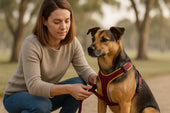
- Harness choice and leash choice work as a pair. For dogs that pull, brachycephalic (flat-faced) breeds, and many small dogs, a well-fitted harness (often front-attach for training) reduces neck pressure and improves control.
- Retractable leads are high-risk in crowded places. They reduce effective control, increase entanglement and burn injuries, and can recoil or break under load.
- Australia’s leash rules are largely state-based and council-enforced. The default in most public places is on-leash unless signage indicates an off-leash area; “effective control” still applies even off-leash.
- Heat and surfaces matter in Australia. Hot pavement can burn paws quickly; choose cooler times, stick to grass where possible, and consider paw protection on hot days.
- Safety is equipment + handling. A strong clip, correct fit, and a simple handling method (two-handed grip near roads, slack when safe) prevent most leash-related incidents.
From PetCareShed, with Love for Every Dog
Introduction
A dog leash is a deceptively simple piece of equipment. In practice, it is a safety device, a training tool, and often the deciding factor between a calm walk and a stressful one. In Australia, where many suburbs combine busy shared paths, off-leash reserves, wildlife-sensitive areas, and hot summer conditions, the “best” leash is rarely a single product. It is the leash that provides reliable control for your dog in your local conditions, while supporting humane, reward-based training.
This guide explains how to choose the best dog leash in Australia by focusing on safety, comfort, durability, and practicality. It also covers Australia-specific considerations that are often overlooked: local leash expectations and signage, walking during heat, beach and salt exposure, and why some popular leash styles create avoidable injuries.
Important note: Requirements vary by state and local council, and signage always matters. This article provides general education and should be paired with your local council’s rules and park signage.
From PetCareShed, with Love for Every Dog
Leash Laws and “Effective Control” in Australia (What Owners Should Know)
Most Australian dog owners quickly learn that leash rules are not only about whether a dog is physically attached to a lead. They are also about whether the dog is under effective control.
Across Australia, the common pattern is:
- Dogs must be on-leash in public unless you are in a designated off-leash area.
- Council signage determines where off-leash exercise is allowed.
- Even in off-leash areas, owners are typically required to keep their dog under effective control—meaning the dog responds to commands and does not harass people, dogs, wildlife, or livestock.
Why this matters when choosing a leash
The law and the environment shape the equipment that is safest. For example:
- If most of your walking is on footpaths near roads, a fixed-length lead that keeps your dog close is usually safer than a long line.
- If you train recall in an oval where off-leash is not permitted, a long line may allow enrichment while still complying with on-leash rules.
Common Australia-wide scenarios where a short lead is usually the safest choice
While precise rules differ, the following places commonly demand close control:
- Footpaths near roads and driveways
- Shopping strips, markets, and café areas
- School zones and playground edges
- Shared paths with cyclists and runners
- Areas with high dog density (popular parks, dog-walking corridors)
RSPCA guidance notes that a short leash can help minimise tangling and prevent unwanted close contact with other dogs and people.
State and council variation (a practical summary)
The key point is not memorising each state act; it is understanding that councils designate off-leash areas and enforce rules via signage. In NSW, for example, dogs are generally required to be on a leash in public unless in a council-designated off-leash area, and councils must provide at least one off-leash area.
If you frequently walk across council boundaries (for example, commuting with your dog, visiting beaches, or hiking in different reserves), it is sensible to keep a “compliance kit”:
- A dependable short lead
- A longer training line (for permitted areas)
- An ID tag and microchip registration details
- A poop bag holder (fines often apply for not picking up)
What Makes a Dog Leash “Best” in Australia?
The best leash is the one that is safe, comfortable, and durable in the conditions you actually face. In Australia, the most overlooked influences are heat, salt, sand, and high UV exposure, all of which can degrade materials and increase risk.
The four pillars of a good leash choice
1) Control and handling
A leash should allow you to shorten and lengthen the working distance quickly. Control is not about forcing a dog into position; it is about preventing sudden risks: a car door opening, a cyclist approaching, a startled dog reacting, or wildlife crossing the path.
2) Comfort and welfare
A leash should support humane walking and reward-based training. The goal is to avoid equipment that relies on pain or panic. RSPCA resources emphasise choosing safe collars and humane training approaches and recommend tools like front-attaching harnesses for dogs that pull.
3) Durability in Australian conditions
Materials should tolerate:
- UV exposure
- Wet grass, rain, and humidity
- Saltwater and sand (for beach walkers)
- Dirt and abrasion from bush tracks
4) Risk management
The best leash is also the one that reduces incident likelihood:
- Secure clip and hardware
- Reliable stitching or joins
- Predictable length (especially near people)
- Good grip or a padded handle
Dog Leash Types Explained (And Where Each One Works Best)
Leashes are often grouped by shape (standard, slip, retractable) and by function (training line, traffic lead). For Australian owners, it helps to think in use-cases.
Standard fixed-length lead (everyday walking lead)
A standard fixed-length lead is the workhorse of dog handling. Common lengths are roughly 1.2–1.8 m, which aligns with widely recommended “everyday” control ranges.[3]
A fixed lead is ideal when:
- You walk near roads or driveways
- You need predictable distance around other dogs
- You are training loose-lead walking
Why it suits Australian suburbs: Many areas combine footpaths, nature strips, and quick road crossings. A fixed lead makes your dog’s position predictable.
Short “traffic” lead (close control lead)
Traffic leads are very short (often under 60 cm). They keep the dog close to your leg and reduce swinging arcs near pedestrians.
Best for:
- Busy urban areas
- Vet visits
- Narrow footpaths
- Dogs that lunge (as a temporary management tool alongside training)
Limitations:
- Not ideal for relaxed sniffing walks
- Can create constant tension if used as the only lead
Double-ended lead (multi-attachment lead)
A double-ended lead has clips on both ends and is commonly paired with a harness and collar or with a two-point harness. RSPCA Queensland notes a front-attaching harness with a double-ended lead can help with loose-lead walking training.
Useful for:
- Reducing pulling by distributing control
- Back-up safety (collar + harness)
- Managing dogs that can back out of harnesses
Long line (training line)
Long lines are fixed-length lines, commonly 3–10 m (or longer) used for recall training and controlled exploration in open spaces.
Best for:
- Teaching recall safely
- Decompression sniffing (where permitted)
- Giving freedom while maintaining physical attachment
Key handling requirements:
- Gloves can prevent rope-burn
- Avoid tangles around people and dogs
- Do not use around cyclists, busy paths, or children running
Slip lead (limited use)
Slip leads combine collar and lead in one loop. They are common in some shelter and handling contexts.
Risks and limitations:
- Easy to apply incorrectly
- Tightening pressure on the neck can be unsafe for pullers
- Not ideal for dogs with airway issues or small breeds
For many pet homes, a harness-based system is a safer default.
Retractable lead (why many professionals caution against them)
Retractable leads can feel convenient because they provide variable distance. However, multiple animal welfare and veterinary-aligned sources caution against them due to:
- Reduced control in unpredictable environments
- Entanglement and cord injuries (to dogs and people)
- Sudden “end-of-line” jolts that can injure necks and spines
- Risk of recoil or hardware failure in some cases
Veterinary guidance has explicitly recommended avoiding retractables and using fixed long lines for controlled exercise instead.
In Australia, where shared paths are common and wildlife can appear suddenly, retractables can create a safety gap that is difficult to close quickly.
Choosing the Right Leash Length (A Practical Australian Guide)
Length is not merely preference; it is a risk calculation. A leash that is too short can create constant tension and frustration. Too long, and you lose the ability to prevent hazards.
Everyday walking: 1.2–1.8 m as a balanced range
Many training and veterinary sources describe 4–6 feet (about 1.2–1.8 m) as a practical standard length for everyday walking and training because it allows slack while keeping the dog close enough for control.
This length range supports:
- Loose-lead walking with slack
- Safe passing distance around others
- Quick shortening near roads
Busy areas: shorter is often safer
In shopping strips, narrow footpaths, and around prams, a shorter working length reduces tripping and tangling. A traffic handle or second handle can help you reduce distance without wrapping the lead around your hand.
Recall training and open spaces: long lines (3–10 m)
Long lines let you rehearse recall and emergency stops without the risk of a full off-leash run. They are a safer alternative to retractable leads for training because the line length is fixed and predictable.
A length decision table
| Situation | Recommended leash type | Typical working length | Why it helps |
|---|---|---|---|
| Suburban footpaths, roads nearby | Fixed everyday lead | 1.2–1.8 m | Predictable distance; easy to shorten at crossings |
| Busy café strips, markets, vet waiting rooms | Traffic lead or lead with second handle | 30–60 cm | Keeps dog close; reduces tangles |
| Recall training (oval, quiet reserve where on-leash required) | Long line | 3–10 m | Practice distance skills with physical safety |
| Beach walks (on-leash zones) | Fixed lead (washable) + strong hardware | 1.2–1.8 m | Control near other dogs; easier around families and children |
| Hiking on narrow tracks | Fixed lead with good grip | 1.2–1.8 m | Prevents dog drifting into scrub or wildlife |
Material Choices: Nylon, Leather, Rope, and Coated Webbing
In Australia, leash materials must cope with UV, heat, water, and abrasion. Material choice also affects grip comfort and handling safety.
Nylon webbing
Strengths
- Common, affordable, widely available
- Dries reasonably quickly
- Often available with reflective stitching
Limitations
- Can burn hands if a dog suddenly bolts
- Stitching quality varies widely
- Can absorb odours if regularly wet
Best for: everyday walking, owners who prefer lightweight equipment.
Rope-style leads
Rope leads often use climbing-rope inspired designs.
Strengths
- Comfortable to hold
- Often strong and durable
Limitations
- Can collect sand and grit
- Can be harder to clean than flat webbing
Best for: medium to large dogs where hand comfort matters.
Leather leads
Leather can be exceptionally comfortable and long-lasting if cared for.
Strengths
- Excellent grip and “feel” in the hand
- Often durable with good hardware
Limitations
- Saltwater and repeated soaking can shorten lifespan
- Requires conditioning and drying
Best for: urban walking and training in dry conditions.
Coated webbing (water-resistant)
Coated webbing is popular for long lines and wet environments.
Strengths
- Easy to wipe clean
- Handles rain, mud, and some beach use well
Limitations
- Some coatings can become slippery when wet
- Lower-quality coatings may crack with age and UV
Best for: long-line recall training, wet grass, and owners who prioritise easy cleaning.
Hardware and Build Quality (Where Leashes Commonly Fail)
When a leash fails, it tends to fail at predictable points. In Australian conditions, salt and sand accelerate wear, especially on clips and springs.
The high-risk components
- Clip mechanism (spring and gate)
- Swivel (prevents twisting but can seize if exposed to sand)
- Stitching or rivets at the handle and clip end
- Webbing fray near high-bend points
What to look for in a safe leash
- A clip sized appropriately for your dog’s weight and strength
- Stitching that is neat, tight, and reinforced
- A handle that is comfortable enough to avoid accidental drops
- For beach walkers: corrosion-resistant hardware and a rinsing routine
A simple inspection routine
A 30-second check before walks prevents many incidents:
- Squeeze and release the clip gate: it should snap back firmly
- Check the swivel rotates smoothly
- Look for fraying, thinning, or fuzzy webbing near joins
- Check stitching for loose threads
If any part looks uncertain, replace the leash. A failed clip near a road is not an acceptable test.
Leash + Collar or Leash + Harness: Choosing the Safest Setup
Leashes do not act alone. The attachment point (collar, harness, or head halter) determines where force goes when your dog pulls, startles, or stops abruptly.
Collars: best for ID, not always best for walking
A well-fitted flat collar is useful for holding ID tags and can be suitable for calm dogs who do not pull. However, for dogs that pull or lunge, collar pressure concentrates on the neck.
RSPCA guidance on safe collars emphasises correct fit and safe design choices.
Harnesses: preferred for many dogs, especially pullers and brachycephalic breeds
Veterinary guidance and research increasingly support harness use for leash walking, particularly where neck pressure is a concern. A 2025 review notes that for brachycephalic breeds, back-clip harnesses can be suitable when pulling is not a concern, and front-clip harnesses are helpful for pullers.
Harnesses can be especially valuable for:
- Flat-faced breeds (French Bulldogs, Pugs, British Bulldogs)
- Small dogs prone to tracheal sensitivity
- Puppies learning walking skills
- Dogs with coughing, collapsing trachea concerns, or neck pain
Two-point attachment (harness + collar) for added safety
A double-ended lead can attach to a harness and a collar at the same time. This is not about “controlling” the dog through discomfort; it is about redundancy:
- If a dog backs out of a harness, the collar remains attached.
- If a collar clip fails, the harness still holds.
This is particularly helpful for sighthounds and other escape-prone shapes.
Managing Pulling, Lunging, and Reactivity: Leash Choice as Part of a Plan
Many owners search for the “best leash” when the real problem is a dog who pulls or reacts to dogs, people, or vehicles. Equipment can help, but it should support training rather than replace it.
Principles that matter more than any leash style
- Aim for slack most of the time. Constant tension teaches dogs to lean into pressure.
- Reward the position you want. Reinforce check-ins and walking near you.
- Increase distance from triggers. A longer lead is not always helpful if it allows the dog to practise lunging.
RSPCA Queensland recommends training approaches such as using a front-attaching harness and appropriate lead setup for loose-lead walking.
Leash features that help with pulling (without relying on harsh tools)
- Comfortable handle and grip (reduces accidental drops)
- Second handle near the clip end (for “traffic moments”)
- Double-ended configuration for harness control
- Shock-absorbing bungee section (useful for strong dogs, but should not encourage pulling)
When to seek professional help
If your dog:
- lunges hard enough to knock you off balance
- has bitten or attempted to bite
- shows escalating reactivity despite training
…a qualified trainer or veterinary behaviour professional is appropriate. Leash choice can reduce risk during behaviour work but should not mask a serious safety issue.
Heat, Hot Pavement, and Summer Walking: An Australian Safety Section
Australian summers create hazards that are not addressed in many overseas leash guides. Pavement temperature can exceed air temperature significantly, and burns can occur quickly.
Veterinary-reviewed guidance commonly recommends the 7-second hand test: place the back of your hand on the pavement for 7 seconds; if it is uncomfortable, it is too hot for your dog’s paws.
How leash choice supports heat safety
In heat, dogs may be more reactive, fatigued, or eager to move quickly to shade. A leash with a comfortable grip helps you keep control without jerking or dragging.
Consider:
- A lead length that keeps your dog from stepping onto hot asphalt while you stay on grass
- A harness that reduces neck pressure if your dog pulls toward shade or water
Practical summer walking tips
- Prefer early mornings and later evenings when ground temperatures have dropped.[4]
- Choose grassy routes and shaded paths.
- Carry water for longer walks.
- Watch for signs of heat stress (heavy panting, slowing down, seeking shade, disorientation).
If paw burns occur, cool the paws gently under running water and contact a veterinarian for assessment.
Beach, Rain, and Bushwalking: Australia-Specific Use Cases
Beach walking
Beaches are attractive walking spots, but they are hard on equipment.
What changes at the beach:
- Saltwater accelerates corrosion on clips and rings.
- Sand enters clip mechanisms and swivels.
- High excitement levels increase pulling and sudden movement.
A sensible beach setup often includes:
- A washable, easy-clean lead material
- Corrosion-resistant hardware
- A rinse-and-dry routine after every beach visit
Rainy season and humidity
In humid coastal areas, mildew and odour can build quickly on absorbent materials. Coated webbing and quick-dry nylon can be easier to maintain.
Bushwalking and wildlife
Australia’s bushland contains wildlife and hazards that justify conservative leash choices:
- Snakes and goannas
- Ground-nesting birds
- Ticks in some regions
- Thorny plants and burrs
A fixed lead helps prevent dogs pushing into scrub where visibility is limited.
Tethering and Tie-Outs: Why a Leash Is Not a Yard Solution
Some owners consider using a leash or tether line as a substitute for fencing. Animal welfare organisations have consistently cautioned against routine tethering.
RSPCA policy and guidance highlight that tethered animals should not be left unsupervised and that tethering can cause injury, distress, and behavioural harm if used inappropriately.
Risks include:
- entanglement and choking
- heat stress without adequate shade and water
- increased frustration and potential aggression
If temporary tethering is unavoidable (for example, short supervised restraint while travelling), it should be done with careful attention to site safety, equipment, and supervision in line with welfare guidance.
Car Travel and Leashes: What Owners Commonly Miss
Leashes keep dogs safe on the ground, but many injuries occur during transport. Several resources summarise that Australian road and welfare rules can require dogs to be restrained or transported safely so they do not distract drivers or risk injury.
A practical approach is:
- Use a dedicated car restraint (crate, barrier, or seatbelt-compatible harness)
- Keep a short lead accessible for loading and unloading
- Do not rely on a leash as the primary in-car restraint
A leash can, however, prevent escape when a car door opens in a carpark—one of the most common real-world incident points.
How to Fit and Use a Leash Safely (Handling Skills That Prevent Incidents)
A high-quality leash cannot compensate for poor handling. The safest handling is calm, predictable, and avoids wrapping the leash around your hand.
A simple, safe handling method
- Hold the handle securely.
- Use the other hand to manage slack rather than winding it.
- Near roads or crowds, shorten the leash by gripping the lead closer to the clip (or use a second handle).
Avoid these common mistakes
- Wrapping the leash around your hand or wrist (risk of injury if the dog bolts)
- Using retractables on shared paths (tangles and reduced control)
- Clipping a leash to an ill-fitting collar or harness (escape risk)
- Allowing the leash to drag (snag hazard)
“Effective control” is also training
A leash is a physical connection. Effective control also means your dog can:
- stop and wait
- come when called (even on-leash)
- disengage from distractions
These skills reduce the force needed, improve welfare, and make the walking experience safer for everyone.
Best Dog Leashes in Australia by Use Case (A Decision Framework)
Rather than naming a single “best” leash, it is more accurate to identify the best leash for your scenario.
1) Best everyday leash for suburban Australia
A fixed-length, comfortable-grip lead in the 1.2–1.8 m range is the most broadly suitable choice for typical walking conditions.[3]
Look for:
- strong clip and reinforced stitching
- comfortable handle
- optional reflective elements for early morning or evening walks
2) Best leash for strong pullers (while training)
A double-ended lead paired with a front-attaching harness can improve steering and reduce pulling practice, consistent with RSPCA Queensland training guidance.
Look for:
- two secure clips
- adjustable length
- durable hardware appropriate to dog size
3) Best leash for recall training
A long line (often 5–10 m) provides controlled freedom while teaching recall.
Look for:
- easy-clean material
- secure clip
- no hand loop (optional) to reduce snag risk in some environments
4) Best leash for small dogs
Small dogs benefit from:
- lightweight clips (heavy hardware can be uncomfortable)
- a comfortable handle for you
- a harness attachment to reduce neck pressure (especially if the dog pulls)
5) Best leash for beach walking
Choose:
- corrosion-resistant hardware
- easy cleaning
- a comfortable grip even when wet
Maintain by rinsing clips and swivels after beach exposure.
Recommended Related Products from PetCareShed
The right lead is most effective when paired with compatible, well-fitted equipment and sensible walking accessories. The following product categories are commonly relevant for Australian walking conditions and training goals.
- Fixed-length dog leads (everyday walking leads): Suitable for footpaths, shared paths, and general compliance walking where predictable distance matters.
- Double-ended training leads: Useful with a harness-and-collar setup, or for front-and-back harness attachment when teaching loose-lead walking.
- Long training lines: Appropriate for recall training and controlled decompression walks in open areas where a longer line is safe and permitted.
- Front-attach dog harnesses: Often helpful for dogs that pull, and for owners aiming to reduce neck pressure during training, aligning with welfare-focused guidance.
- Reflective collars and leads: Helpful for early mornings and evenings, particularly in winter or in poorly lit suburban streets.
- Poop bag holders and walking pouches: Support responsible public walking and reduce the risk of forgetting essentials.
- Collars with secure buckles (for ID): Useful for holding tags even when walking on a harness.
Care, Cleaning, and Maintenance (To Make a Good Leash Last)
Leashes fail more often from neglect than from manufacturing defects. A simple care routine improves safety and lifespan.
Cleaning by environment
- Beach: Rinse thoroughly in fresh water, especially clips and swivels. Shake out sand. Dry fully.
- Mud and rain: Rinse, then air dry away from direct heat.
- Urban: Wipe down weekly to remove grime and oils.
When to replace a leash
Replace immediately if you see:
- fraying webbing
- cracked coating
- clip gate sticking
- loose stitching
- a “soft” clip spring that does not snap closed
It is also sensible to retire an older leash to “backup duty” rather than relying on it in high-risk environments.
Frequently Asked Questions (FAQ)
What is the best leash length for walking a dog in Australia?
For everyday walking in most Australian suburbs, a fixed-length leash around 1.2–1.8 m is a practical standard because it balances freedom and control. Shorter options suit crowded areas, while long lines suit training in open spaces.
Are retractable dog leashes safe?
Retractable leashes can create safety risks, particularly in busy public spaces. Risks include reduced control, entanglement, cord burns, and sudden jolts at full extension. Veterinary-aligned guidance has advised avoiding retractables and using fixed-length lines for safer control.
Should a dog be walked on a collar or a harness?
Many dogs walk more safely on a well-fitted harness, especially dogs that pull, small dogs with delicate necks, and brachycephalic breeds. Research and veterinary guidance support harnesses to reduce neck pressure, with front-clip options often used for pullers.
What leash is best for a dog that pulls?
A double-ended lead paired with a front-attaching harness is commonly used in reward-based training to reduce pulling and improve steering, and this approach aligns with RSPCA Queensland guidance on loose-lead walking tools.
Can I use a long line instead of an off-leash walk?
A long line can provide controlled freedom and enrichment while keeping your dog physically attached, which may help in areas where off-leash exercise is not permitted. Long lines (often 3–10 m) are commonly used for recall training and exploration, but they must be handled carefully to avoid tangles and should not be used on busy shared paths.
Do leash laws in Australia differ by state?
Yes. Leash requirements are governed by state legislation and enforced with local council rules and signage. A common default is on-leash in public unless an area is signposted as off-leash, and “effective control” is expected even off-leash.
Is it safe to tether my dog in the yard using a leash?
Routine tethering is not recommended as a yard solution. Animal welfare guidance notes tethering can cause injury, distress, and behavioural problems and should not be used unsupervised. If tethering is used at all, it should be temporary, supervised, and set up to minimise entanglement and heat risks.
How do I know if pavement is too hot for my dog?
Use the 7-second hand test: place the back of your hand on the surface for 7 seconds. If it is uncomfortable, it is too hot for your dog’s paws. In hot Australian weather, choose cooler walking times and prefer grass and shaded routes.
What is the best leash for a puppy?
A puppy usually does best with a lightweight fixed-length lead (often in the 1.2–1.8 m range) and a well-fitted harness, allowing slack for training without neck strain. As training progresses, a long line can be introduced for recall practice in appropriate spaces.
Should I use a slip lead for everyday walking?
Slip leads can tighten on the neck and are easy to use incorrectly, especially with dogs that pull. For most pet homes, a harness-and-fixed-lead setup is a safer, more welfare-focused option.
How often should I replace my dog’s leash?
Replace a leash as soon as you see wear that affects safety: fraying, cracking, loose stitching, or a clip that sticks or does not spring shut firmly. In beach and coastal areas, hardware may need earlier replacement due to corrosion and sand exposure.
What is a double-ended leash used for?
A double-ended leash clips at both ends and can connect to a harness and collar simultaneously or to two points on a harness. It is commonly used to improve control, reduce pulling, and provide redundancy if one attachment point fails.
Can I take my dog off-leash on the beach in Australia?
Some beaches have designated off-leash times or zones, while others require leashes at all times. Rules vary by council and are indicated by signage. Always follow local signs and ensure your dog remains under effective control.