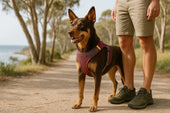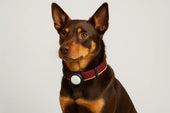

Key Takeaways
- A harness is not automatically “safer” than a collar. In Australia, harnesses usually reduce pressure on the throat, but the wrong harness (poor fit, poor design, or used without training) can create new risks such as rubbing injuries, restricted shoulder movement, or increased pulling.
- Collars can be safer in specific situations, particularly for calm, leash-trained dogs, quick toilet breaks, some training contexts, and when a harness would overheat or chafe.
- Neck collars can raise intraocular pressure (IOP) when a dog pulls, which matters for dogs with glaucoma risk or eye disease. A peer‑reviewed study concluded dogs with glaucoma or thin/weak corneas should wear a harness rather than a collar for restraint on lead.
- Back‑clip harnesses may encourage stronger pulling because they are comfortable and distribute pressure; one controlled study found dogs pulled more strongly in a back‑connection harness than with a collar.
- Front‑clip harnesses can improve control for many dogs, but they must be fitted carefully to avoid rubbing the armpits (axilla) and to reduce twisting.
- Australian conditions change the harness-vs-collar decision: heat, humidity, ticks, coastal salt, bindii/spinifex, and long summer walking seasons make breathable materials, drying time, and skin checks more important than many overseas guides suggest.
- Best practice for many households is “ID collar + walking harness.” Use a collar for identification at home, and a harness (plus training) for walks—unless your dog’s situation fits one of the collar‑safer scenarios.
Shop the PetCareShed Dog Collection
Introduction
Australian dog owners are often told that harnesses are the safest choice and that collars are outdated. That advice is partly true. Harnesses commonly reduce pressure on the trachea and the structures of the neck, which is a genuine welfare advantage—especially for dogs that pull, brachycephalic breeds, and dogs with respiratory or eye concerns.
However, the Australian market is crowded with harness styles that vary dramatically in fit, build quality, and biomechanics. A harness that shifts, rubs, traps heat, or changes the dog’s gait can be less safe than a properly fitted collar on a dog that already walks politely.
This review-style guide is written for Australian conditions and real-world use: suburban footpaths, beach walks, bush tracks, school drop-off runs, and hot weather management. It explains when harnesses are the smarter default and, importantly, when collars are actually safer—so choices are based on risk, not trends.
What “Safer” Really Means for a Dog Harness (and Why It’s Not One-Size-Fits-All)
When pet owners compare collars and harnesses, the conversation often narrows to one issue: throat pressure. That is important, but safety is broader and includes:
- Airway and eye safety (trachea, larynx, jugular compression, intraocular pressure)
- Musculoskeletal safety (shoulders, spine, gait, load distribution)
- Skin safety (chafing, pressure sores, hot spots, coat breakage)
- Escape risk (backing out, slipping a harness, panic bolting)
- Handling safety (how well you can prevent lunges toward traffic, other dogs, snakes, or cyclists)
- Environmental safety (heat retention, water retention, sand, burrs, ticks, salt exposure)
A tool is “safer” only if it reduces your dog’s most likely harms in your context. For example, a brachycephalic dog in humid Brisbane that pulls hard on lead has different risks to a calm, leash-trained Kelpie in Hobart.
Your Dog’s Happiness Starts Here - at PetCareShed
Evidence Snapshot: What Research and Veterinary Guidance Actually Say
Several commonly repeated claims about collars and harnesses have some evidence behind them, while other claims are oversimplified.
Collars and intraocular pressure (IOP)
A well-cited study in the Journal of the American Animal Hospital Association found that neck pressure from a collar significantly increased intraocular pressure, while a harness did not produce a significant rise. The authors concluded that dogs with glaucoma, thin/weak corneas, or any condition where IOP increases could be harmful should wear a harness instead of a collar when restrained on lead. Source: Pauli et al. (2006), PubMed record: https://pubmed.ncbi.nlm.nih.gov/16611932/
This is not a niche detail. In practical terms, if a dog is predisposed to glaucoma or has an eye condition, avoiding neck compression is a reasonable risk reduction.
Harnesses and pulling behaviour
A controlled study published in 2021 reported that dogs tended to pull stronger and more steadily in a back-connection harness compared with a neck collar, when motivated to reach food. Source: “Dog pulling on the leash: effects of restraint by a neck collar vs a back-connection harness” (open access via PubMed Central): https://pmc.ncbi.nlm.nih.gov/articles/PMC8450523/
This does not mean harnesses are “bad”. It means a harness should be paired with training and, for many pullers, front-clip or double-connection options are often more functional than back-clip alone.
Brachycephalic breeds and collar pressure
Emerging research continues to highlight that collars can elevate IOP and affect respiration, with particular concerns in brachycephalic dogs. A 2025 paper reported collar-associated IOP increases and effects during exercise, particularly relevant to brachycephalic breeds. Source (open access): https://pmc.ncbi.nlm.nih.gov/articles/PMC12036695/
Heat risk is real in Australia
The RSPCA strongly recommends adjusting walking times to avoid heat, and highlights that heat stress can be subtle but life-threatening. Early morning or late evening walks reduce pavement burn and heat load. Source: RSPCA guidance on hot weather and heatstroke prevention (knowledgebase and Australian pages):
Harness choice intersects with heat risk because some designs trap heat and restrict airflow, particularly in thick-coated dogs.
Dog Harness Reviews in Australia: A Practical, Style-by-Style Safety Review
Rather than reviewing individual brands (which change rapidly and do not translate well across supply chains), the most reliable way to review harnesses for Australian owners is by category and design outcomes. The sections below explain what each harness type does well, where it fails, and which dogs tend to suit it.
Step-in harnesses (often Y-front variations)
What they are: The dog “steps in” and the harness closes over the shoulders.
What they do well:
- Usually easy to put on for dogs that dislike overhead handling
- Often lighter and less bulky
Common safety issues in Australia:
- Many step-in designs sit close to the armpits and can rub during long walks, especially with sand, salt, or bindii debris.
- Some shift sideways on lean-bodied dogs, increasing chafe and escape risk.
Good match for: calm walkers, short urban outings, dogs sensitive to overhead handling.
Caution for: high-energy pullers, long hikes, beach dogs prone to sand rub.
Back-clip (D-ring on the back)
What they are: A harness with the lead attachment on the dog’s back.
Safety strengths:
- Reduces throat pressure compared with a collar
- Comfortable for many dogs
- Simple to use
Safety drawbacks (and why they matter):
- Back-clip harnesses can allow a dog to lean into pulling, and research suggests dogs may pull more strongly in this configuration compared with a collar in certain contexts (see study above).
- If a dog lunges suddenly (wildlife, another dog, a skateboard), the owner may have less steering control than with a front-clip or head halter.
Good match for: leash-trained dogs, moderate walkers, dogs that do not lunge.
Caution for: strong pullers, reactive dogs, dogs walked by children or older adults.
Front-clip (D-ring at the chest)
What they are: A harness with a lead attachment at the front of the chest.
Safety strengths:
- Often improves handling by redirecting the dog’s front end during pulling
- Can reduce the intensity of lunges without neck pressure
Potential problems:
- Poorly fitted front-clip harnesses can twist and create friction points.
- Some designs may restrict shoulder extension if the straps sit too far across the shoulder joint.
Good match for: mild-to-moderate pullers, training-focused households.
Caution for: dogs with shoulder pathology, very short-coated dogs prone to rub.
Dual-clip harnesses (front + back attachment)
What they are: A harness with both front and back lead points, often used with a double-ended lead.
Why they rate well for safety:
- Offers flexibility: back-clip for calm walking, front-clip for training, and dual connection for added steering control
- Useful when transitioning a dog away from collar pulling
What to check: the harness must stay stable under dual tension; if it rolls, it can create rubbing and inconsistent handling.
Overhead “H-style” vs “Y-front” geometry
Harness geometry affects movement more than many owners realise.
- Y-front designs tend to allow the shoulder to move more freely when fitted correctly because the front strap sits in a “Y” down the chest.
- Broad chest panels can be comfortable for some dogs but may trap heat and restrict airflow, especially in humid conditions.
There is no universal “best shape,” but movement and heat management should be part of an Australian buyer’s checklist.
Tactical / heavy-duty harnesses
What they are: Thick webbing, multiple straps, often with handle and panels.
Pros:
- Strong hardware, handles helpful for navigating stairs, getting into cars, or supporting seniors
- Often more secure for escape-prone dogs
Cons:
- Heat retention can be significant in Australian summers
- Bulk can hide skin irritation until it becomes a sore
Good match for: working breeds needing a secure system, dogs requiring assisted mobility.
Caution for: hot-weather walking, thick-coated breeds, long summer hikes.
When Collars Are Actually Safer (and Why)
Collars are not inherently unsafe. They become risky when a dog pulls, when the collar is too tight, when it is used as the primary restraint for dogs with health vulnerabilities, or when owners rely on collar pressure to “control” behaviour.
The scenarios below are where collars can be the safer, simpler, lower-risk choice.
1) For calm, leash-trained dogs on short, low-risk outings
If a dog already walks on a loose lead and is unlikely to lunge, a collar can be safe and practical for:
- quick toilet breaks
- short footpath strolls
- calm neighbourhood routines
In these situations, a harness may introduce chafe or heat retention without offering meaningful risk reduction.
2) In very hot or humid conditions where a harness traps heat
Australian summers are a genuine welfare challenge. Bulky harnesses can reduce heat loss, especially if they have broad panels or thick padding.
RSPCA guidance emphasises walking at cooler times and being alert to heat stress signs. If your dog overheats easily, a lightweight collar for a short, cool-time walk (paired with excellent leash manners) may be safer than a heavy harness used at the wrong time of day.
3) When the harness fit is poor and causes rubbing, hotspots, or sores
A badly fitted harness can cause:
- armpit chafe
- hair loss under straps
- moist dermatitis (“hot spots”), particularly after swimming
- pressure sores in lean, short-coated dogs
In these cases, a correctly fitted collar (or a different harness type) is safer than “any harness.”
4) For some dogs with shoulder or front-limb issues
Some harness designs can alter gait by limiting shoulder extension or changing how load is distributed. For dogs with existing shoulder pathology, a collar may be safer if the dog can walk without pulling and does not require strong physical restraint.
Where restraint is still needed, consider harness designs that avoid shoulder restriction and seek veterinary or qualified canine rehab advice.
5) When immediate, precise communication is needed for skilled training (not “corrections”)
In certain training contexts with skilled handling—particularly for calm dogs—light lead cues on a flat collar can be clearer than a harness that absorbs or changes the direction of pressure.
This is not a justification for yanking, jerk corrections, or punitive tools. It is a reminder that control and clarity can reduce risk in some environments (busy streets, narrow paths) when used gently and correctly.
6) For dogs that are skilled escape artists in a poorly designed harness
Some dogs can back out of certain harnesses, particularly if:
- the neck opening is wide
- the chest strap sits too far forward
- the dog has a narrow head/neck relative to chest
In those cases, a collar may be safer than an insecure harness—but many escape-prone dogs are better served by a more secure harness style or a dual system.
The Best “Two-Tool” Setup: ID Collar + Walking Harness
For many Australian households, the safest everyday solution is:
- A comfortable collar worn at home for identification, with tags and microchip details kept current.
- A dedicated walking harness for outings, chosen for the dog’s body shape, behaviour, and climate.
This reduces the temptation to clip a lead to an ID collar “just for a minute” when the dog is excited or reactive. It also protects dogs that may be vulnerable to collar-related IOP or airway effects.
Fit and Safety Checklist (Australia-Specific)
Harness safety is primarily a fit and use issue. Before relying on any harness, check the following.
Quick fitting checks
- Two-finger rule under each strap (snug but not tight)
- Straps do not sit in the soft armpit crease when the dog walks
- The harness does not rotate significantly when the lead is tensioned
- The chest strap does not press on the throat when the dog lowers its head
- No buckles or sliders sit directly on bony points
Australian environment checks
- Heat: choose breathable materials and avoid thick padding in summer; walk at cooler times (RSPCA guidance).
- Beach/salt: rinse hardware to reduce corrosion; check for sand rubbing after swimming.
- Bushwalks: check under straps for burrs, grass seeds, and ticks after outings.
- Wet weather: ensure the harness dries quickly; damp padding can cause skin irritation.
Harness Hardware: What Matters for Real-World Safety
Hardware quality is not just about longevity; it affects failure risk.
- D-rings and clips: should be solid, smooth-edged, and appropriately sized for the dog.
- Stitching: bar-tack stitching at stress points improves durability.
- Adjusters: should hold their position; slipping adjusters can turn a secure harness into an escape risk mid-walk.
For dogs that lunge or for large breeds, conservative choices are sensible: stronger webbing, reinforced stitching, and secure buckles.
Special Cases: Which Dogs Need Extra Thought
Brachycephalic breeds (French Bulldogs, Pugs, Bulldogs)
These dogs often have compromised airways. Collar pressure can worsen breathing, and research indicates collar pressure can influence IOP and respiration, with particular relevance to brachycephalic dogs (see PMC source above).
Practical approach: a well-fitted, breathable harness is usually the safer choice for walks, combined with heat-conscious scheduling.
Small breeds and toy breeds
Small dogs can be more vulnerable to neck injury and tracheal irritation from pulling.
Practical approach: harness for walks; collar for ID. Prioritise lightweight, low-bulk designs to reduce overheating and rubbing.
Sighthounds and narrow-necked dogs (escape risk)
Sighthounds are often cited for martingale collar use due to escape risk from standard collars. External sources commonly warn that martingales require correct fit and supervision, as snagging and tightening risks exist.
Practical approach: if escape risk is high, a secure harness system (or dual attachment with a safety connector) is often safer than relying solely on any collar.
Seniors and dogs with mobility issues
A harness with a handle can assist with:
- stairs
- car entry
- balance support
Practical approach: consider a supportive harness that distributes load and does not pinch; check skin daily because seniors may have thinner skin.
Car Travel in Australia: Harnesses, Restraints, and Practical Compliance
Australian road rules vary by state and are often misunderstood. Several summaries note that while some jurisdictions focus on driver control and animal welfare rather than explicitly mandating a specific restraint, unrestrained dogs can still create legal and safety problems if they distract the driver or are transported unsafely.
A practical, safety-first approach is consistent nationwide:
- Use a crash-tested style restraint or a secured crate where possible.
- Avoid lap travel.
- For utes and open vehicles, restraint/enclosure requirements and animal welfare laws apply; dogs must not be at risk of falling or injury.
A NSW-focused PDF from Dogs NSW discusses fines and safety considerations for pets in cars: https://www.dogsnsw.org.au/media/2944/pets-in-cars-the-real-facts.pdf
Because state rules and penalties change, check your local transport authority for current wording. For day-to-day safety, restraint is the sensible baseline regardless of minimum legal wording.
A Decision Framework: Collar or Harness for Your Dog?
Use the following structured approach to reduce guesswork.
Step 1: Identify your dog’s main risk
- Pulling/lunging risk
- Respiratory risk (brachycephalic traits, chronic cough)
- Eye risk (glaucoma risk, eye disease)
- Escape risk
- Heat intolerance
- Shoulder/orthopaedic issues
Step 2: Match the tool
- High pulling/lunging: front-clip or dual-clip harness + training
- Eye disease risk: harness over collar for lead attachment (Pauli et al. 2006)
- Heat intolerance: light, breathable harness or collar for short calm outings at cool times
- Orthopaedic front-end issues: careful harness selection; collar only if no pulling
- Escape-prone: secure harness or dual system; avoid loose-fitting harnesses
Step 3: Validate with a fit-and-walk test
A harness that looks correct standing still can fail once the dog moves.
- Walk for 5–10 minutes.
- Check for rotation, rubbing, coughing, or altered gait.
- Recheck strap tension after movement.
Comparison Table: Collar vs Harness (Safety-Oriented)
| Factor | Collar (flat) | Harness (well-fitted) |
|---|---|---|
| Throat / trachea pressure | Higher if dog pulls | Lower (pressure distributed) |
| Intraocular pressure risk | Can increase with neck pressure (study) | Less likely to increase IOP (study) |
| Pulling tendency | May discourage pulling through discomfort | Back-clip may allow stronger pulling |
| Handling / steering control | Good for trained dogs | Front/dual-clip often better for pullers |
| Heat retention | Low | Varies; bulky styles can trap heat |
| Chafing risk | Neck hair wear if left on too tight | Armpit/chest rub if poor fit |
| Escape risk | Moderate if dog backs out (depends on fit) | Varies widely; secure styles reduce risk |
“Review” Notes: What to Look for When Buying a Dog Harness in Australia
A good harness review should judge safety beyond colour and padding.
Features that tend to improve safety
- Y-front geometry that avoids shoulder restriction (when fitted correctly)
- Front-clip or dual-clip attachment options for training
- Multiple adjustment points for a stable fit
- Breathable materials suited to Australian temperatures
- Reflective trim for early morning and dusk walks
- A handle for large dogs, seniors, or busy environments (used gently)
Features that often create problems
- Wide chest panels that trap heat and collect sand
- Straps that sit deep in the armpit
- Soft, thick padding that stays wet after swimming
- Decorative hardware that adds weight but not strength
Recommended Related Products from PetCareShed
The following product categories are commonly helpful when choosing a safer walking setup. Selection should be based on your dog’s size, coat, health, and walking environment.
- Adjustable front-clip dog harness: often useful for dogs that pull or lunge, as it can improve steering control without relying on neck pressure.
- Dual-clip dog harness: suitable when you want flexibility (back-clip for relaxed walks; front-clip for training).
- Lightweight breathable dog harness: practical for hot Australian conditions and thick-coated breeds.
- Dog collar for identification: best used for ID tags and everyday wear when properly fitted (not as the main restraint for pullers).
- Double-ended training lead: supports dual-clip handling and smoother transitions during leash training.
- Seatbelt tether / car restraint connector: helps reduce distraction and improves travel safety when used with a suitable harness.
- Long line lead: useful for controlled sniff walks and recall practice in open areas while maintaining safety.
Training Matters: The Safest Equipment Still Needs Good Lead Skills
Equipment is a safety aid, not a substitute for training. A dog that drags its owner toward every scent is at higher risk of:
- sudden neck pressure (collar)
- shoulder strain and rubbing (harness)
- traffic incidents due to handler imbalance
Helpful training priorities include:
- rewarding loose-lead walking
- teaching a consistent “let’s go” cue
- practising calm check-ins around distractions
- using distance, not force, to manage reactivity
If pulling is severe, consider working with a qualified trainer. The safest equipment choice is the one that allows calm, controlled handling while you improve behaviour.
FAQ: Dog Harness Reviews in Australia (and When Collars Are Safer)
Are harnesses always safer than collars?
No. Harnesses often reduce throat pressure, but a poor fit can cause rubbing injuries, restrict movement, or increase pulling. For a calm, well-trained dog on short outings, a properly fitted collar can be equally safe or safer.
Can collars damage a dog’s eyes?
They can contribute to temporary increases in intraocular pressure when a dog pulls against a collar. A study in the Journal of the American Animal Hospital Association concluded dogs with glaucoma, thin/weak corneas, or conditions sensitive to IOP changes should use a harness rather than a collar for lead restraint. Source: https://pubmed.ncbi.nlm.nih.gov/16611932/
Do dogs pull more in a harness?
They can, particularly in back-clip harnesses. A controlled study found dogs pulled more strongly and steadily in a back-connection harness than in a collar when motivated to reach food. Source: https://pmc.ncbi.nlm.nih.gov/articles/PMC8450523/
Is a front-clip harness better for pulling?
Often, yes. Front-clip harnesses can reduce the dog’s ability to lean into pulling by redirecting the chest. Fit is critical—if it twists or rubs, it can create new problems.
When is a collar the safer option?
Common collar-safer situations include: calm dogs with reliable loose-lead walking, very hot conditions where a bulky harness increases heat load, dogs that suffer harness rubbing, and specific short, low-risk tasks such as quick toilet breaks.
Should a dog wear a harness all day?
Usually not. Harnesses can trap moisture and heat, and rubbing can develop without being noticed. Many households use a collar for ID at home and a harness for walks.
How tight should a dog harness be?
A practical guide is the two-finger rule under each strap, with no strap sitting deep in the armpit crease. After a short walk, recheck fit and look for redness.
What is the safest harness for a brachycephalic dog?
A breathable, well-fitted harness is usually safer than a collar because it avoids compressing the throat. Heat management is essential; follow RSPCA hot weather guidance and walk at cooler times. Sources: https://kb.rspca.org.au/categories/companion-animals/dogs/caring-for-my-dog/how-can-i-protect-my-dog-from-heatstroke and https://www.rspcasa.org.au/hot-weather-tips/
Can a harness cause shoulder problems?
Some designs may restrict shoulder extension if straps sit across the shoulder joint or if the harness is too tight. If your dog has an orthopaedic condition or shows gait changes, reassess harness geometry and seek veterinary advice.
How can Australian owners reduce chafing at the beach?
Choose quick-drying materials, rinse salt and sand after swimming, and check armpits and chest after each outing. Sand trapped under straps is a common cause of irritation.
What if my dog can slip out of a harness?
Check fit first (especially the neck opening and chest strap placement). Consider a more secure style, additional adjustment points, or a dual-attachment setup that connects to both harness and collar for redundancy.
Are car harnesses required by law in Australia?
Rules vary by state and are often framed around driver control and safe transport. Regardless of minimum legal wording, restraint is a safety best practice to reduce distraction and injury risk. A NSW reference document is available from Dogs NSW: https://www.dogsnsw.org.au/media/2944/pets-in-cars-the-real-facts.pdf
How do I choose between a Y-front and a chest-panel harness?
A well-fitted Y-front often allows freer shoulder movement and can be more breathable. Chest panels may be comfortable for some dogs but can trap heat and collect sand. The “best” choice is the one that remains stable and does not rub during movement.
What should I do if my dog coughs while walking on a collar?
Stop using the collar as the main restraint and consult a veterinarian, particularly if coughing is frequent or worsening. Switch to a harness for walking in the meantime and avoid any equipment that compresses the throat.