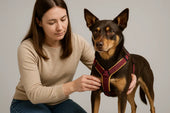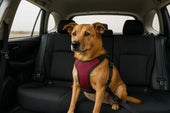

Key Takeaways
- Most “escape-proof” claims fail at the same points: a wide neck opening, a short back panel that rides up, slippery webbing, and hardware that rotates under load.
- Escapes are usually a fit-and-physics problem, not a “naughty dog” problem. Dogs back out when the harness can move forward enough to clear the shoulder points.
- A true anti-escape setup usually needs three zones of control: a stable chest/shoulder structure, a correctly positioned girth strap, and a rear belly/waist strap that sits behind the ribcage.
- Front-attach points can reduce pulling, but they do not automatically make a harness escape-proof; many front-attach designs still allow reverse exits.
- Breed shape matters more than size. Deep-chested sighthounds, thick-necked bull breeds, fluffy double-coated breeds, and “head-as-wide-as-neck” dogs each fail in different ways.
- Australia’s conditions (heat, salt air, burrs, coastal corrosion) accelerate wear and can turn a previously secure harness into an escape risk.
- A backup connection is a sensible safety layer for anxious or reactive dogs: use a double-ended lead or a short safety tether between collar and harness during training.
- Comfort and escape prevention must be balanced. Over-tightening to prevent escapes increases chafing, restricts shoulder movement, and can worsen fear.
Shop the PetCareShed Dog Collection
Introduction
“Escape-proof dog harness” is one of the most searched phrases among Australian dog owners who have experienced the same unsettling moment: a dog reversing out of a harness in a driveway, on a bush track, near traffic, or outside a vet clinic. The label suggests certainty. In practice, escape resistance is a spectrum that depends on design geometry, fit, materials, and the dog’s behaviour under stress.
This review-style guide explains where escape-proof harness designs commonly fail in Australia, why those failures occur, and how to assess harness structure with the same care used for child safety gear—because the consequence of failure is often a loose dog near hazards.
RSPCA guidance generally supports harness use for walking and training, noting that harnesses can be safer than collars for many dogs because they reduce pressure on the neck and throat and can help prevent pulling-related injury when correctly fitted. RSPCA advice also emphasises choosing comfortable equipment and avoiding harmful training devices. Sources include RSPCA Pet Insurance and RSPCA knowledge base guidance on walking equipment and training tools.
This article is written for Australian conditions and expectations: hot pavements, coastal corrosion, paralysis ticks and grass seeds, council rules about ID, off-lead areas with wildlife, and common suburban walking environments. It does not rely on brand hype. Instead, it evaluates design principles and the real-world failure points that determine whether a dog can reverse out.
Your Dog’s Happiness Starts Here — at PetCareShed
What “Escape-Proof” Really Means (and What It Cannot Promise)
An escape-resistant harness does not magically prevent every possible exit. Dogs can still escape if:
- the harness is fitted incorrectly (too loose, poorly positioned)
- straps stretch over time
- hair compresses (especially in double-coated breeds)
- the dog panics and applies force in a direction the harness was not designed to resist
- the handler drops the lead or a clip fails
In other words, “escape-proof” is not a legal standard or regulated performance grade. It is usually a marketing term.
A more practical definition is:
An escape-resistant harness is one that significantly reduces the likelihood of a dog backing out during sudden reverse movement, without compromising breathing, shoulder range of motion, or skin comfort.
To achieve that, the harness must prevent the body from sliding forward enough for the shoulder points to clear the front structure.
The Physics of a Harness Escape: Why Dogs Back Out
Most harness escapes follow the same sequence:
- The dog experiences a trigger (noise, another dog, a car door, a scooter).
- The dog reverses rapidly, often lowering the body and tucking the head.
- Lead tension pulls the harness forward.
- If the harness can translate forward far enough, the dog’s shoulders pass through the neck opening.
- The harness rotates or collapses, and the dog steps out.
This is why “tighten it” is not always the right answer. A harness can be snug yet still slide forward if the geometry allows it.
Why reverse movement defeats common designs
Many everyday harnesses are designed primarily for forward walking forces. When the lead is behind the dog and the dog moves forward, the harness “catches” at the chest and girth. When the dog moves backward, the load shifts toward the neck opening. If that opening is wide, soft, or poorly anchored, the harness can move forward and off.
The role of body shape
Dogs are not cylindrical. Their anatomy includes:
- the shoulder point (greater tubercle)
- the ribcage (widest point)
- the waist behind the ribcage (often narrower)
- the neck and head relationship (some dogs have minimal taper)
Harnesses that secure only at the chest and ribcage often fail in reverse because the ribcage strap sits at the widest part. If nothing sits behind the ribcage, there is no “stop” to prevent forward translation.
Escape-Proof Harness Design Types (and How They Commonly Fail)
The Australian market commonly offers four broad harness styles. Each can work, but each has predictable failure modes.
1) Standard H-harness (two straps: neck/chest + girth)
Typical strengths:
- simple, lightweight
- easy to put on
- often affordable
Common escape failure points:
- neck opening is too large or becomes too large when straps loosen
- back strap sits too far forward and rides up toward the neck under reverse load
- side straps allow the harness to twist, creating a “gap” near one shoulder
This style is often the first to fail with fearful dogs who back up.
2) Y-front harness (often marketed as “non-restrictive”)
Y-front designs aim to keep the shoulder free by creating a “Y” shape on the chest.
Typical strengths:
- good shoulder movement when correctly fitted
- popular for hiking and daily walking
Common escape failure points:
- short body length (not enough coverage to stabilise the harness)
- chest piece sits too low or too high; either can allow rotation
- Y-front alone does not prevent backing out unless the rest of the harness anchors behind the ribcage
Independent reviewers and product guides often note that some short Y-shaped harnesses can still allow manoeuvrability that enables escape unless paired with additional anti-escape features (for example, a third strap or more rigid structure).
3) Vest-style harness (broad fabric panels)
Typical strengths:
- distributes pressure over a larger area
- can feel secure for some dogs
Common escape failure points:
- fabric compresses the coat and then loosens as the dog moves, creating slack
- Velcro fatigue (if used) leads to gradual loss of security
- in hot Australian conditions, thicker vests can increase heat load and cause panting or discomfort, which can increase wriggling and escape attempts
Vest harnesses may also mask poor fit because they “look secure” while still allowing forward translation.
4) Three-strap “anti-escape” harness (includes a rear belly/waist strap)
This design adds an extra strap that sits behind the ribcage at the narrower waist.
Typical strengths:
- best mechanical prevention of backing out
- often the most reliable for anxious rescues and sighthounds
Common failure points (still possible):
- rear strap positioned too far forward (on the ribcage) rather than behind it
- rear strap too loose; it must be snug enough to act as a stop
- insufficient adjustability range for deep-chested or barrel-chested dogs
- poorly placed stitching or hard edges that cause rubbing near the flank
As a design principle, adding a third strap is one of the most meaningful upgrades for escape resistance because it introduces a second “anchor point” behind the widest part of the torso.
Where “Escape-Proof” Designs Fail in Real Life: A Structured Review Checklist
The most useful way to review harnesses is to examine failure risks under controlled headings. The checklist below can be used when comparing any escape-resistant harness in Australia.
Neck opening geometry: the most common escape portal
Neck openings fail when they are:
- too large for the dog’s head/neck taper
- too flexible (collapses and widens under load)
- connected to straps that slide easily through buckles (creep)
Dogs with necks not much narrower than their heads are particularly vulnerable to slipping out of collars and loose harness openings, which is why harness choice and fit are emphasised in RSPCA walking guidance.
Strap creep: when adjustment does not stay adjusted
Strap creep is gradual loosening during movement. It is caused by:
- smooth webbing with low friction at the adjuster
- heavy coat compression
- repeated wet/dry cycles (beach walks, rain, washing)
In Australian coastal areas, repeated salt exposure can also stiffen some materials and weaken stitching over time.
Practical sign: after a 10-minute walk, you can suddenly fit three or four fingers under a strap that was previously snug.
Harness rotation: twisting creates an exit gap
Rotation happens when:
- the back panel is short
- the dog pulls laterally (side-to-side)
- a front-attach ring pulls the harness sideways without enough stabilisation
Once the harness rotates, the chest piece can shift off-centre, creating a larger gap at one shoulder.
Chest panel placement: too high, too low, or too narrow
A chest panel that sits too high can press on the throat when the dog pulls. Too low and it can slide and fold. Too narrow and it provides minimal lateral stability.
A well-placed chest structure helps keep the harness centred, reducing rotation and preventing the neck opening from shifting.
Girth strap placement: sitting on the wrong part of the ribcage
The girth strap should sit behind the front legs at the widest part of the ribcage, without rubbing in the armpits.
If it sits too far forward:
- it rubs the axilla (armpit)
- it encourages the harness to migrate forward
If it sits too far back (without a rear strap design):
- it can interfere with movement
- it may still fail to prevent backing out if the neck opening is large
Rear belly/waist strap errors (three-strap harnesses)
Three-strap harnesses fail when the rear strap is treated as decorative rather than functional.
Common fitting errors include:
- placing the rear strap on the ribcage instead of behind it
- leaving the rear strap loose “for comfort”
- choosing a size where the rear strap ends up on the flank soft tissue rather than the bony structure behind the ribs
A correct rear strap sits behind the ribcage, acting as a stop that prevents the harness from sliding forward.
Hardware failure: buckles, rings, sliders
Hardware is rarely reviewed until it fails.
In Australian use, hardware problems commonly relate to:
- UV exposure (plastics becoming brittle)
- sand and grit reducing clip function
- coastal corrosion on metal rings
Even without catastrophic failure, stiff clips can lead to incomplete closure—one of the most preventable reasons dogs escape.
Stitching and edge binding: where chafe becomes a behavioural trigger
A harness that rubs may cause a dog to:
- freeze when the harness is presented
- bite or mouth straps
- roll and wriggle intensely after fitting
That behaviour can itself create escape opportunities.
Australia-Specific Factors That Increase Escape Risk
Escape-proof discussions often ignore the environment. Australia presents several practical challenges that affect harness reliability and dog behaviour.
Heat and humidity: discomfort increases wriggling
Thick vest harnesses can trap heat. Dogs that are uncomfortable are more likely to “alligator roll” or paw at equipment.
In hot weather:
- choose breathable padding
- reduce walk duration
- monitor panting and dark gums
If a dog is already anxious, heat stress can lower the threshold for panic behaviour.
Coastal corrosion and saltwater exposure
Saltwater and salt air accelerate corrosion on metal rings and can degrade stitching threads. Rinse hardware after beach walks and allow it to dry out of direct sun.
Grass seeds, burrs, and skin irritation
In many parts of Australia, grass seeds can become trapped under straps and padding, causing painful skin penetration. Pain can trigger sudden bolting and backing out.
Regularly check:
- armpits
- groin and flank
- under chest panels
Paralysis tick regions
In tick-prone regions, owners often perform daily checks around the neck and chest. A harness that covers too much area can make checks harder and can delay detection. This does not directly cause escapes, but it influences harness choice and the desire for easy on/off—often leading people back to less secure designs.
How to Fit an Escape-Resistant Harness: A Step-by-Step Method
A secure harness starts with measurement and ends with movement testing.
Step 1: Measure correctly (before buying)
Use a soft tape measure.
- Chest girth: measure around the widest part of the ribcage, just behind the front legs.
- Lower neck (if required): measure around the base of the neck where a collar would sit low, not high near the head.
- Back length (for long-bodied dogs): some designs need a measurement from withers to the start of the tail, but avoid harnesses that run too far back.
Step 2: Fit for security using a realistic rule
A common guideline is the two-finger rule: straps should be snug enough that two fingers fit under the strap without force, but not so loose that the strap lifts away.
However, for escape-risk dogs, the better test is functional:
- No shoulder clearance test: with the dog standing, gently apply backward pressure on the lead. The harness should not slide forward enough to expose the shoulder points.
- Rotation test: apply gentle lateral tension (left and right). The harness should remain centred.
Step 3: Check critical zones for comfort
Look for:
- rubbing in the armpits
- pressure on the throat
- strap sitting on soft belly tissue rather than behind the ribcage (three-strap designs)
If the dog has a double coat, expect the harness to feel looser after movement as coat compresses.
Step 4: Re-check fit after 10 minutes of walking
Harnesses can loosen as the dog warms up and moves. Re-check and adjust.
Step 5: Re-check fit routinely
Re-check every:
- 2–4 weeks for growing puppies
- 3–6 months for adults
- after grooming (coat changes can affect fit)
- after weight gain/loss
A Practical “Design Failure” Scorecard (Use This Before You Buy)
The table below summarises common design elements and what to look for.
| Design element | What good looks like | Common failure mode |
|---|---|---|
| Neck opening | Stable shape, adjustable, not overly wide | Slides forward; dog backs out |
| Back panel length | Long enough to resist rotation | Rides up; twists sideways |
| Girth strap | Sits behind front legs; minimal armpit rub | Chafes; encourages forward migration |
| Rear belly/waist strap | Sits behind ribcage; snug and adjustable | Too far forward or too loose; decorative only |
| Webbing & adjusters | Low stretch; adjusters hold under movement | Strap creep; fit changes mid-walk |
| Hardware | Rust-resistant rings; reliable buckles | Corrosion; partial closure; clip failure |
Breed and Body-Shape Reviews: Where Designs Fail by Dog Type
“Small” and “large” are not reliable categories for escape risk. The deciding factor is often geometry: head-to-neck taper, shoulder angle, chest depth, and waist definition.
Sighthounds and deep-chested dogs (Greyhounds, Whippets, Salukis)
Why escapes happen:
- narrow head/neck transition can allow slipping through openings
- deep chest with a pronounced waist makes a rear strap effective
Where designs fail:
- standard two-strap harnesses without a rear strap
- wide, soft neck openings
What to prioritise:
- a three-strap harness with a rear strap behind the ribcage
- high adjustability range
- smooth, low-profile edges to reduce rubbing on thin skin
Bull breeds and thick-necked, broad-shouldered dogs (Staffies, Bulldogs)
Why escapes happen:
- neck may be close to head width
- shoulders are strong; harnesses can rotate under sudden lateral pulls
Where designs fail:
- step-in harnesses that twist
- narrow chest panels that do not stabilise
What to prioritise:
- strong anti-rotation structure
- reliable adjusters (strap creep is common with strong dogs)
- careful armpit clearance due to broad chest
Spitz and fluffy double-coated breeds (Samoyeds, Keeshonds, Pomeranians)
Why escapes happen:
- coat compresses, loosening fit
- fluff can mask poor placement
Where designs fail:
- vest harnesses that loosen after movement
- webbing that slides on coat
What to prioritise:
- multiple adjustment points
- non-slip lining where appropriate
- routine re-checking after grooming
Toy breeds and small dogs
Why escapes happen:
- light weight reduces “settling” of the harness
- tiny bodies can slip through gaps easily
Where designs fail:
- oversized buckles creating pressure points
- harnesses with limited adjustment range
What to prioritise:
- lightweight hardware
- precise adjustability
- soft but stable chest structure
Long-bodied dogs (Dachshunds, Corgis)
Why escapes happen:
- harnesses may ride up due to body proportions
Where designs fail:
- short back panels; poor strap placement
What to prioritise:
- chest structure that stays low and stable
- enough length to resist ride-up without restricting spine movement
Behavioural Drivers: When Escapes Are More Likely
A harness can be technically sound and still fail when the dog’s behaviour creates extreme reverse force.
Fear and panic responses
Dogs that are fearful often reverse suddenly. These are the dogs most likely to back out.
Common triggers include:
- loud vehicles and construction noise
- sudden dog-to-dog encounters
- unfamiliar handling (vet, groomer)
- slipping on hot or smooth surfaces
Reactivity and lunging
Reactive dogs may lunge and then recoil backward. The rapid change in direction increases rotation and strap migration.
Under-trained loose-lead skills
RSPCA guidance on walking and training typically recommends humane equipment and training approaches, often noting front-attaching harnesses as helpful tools for control when teaching loose-lead walking (for example, RSPCA WA materials recommend front-attaching harnesses as a tool for lead manners).
However, equipment is not a substitute for training. A pulling dog creates higher loads, increasing the chance of hardware failure and strap creep.
Conditioning a Dog to Accept a Harness (So They Don’t Fight It)
Some dogs “escape” before they even leave home by freezing, backing away during fitting, or twisting during clipping.
Desensitisation and counter-conditioning (DS/CC) is widely used in behaviour modification: gradually expose the dog to the harness at a low intensity and pair it with high-value treats, progressing only when the dog is relaxed.
A practical progression:
- Place the harness on the floor; reward calm investigation.
- Lift the harness briefly; reward.
- Introduce buckle sounds at a distance; reward.
- Encourage voluntary nose-through for overhead styles; reward.
- Clip briefly, reward, remove.
- Build duration gradually.
If a dog is showing stress signals (avoidance, lip licking, whale eye, freezing), reduce difficulty.
Backup connections during training
For dogs with a history of bolting, consider a backup connection during early training:
- a double-ended lead connecting harness and collar, or
- a short safety tether linking harness to collar
This redundancy does not replace proper fit, but it reduces the consequence of an escape attempt.
The “Two-Point Safety System” for High-Risk Dogs
For anxious rescues, newly adopted dogs, or dogs with a known escape history, a two-point system is often sensible.
Core components:
- A well-fitted escape-resistant harness (ideally three-strap).
- A flat collar fitted correctly (primarily for ID and backup).
- A double-ended lead or a lead plus safety tether.
How it helps:
- if one clip fails, the other may hold
- if the harness shifts, the collar can prevent full exit
This is especially useful in the first 4–8 weeks of adoption when a dog is still adjusting.
Common “Escape-Proof” Marketing Claims That Deserve Scrutiny
Some claims are not incorrect, but they can be incomplete.
“Non-restrictive” does not equal escape-resistant
A non-restrictive Y-front can be excellent for shoulder movement yet still be escapable if the harness is short or lacks a rear strap.
“No-pull” does not mean “no-escape”
Front-attach points can reduce pulling by turning the dog toward the handler, but they can also increase harness rotation if the design is not stabilised.
“Fully adjustable” depends on adjuster quality
Adjustability is only helpful if the adjusters hold under movement and load.
When a Harness Is Not the Only Solution: Handling and Environment Choices
Even the best harness can be undermined by walking decisions.
Practical strategies include:
- Avoiding narrow footpaths near high-traffic roads during the dog’s adjustment period.
- Choosing quieter times for walks.
- Using long lines only in low-risk open areas and only when the harness is proven secure.
- Adding visible ID tags and keeping microchip details current.
Dogs in Cars: Safety Expectations in Australia (and Why Harnesses Matter)
Australian states generally focus on driver control and animal welfare rather than a universal seatbelt-style mandate for dogs. Guidance and summaries indicate:
- Dogs must not sit on the driver’s lap.
- Dogs transported in utes/trays generally must be restrained or enclosed to prevent falling.
- There may not be a specific rule requiring a harness seatbelt inside passenger vehicles in every state, but owners still have a duty to prevent distraction and injury.
Practical implication: a walking harness is not automatically a crash-tested restraint. If using a car restraint that attaches to a harness, ensure the harness is suitable for that use and does not place load on the throat.
Recommended Related Products from PetCareShed
The following product categories are commonly used as part of an escape-reduction setup. Selection should be based on your dog’s body shape, behaviour, and walking environment.
- Three-strap anti-escape dog harnesses: useful for dogs that back out of standard designs, particularly deep-chested or anxious dogs.
- Y-front walking harnesses (high adjustability): suitable for dogs needing shoulder freedom, provided fit is stable and rotation is controlled.
- Double-ended dog leads: enable a two-point connection (harness + collar) for redundancy and improved steering.
- Short safety tether (collar-to-harness): a simple backup link that reduces the consequences of clip failure or harness shift.
- Flat dog collars (ID-ready): practical for attaching identification while using the harness as the primary walking tool.
- Long lines (training leads): for controlled recall work in safe spaces, used only after the harness fit is validated.
- Grooming brushes and de-shedding tools: help manage coat compression changes that affect harness fit, especially in double-coated breeds.
Maintenance: Keeping an Escape-Resistant Harness Escape-Resistant
A harness that was secure last month can become risky after wear.
Weekly checks (quick)
- confirm buckles click and lock cleanly
- check adjusters have not slipped
- look for frayed stitching near rings
- check padding edges for hard wear
After beach or muddy walks
- rinse hardware
- remove sand from buckles
- air dry out of direct sun
Replace when
- webbing has become shiny and slippery
- stitching is loose around attachment points
- buckles show cracks or stiffness n
Signs Your Current Harness Is Likely to Fail
Consider changing design or re-fitting if you notice:
- the harness rides up toward the neck when the dog pulls or reverses
- one shoulder repeatedly “escapes” the strap during turns
- straps loosen noticeably during a walk
- the dog develops rubbing under the armpits or behind the elbows
- the dog freezes, mouths the harness, or rolls intensely after fitting
Choosing the Right Escape-Resistant Harness: A Decision Guide
Use this simplified guide to match risk to design.
| Dog profile | Common risk | Design features to prioritise |
|---|---|---|
| Anxious rescue, backs out | Sudden reverse exit | Three-strap; stable neck opening; backup lead |
| Strong puller, reactive | Rotation, hardware stress | Anti-rotation structure; strong hardware; front+back options |
| Deep-chested sighthound | Wide opening slips forward | Rear waist strap behind ribcage; soft edges |
| Fluffy double coat | Coat compression loosens fit | High adjustability; non-slip contact; re-check routine |
| Small dog, quick wriggle | Gaps and oversized hardware | Lightweight; precise sizing; stable chest structure |
FAQ
Are escape-proof dog harnesses actually escape-proof?
No harness can be guaranteed escape-proof in every scenario. Escape resistance depends on design geometry (especially neck opening stability and rear anchoring), correct fit, hardware condition, and the dog’s behaviour under stress. Three-strap designs generally reduce reverse exits because the rear strap can sit behind the ribcage and prevent forward translation.
Why does my dog back out of a harness even when it seems tight?
A harness can feel snug yet still slide forward enough for the shoulders to clear the front structure. This is common when the neck opening is wide, the back panel is short and rides up, or the harness rotates during movement. Over-tightening may increase rubbing without solving the geometry problem.
What is the best harness style for a fearful rescue dog?
For dogs likely to panic and reverse, a three-strap anti-escape harness is often the most mechanically reliable option. Pair it with calm, structured harness conditioning (desensitisation and counter-conditioning) and consider a backup connection (double-ended lead or safety tether) while the dog settles.
Do front-clip harnesses stop dogs escaping?
Not necessarily. Front-clip harnesses can help reduce pulling by redirecting the dog, but many front-clip designs still allow backing out if the harness can slide forward or rotate. Escape resistance comes more from stable fit and rear anchoring than from clip location alone.
How should the rear strap sit on a three-strap harness?
The rear strap should sit behind the ribcage at the narrower waist area, not on the ribcage itself. It should be snug enough to act as a stop if the harness is pulled forward, while still allowing comfortable breathing and movement.
Can I use a walking harness as a car restraint harness?
Not automatically. Many walking harnesses are not designed or tested for crash restraint loads. If using a seatbelt attachment, ensure the harness design does not concentrate force on the throat and monitor fit carefully. Consider separate travel restraint solutions where appropriate.
What’s the safest setup if my dog has escaped before?
A practical high-safety setup often includes:
- a well-fitted three-strap anti-escape harness
- a flat collar for ID
- a double-ended lead or a safety tether linking collar and harness
This two-point approach reduces the consequence of a single point of failure.
How do I know if the harness is rubbing or restricting movement?
Check for hair loss, redness, or damp spots under straps, especially in the armpits and behind the elbows. Observe your dog’s gait: shortened front stride, reluctance to move, or frequent stopping can indicate discomfort. A harness should not sit against the throat or cut into the axilla during walking.
How often should I replace a dog harness in Australia?
Replace earlier if you regularly walk on beaches, in heavy burr/seed areas, or if your dog is a strong puller. Inspect weekly and replace if you see frayed stitching near rings, cracked buckles, strap creep that cannot be corrected, or significant corrosion.
Should I walk my dog on a collar or a harness?
RSPCA guidance commonly supports harness use for many dogs because it can reduce pressure on the neck and throat and help with training and control when correctly fitted. Collars are still important for identification, but many owners use a harness as the primary walking tool.
My dog hates the harness—what can I do?
Use gradual desensitisation and counter-conditioning:
- reward calm interaction with the harness
- introduce buckle sounds slowly
- encourage voluntary nose-through
- clip for short periods while feeding treats
If fear is significant or worsening, consult a qualified trainer or veterinary behaviour professional.