
Key Takeaways
- Puzzle feeders are a practical way to slow fast eaters while adding mental stimulation, scent work, and problem-solving to everyday meals.
- The “best” puzzle feeder depends on your dog’s eating style, nose-work skills, jaw strength, and diet (dry kibble, wet food, rehydrated meals, or mixed).
- Safety is mostly about fit and supervision: choose an appropriate size, avoid brittle plastics for strong chewers, and monitor brachycephalic (flat-faced) dogs and enthusiastic gulpers.
- Enrichment feeding supports canine welfare by encouraging natural foraging behaviour and reducing boredom-related behaviours in many dogs, especially when rotated with other enrichment types. Evidence from enrichment studies supports welfare benefits of environmental enrichment broadly, including food-based enrichment.
- Slower eating may help reduce air swallowing (aerophagia) and post-meal regurgitation/vomiting in some dogs; if your dog is at risk of bloat (GDV), discuss an individual prevention plan with your vet.
- Hygiene matters: puzzle feeders have grooves and cavities that can hold oils and food residue. Cleaning routines should match the food type (especially for wet or raw-style diets).
PetCareShed’s Handpicked Dog Comforts
Introduction
For many Australian dogs, mealtime is over in seconds. A bowl of kibble disappears, the dog searches the kitchen for more, and the rest of the day’s energy spills into chewing, barking, pacing, or pestering. That pattern is not “bad behaviour”; it is often a normal dog doing what dogs do—seeking activity and reward—without enough appropriate outlets.
A puzzle feeder is one of the simplest, most realistic changes a household can make: it turns eating into a small, safe challenge. Instead of swallowing food at speed, the dog must lick, nudge, paw, roll, or manipulate a device to access each portion. This can slow intake, extend the time spent on a meal, and provide a daily dose of mental stimulation.
This guide explains how to choose the best dog puzzle feeder in Australia, how to match difficulty to your dog, and how to use puzzle feeding safely—particularly for fast eaters, multi-dog homes, and dogs prone to digestive upsets. It also covers practical, Australia-specific considerations such as heat, ants, outdoor feeding, and cleaning for mixed diets.
What a Puzzle Feeder Is (and What It Isn’t)
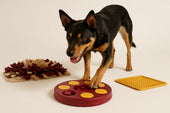
A puzzle feeder is any feeding tool that requires your dog to perform actions or solve a simple problem to access food. Some are movement-based (the dog rolls or nudges), others are lick-based (the dog licks soft food from grooves), and others are “interactive” with sliding parts or compartments.
A puzzle feeder is not:
- A replacement for veterinary care if your dog has ongoing vomiting, suspected pain, severe anxiety, or compulsive behaviours.
- A guarantee of preventing serious conditions such as gastric dilatation-volvulus (GDV). GDV risk is multi-factorial and strongly associated with anatomy and breed predisposition.
- A training shortcut. It can help manage boredom and arousal, but it does not replace consistent exercise, social interaction, and calm routines.
Used appropriately, puzzle feeders can be part of a robust enrichment plan—especially in Australian homes where dogs may spend significant time indoors (heat, snakes, fencing) or alone (workdays, school).
Discover PetCareShed’s Top Dog Essentials
Why Puzzle Feeding Works: Mental Stimulation and Welfare Benefits
Dogs are scavengers and foragers by nature. In many modern households, food arrives in a predictable bowl at predictable times, with minimal effort required. Puzzle feeding restores a small part of the natural sequence: searching, working, achieving, and consuming.
What the evidence says (in plain terms)
Environmental enrichment research in dogs and other species consistently shows that enrichment can support welfare by reducing stress-related behaviours and increasing relaxation. A pilot study on environmental enrichment in dogs reported benefits such as reduced stress behaviours and changes consistent with improved welfare.
Veterinary nursing education resources also describe food puzzles as a useful tool for emotional stimulation and activity, and as a way to channel natural foraging behaviours into the home environment.
It is also important to be realistic: enrichment works best when it is varied. In some studies, food-based enrichment produced smaller behavioural changes than social or novelty-based enrichment, partly because interaction ends when the food is gone.
Practical benefits you may notice at home
Depending on your dog, puzzle feeding may help with:
- Rapid eating (gulping) and post-meal regurgitation in some dogs
- Boredom-related behaviours, such as restlessness and nuisance attention-seeking
- Weight management, by slowing intake and helping portions feel more substantial
- Confidence building in cautious dogs through low-stakes “problems” they can solve
- Calmer transitions, particularly before owners leave for work or after school drop-off
The key is selection and setup. The best feeder is the one your dog can succeed with, safely, in your home environment.
Puzzle Feeder vs Slow Feeder Bowl vs Lick Mat: What’s the Difference?
These terms are often used interchangeably, but they solve slightly different problems.
- Slow feeder bowl: Usually a bowl with ridges or maze-like channels. It is designed primarily to slow eating of kibble or mixed meals.
- Puzzle feeder / food dispenser: Often movement-based. The dog manipulates the device (roll, wobble, paw) to release pieces.
- Lick mat: A flat mat with texture designed for licking soft foods. Licking can be soothing for many dogs and can extend the time spent consuming a small amount.
In practice, many households use a combination:
- Slow feeder bowl for main meals
- Lick mat for grooming/desensitisation sessions or hot days
- Food dispenser for rainy days, indoor enrichment, or post-walk decompression
Australia-Specific Considerations (Often Missed)
Australian conditions can change what “best” looks like.
Heat and hydration
On hot days, dogs may gulp water and eat quickly. Lick mats and freezable puzzle feeders can help slow intake and provide cooling enrichment. Always ensure fresh water is available, and avoid offering frozen treats to dogs with dental pain or very sensitive teeth.
Ants, cockroaches, and outdoor feeding
In many parts of Australia, leaving food residue outdoors invites ants quickly. For outdoor feeding:
- Choose puzzle feeders with smooth surfaces and minimal seams
- Wash immediately after use
- Avoid leaving lick mats with residue on decks or pavers
Strong chewers and “destroyers”
Some dogs treat enrichment items as chew toys. For these dogs:
- Avoid brittle plastics
- Prefer heavy-duty rubber-style dispensers or thick, dishwasher-safe slow bowls
- Supervise early sessions until you know your dog’s pattern (work vs chew)
Flat-faced breeds (brachycephalic dogs)
Pugs, French Bulldogs, British Bulldogs, and similar breeds can struggle with deep channels and narrow openings. They often do best with:
- Wider, shallow slow bowls
- Lick mats with soft food
- Low-difficulty dispensers with larger exits
If your brachycephalic dog shows repeated gagging, coughing, or distress when feeding, stop and consult your vet.
Safety First: Choosing a Puzzle Feeder That Won’t Create New Problems
Most puzzle feeders are safe when matched to the dog and used correctly. Issues tend to arise when a feeder is too small, too hard, too difficult, or used unsupervised before the dog has learned the rules.
Core safety checklist
- Correct size: Your dog should not be able to fit the entire feeder in their mouth.
- Stable base (where needed): Slow bowls that slide can increase frustration and tipping.
- No sharp edges or fragile parts: Avoid designs with thin plastic fins for powerful chewers.
- Appropriate difficulty: Excess difficulty can increase frustration and lead to biting/chewing.
- Supervision for beginners: Especially for puppies, anxious dogs, and strong chewers.
Choking and gulping concerns
Fast eating can contribute to gagging and choking episodes in some dogs. Slow-feeding tools are commonly used to reduce speed and encourage smaller mouthfuls. While many articles discuss these benefits, if your dog has repeated choking or regurgitation, a veterinary assessment is essential to rule out medical causes.
GDV (bloat) risk: what puzzle feeding can and can’t do
GDV is a medical emergency, most common in large, deep-chested breeds. Cornell’s canine health guidance explains the condition and highlights that large, deep-chested dogs are most at risk. https://www.vet.cornell.edu/departments-centers-and-institutes/riney-canine-health-center/canine-health-information/gastric-dilatation-volvulus-gdv-or-bloat
Slowing eating may reduce air intake in some dogs, but it should not be treated as a standalone prevention strategy. For at-risk dogs, your vet may discuss:
- Feeding routines (smaller, more frequent meals)
- Stress reduction around meals
- Recognising early signs of GDV
- Preventive gastropexy for very high-risk dogs
If your dog shows a suddenly swollen abdomen, non-productive retching, distress, or collapse, treat it as an emergency.
Types of Dog Puzzle Feeders (and Who They Suit)
1) Slow feeder bowls (maze bowls)
Best for: fast kibble eaters, dogs that tip bowls, households wanting simple routines.
Pros:
- Simple to introduce
- Works for most dogs
- Usually easy to portion
Limitations:
- Some are difficult to clean if grooves are narrow
- Can frustrate dogs if the maze is too tight
2) Lick mats
Best for: anxious dogs, grooming sessions, hot days, dogs that benefit from soothing licking.
Pros:
- Excellent for wet food, yoghurt-style dog-safe spreads, rehydrated meals
- Can be frozen to extend duration
Limitations:
- Not ideal for all-kibble meals unless combined with soft binder
- Some dogs chew the mat if left unattended
3) Rolling dispensers and wobble feeders
Best for: energetic dogs, indoor exercise, dogs that enjoy movement-based play.
Pros:
- Adds light physical activity
- Works well for kibble and small treats
Limitations:
- Noise on hard floors
- Not suitable for wet food
4) Snuffle mats (foraging mats)
Best for: scent-driven dogs, gentle eaters, enrichment on rainy days.
Pros:
- Encourages sniffing and natural foraging
- Often low frustration
Limitations:
- Can be hard to clean thoroughly if used with oily foods
- Not ideal for dogs that shred fabric
5) Sliding/compartment puzzle boards
Best for: dogs that enjoy problem-solving and have decent impulse control.
Pros:
- Adjustable challenge
- Good for treat-based training sessions
Limitations:
- Some dogs learn to flip the whole board
- Small parts may not suit enthusiastic chewers
What Makes the “Best” Dog Puzzle Feeder in Australia?
There is no single best option for every dog. The best puzzle feeder is the one that fits your dog’s needs and your household’s practical reality.
Selection criteria that matter
1) Meal type compatibility
- Dry kibble: most dispensers and slow bowls
- Wet food: lick mats, some slow bowls with wider channels
- Mixed meals: slow bowls with rounded grooves and enough depth
2) Difficulty level
Start easier than you think. Success builds confidence; frustration builds avoidance.
3) Durability and chew-resistance
For strong chewers, look for thick materials and minimal protruding fins.
4) Ease of cleaning
Australian homes often rely on quick, repeatable routines. If a feeder is hard to wash, it will not be used consistently.
5) Stability and non-slip features
This matters for older dogs, dogs with arthritis, and dogs that become over-aroused.
“Best by scenario” guide
- Best for fast eaters: maze-style slow feeder bowl with moderate ridges
- Best for anxious dogs: lick mat with freezing option
- Best for high-energy indoor enrichment: rolling dispenser or wobble feeder
- Best for scent hounds: snuffle mat (with supervision)
- Best for multi-dog homes: individual slow bowls in separate spaces
Matching Puzzle Feeder Difficulty to Your Dog
A common reason puzzle feeders fail is that the challenge level is wrong. Dogs either finish too quickly (not enough benefit) or give up (too hard).
Signs the puzzle is too easy
- Meal finished in under 2–3 minutes (for a dog that usually gulps)
- Dog barely pauses or sniffs
- Dog can “dump” the food out immediately
Signs the puzzle is too hard
- Dog paws repeatedly with escalating intensity
- Vocalising, leaving and returning, or refusing to engage
- Chewing the feeder rather than working it
A simple progression plan
- Week 1: slow bowl or easy lick mat
- Week 2: add a low-difficulty rolling dispenser for part of the meal
- Week 3: introduce a puzzle board once or twice a week
- Ongoing: rotate 2–4 feeders to keep novelty without constant escalation
Rotation matters because novelty is part of enrichment value, and it also reduces wear on any single item.
Portion Control and Nutrition: Keeping Puzzle Feeding Healthy
Puzzle feeders can help dogs feel fuller because eating takes longer, but they can also cause accidental overfeeding if treats are added “on top” of meals.
Practical portioning rules
- Measure the full daily ration first.
- Allocate a portion to enrichment (puzzle feeder, training, scatter feeding).
- Reduce bowl meals accordingly.
If you use high-calorie toppers (peanut butter-style spreads, oily fish), use very small amounts and spread thinly. For dogs with pancreatitis history, gastrointestinal disease, or food allergies, discuss suitable options with your vet.
RSPCA guidance on safe feeding emphasises avoiding risky foods (for example, cooked bones and corncobs) and choosing appropriate diets. Use that same caution with puzzle feeding: the feeder is just a delivery method; the food still needs to be safe. https://kb.rspca.org.au/categories/companion-animals/dogs/caring-for-my-dog/what-should-i-feed-my-dog
Introducing a Puzzle Feeder: A Calm, Low-Stress Method
Some dogs take to puzzle feeders immediately. Others need a gentle introduction, particularly dogs that have experienced food competition, rescue dogs, and puppies.
Step-by-step introduction
- Start with success: place a small amount of food in the feeder with easy access.
- Let your dog investigate: avoid hovering; keep the environment calm.
- Use high-value but suitable food initially: a small amount of their usual food plus a few higher-value pieces can build interest.
- Stop before frustration: it is better to end early and succeed than to push until your dog gives up.
- Increase challenge gradually: once your dog is confidently working the feeder.
Multi-dog household tip
Feed dogs separately during puzzle feeding, at least initially. Puzzle feeding can increase food focus, and some dogs may guard resources when a meal becomes “work”.
Cleaning and Food Safety: A Practical Routine for Australian Homes
Puzzle feeders have more surface area and more crevices than bowls. That is good for slowing eating, but it also increases the need for routine cleaning.
Cleaning principles
- Wash after every use for wet food.
- For kibble-only feeders, wash frequently enough to remove oils and saliva residue (often every 1–3 uses depending on the dog and climate).
- Ensure feeders are fully dry before storing to reduce odours and residue build-up.
Quick cleaning checklist
- Warm water and dish detergent for routine cleaning
- Bottle brush or small brush for grooves
- Dishwasher use only if the product is dishwasher-safe
If you feed raw-style diets, hygiene is especially important; treat feeders like food-prep items.
Troubleshooting Common Puzzle Feeder Problems
“My dog flips the feeder and empties it.”
- Choose a heavier, wider-base slow bowl
- Use feeders designed to resist tipping
- Feed on a non-slip mat
“My dog gets frustrated and starts biting it.”
- Reduce difficulty
- Switch to a lick mat (often lower frustration)
- Shorten sessions
- Use supervision and remove the feeder if the dog escalates
“My dog ignores it.”
- Start with a simpler design
- Make the first sessions very easy
- Use a small amount of higher-value food mixed in
“It’s too noisy on tiles.”
- Use a feeding mat underneath
- Choose a slow bowl or lick mat for hard-floor homes
“My dog eats grass after puzzle feeding.”
Occasional grass eating can be normal, but frequent grass eating may indicate nausea, reflux, or dietary mismatch. Review meal size, speed, and ingredients, and consult your vet if it persists.
Best Dog Puzzle Feeder “Shortlist” by Category (No Brand Names)
The options below are written as product categories so you can match the design to your dog’s needs.
Best all-rounder for most dogs
- Maze-style slow feeder bowl (moderate depth, rounded ridges)
Best for wet food and calming enrichment
- Dishwasher-safe lick mat (medium texture, suctions optional)
Best for active dogs that need movement
- Adjustable rolling kibble dispenser (large capacity, durable shell)
Best for scent-driven enrichment
- Washable snuffle mat (dense fleece strips, non-slip base)
Best for advanced problem-solvers
- Sliding compartment puzzle board (large sliders, chew-resistant build)
Recommended Related Products from PetCareShed
The following PetCareShed product categories are commonly useful alongside puzzle feeding. They are selected to support safe setup, hygiene, and daily variety.
- Slow feeder bowls: helpful for dogs that gulp meals, especially kibble and mixed meals.
- Lick mats: useful for wet food, calming enrichment, and freezing on hot Australian days.
- Treat-dispensing puzzle feeders: suitable for indoor enrichment and controlled treat delivery.
- Snuffle mats: for scent work and gentle foraging-style feeding.
- Non-slip feeding mats: reduce sliding on tiles and timber floors; helpful for seniors.
- Stainless steel bowls: useful as a backup bowl and for households rotating feeding setups.
- Grooming brushes and nail care tools: puzzle feeding often pairs well with calm grooming routines.
A Practical Comparison Table: Choosing the Right Feeder
| Feeder type | Best for | Works with | Watch-outs | Difficulty |
|---|---|---|---|---|
| Slow feeder bowl | Fast eaters | Kibble, mixed | Groove cleaning | Low–Medium |
| Lick mat | Anxious dogs | Wet, soft foods | Chewing risk | Low |
| Rolling dispenser | Indoor activity | Kibble | Noise on tiles | Medium |
| Snuffle mat | Scent work | Kibble, treats | Fabric shredders | Low–Medium |
| Puzzle board | Problem-solvers | Treats, some kibble | Flipping/chewing | Medium–High |
How to Build a Weekly Puzzle Feeding Routine (Without Overthinking It)
Consistency matters more than complexity. A realistic routine reduces owner workload and keeps the dog engaged.
Example weekly plan
- Mon/Wed/Fri: slow feeder bowl for breakfast; normal bowl dinner
- Tue/Thu: lick mat after morning walk (small portion); slow bowl dinner
- Sat: rolling dispenser for part of breakfast; training treats counted from daily ration
- Sun: snuffle mat “foraging breakfast”; calm chew or enrichment walk later
This approach spreads enrichment across the week and reduces the likelihood that a single device becomes boring or that the dog becomes overly dependent on one style.
Dogs Who Need Extra Care with Puzzle Feeders
Puppies
Puppies benefit from enrichment feeding, but they also explore with their mouths. Choose simple, robust designs and supervise closely.
Senior dogs
Older dogs may have dental wear, arthritis, or reduced vision. Prioritise:
- Non-slip bases
- Shallow, wide patterns
- Softer foods if dental sensitivity is present
Dogs with anxiety
Puzzle feeding can help some anxious dogs settle, particularly lick-based enrichment. However, severe separation anxiety requires a structured plan with a veterinarian or qualified behaviour professional.
Dogs with medical conditions
If your dog has any of the following, seek veterinary guidance before major feeding changes:
- Recurrent vomiting, regurgitation, or suspected reflux
- History of pancreatitis
- Food allergies or inflammatory bowel disease
- Diagnosed dental disease
- High GDV-risk breed or prior gastric dilatation episode
Signs Your Puzzle Feeder Is Working (Beyond “It Takes Longer”)
Time is only one outcome. Look for broader signs of improved welfare and calmer daily rhythms.
- The dog finishes the meal and settles more easily afterward.
- Less frantic behaviour around food preparation.
- Reduced scavenging behaviours and less constant “searching” after meals.
- A more even energy level across the day.
If your dog becomes more aroused, guardy, or frustrated, the feeder choice or setup needs adjusting.
FAQ: Best Dog Puzzle Feeders in Australia
Are puzzle feeders good for dogs?
For many dogs, yes. Puzzle feeders provide food-based enrichment that encourages foraging behaviour and can support welfare when used appropriately. Environmental enrichment research in dogs supports benefits such as reduced stress behaviours and increased relaxation.
Do puzzle feeders actually slow down eating?
Most do, especially slow feeder bowls and lick mats. Movement-based dispensers can also slow eating, although very experienced dogs may become efficient. If a dog finishes a meal in under a few minutes, consider a more complex design or splitting the meal across two devices.
Can slow feeding prevent bloat (GDV)?
Slower eating may reduce air swallowing for some dogs, but GDV risk is influenced strongly by breed and body shape. Large, deep-chested dogs are at higher risk, and GDV is a medical emergency. Use puzzle feeding as one supportive strategy, and discuss GDV risk management with your veterinarian.
Are puzzle feeders suitable for wet food?
Yes, but choose the right type. Lick mats and wide-groove slow bowls are usually best for wet food. Rolling dispensers are generally for kibble only.
Can I use puzzle feeders for raw-style diets?
Some households do, but hygiene becomes critical because crevices can hold residue. Choose designs that are easy to scrub and wash immediately after use. If your dog has health conditions or you have vulnerable people in the home, seek veterinary advice on safe feeding practices.
My dog chews the puzzle feeder. What should I do?
Stop the session and switch to a safer option. Chewing can mean the feeder is too difficult, the dog is overstimulated, or the material is not suitable for that dog. Use a more durable design and supervise.
Are lick mats safe for all dogs?
They are generally safe when supervised, but some dogs will chew the mat, particularly if it is left down after the food is finished. Remove and wash the mat once the dog is done.
What’s better: a slow feeder bowl or a puzzle toy?
They serve different roles.
- Slow feeder bowls are usually best for daily main meals.
- Puzzle toys are often best for enrichment sessions and rainy-day activity.
Many households use both, rotating across the week.
How long should a meal take with a puzzle feeder?
There is no single correct time, but many owners aim for roughly 8–20 minutes for a main meal depending on the dog and feeder type. Lick mats (especially frozen) can last longer. The goal is calm engagement, not maximum difficulty.
Can puzzle feeding replace walks?
No. Puzzle feeding is mental enrichment and can complement exercise, but dogs still need appropriate physical activity, outdoor sniffing, and social interaction.
My dog gets frustrated and walks away. Does that mean puzzle feeders don’t work for them?
Not necessarily. It usually means the difficulty is too high or the design does not match your dog’s style. Reduce the challenge, make the first sessions very easy, and try a different type (often a lick mat or a simple slow bowl).
Are puzzle feeders good for overweight dogs?
They can be helpful because they slow eating and make measured portions feel more substantial. Weight loss still depends on overall calories, appropriate diet, and veterinary guidance.
What foods should I avoid putting in a puzzle feeder?
Avoid foods that are unsafe for dogs (including items that can cause obstruction or toxicity). RSPCA resources outline safe feeding considerations and items that can be dangerous for dogs.
How do I know if my dog’s feeder is the right size?
A good rule is that the feeder should be too large to fit fully inside the mouth, and openings should not allow the dog to wedge their jaw or teeth. If in doubt, size up and choose a simpler pattern.
Do puzzle feeders help with separation-related behaviours?
They may help some dogs settle during short departures by providing a predictable, calming activity (particularly lick-based feeding). However, true separation anxiety is complex and should be managed with professional guidance.
When should I talk to a vet about puzzle feeding?
Seek veterinary advice if your dog has:
- Recurrent vomiting, regurgitation, gagging, or coughing during meals
- Suspected dental pain
- A history of pancreatitis or significant gastrointestinal disease
- High GDV risk or previous gastric dilatation
- Sudden changes in appetite or behaviour around food