
Key Takeaways
- Puzzle feeders are a practical form of canine enrichment, designed to turn part (or all) of a meal into a problem-solving activity rather than a quick bowl-based feed. Australian animal welfare guidance recognises enrichment as essential for wellbeing and behaviour.
- They are especially helpful for boredom, mild anxiety, and high-drive intelligence, because they promote sniffing, licking, chewing, and decision-making—behaviours that are naturally calming for many dogs.
- Not all puzzle feeders suit all dogs. Size, chewing style, frustration tolerance, diet type (kibble vs wet vs raw), and supervision needs matter more than the label “interactive” or “IQ toy”.
- Safety and hygiene should be treated as non-negotiable. Choose robust, food-safe materials; avoid loose parts for aggressive chewers; and clean thoroughly to prevent biofilm and odours.
- If your dog shows panic, self-injury, severe separation anxiety, or resource guarding, puzzle feeders can support a broader plan, but they are not a standalone treatment. Veterinary and qualified behaviour advice is recommended.
PetCareShed’s Handpicked Dog Comforts
Introduction
In many Australian households, dogs spend substantial portions of the day indoors or in backyards with limited novelty. Even when owners provide regular walks, it is common for intelligent or anxious dogs to remain under-stimulated. Under-stimulation can present as barking, digging, chewing, pacing, jumping, or apparent “naughtiness” that is often better understood as unmet behavioural needs.
A puzzle feeder is one of the simplest ways to introduce daily, repeatable mental enrichment without adding extra time to the day. Rather than placing food in a standard bowl, puzzle feeders encourage dogs to work for the same meal using their nose, tongue, paws, and problem-solving skills. This approach aligns with welfare guidance that enrichment should engage an animal’s mind and senses, and can help reduce undesirable behaviours when implemented appropriately. The RSPCA describes enrichment—including feeding enrichment and cognitive enrichment—as important for mental stimulation, exploratory behaviour, and wellbeing.
This article explains how puzzle feeders work, which styles suit different dogs, what to look for in Australian conditions, and how to use them safely for dogs that are bored, anxious, or exceptionally bright.
What Counts as a “Puzzle Feeder” (and How It Differs from a Slow Feeder)
The term puzzle feeder is often used loosely. In practice, there are several categories, each offering a different kind of challenge.
Puzzle feeder vs slow feeder
A slow feeder primarily aims to reduce eating speed by adding physical barriers inside a bowl. A puzzle feeder goes further: it requires a sequence of behaviours (pushing, rolling, flipping, sliding, licking, sniffing, searching) to access food.
- A slow feeder is often best for dogs that inhale meals.
- A puzzle feeder is usually best for boredom relief, confidence building, and cognitive engagement.
In reality, many products sit in the middle: a slow-feeder bowl may offer mild problem-solving, while a treat-dispensing ball may also slow eating.
Common puzzle feeder types
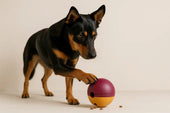
- Rolling dispensers: A ball or cylinder that releases kibble as it rolls.
- Sliding-lid boards: Compartments opened by moving pieces with nose or paw.
- Snuffle mats and forage trays: Food hidden among fabric or textures to encourage sniffing.
- Lick mats: Spreadable foods in ridged surfaces, promoting slow licking.
- Stuffable rubber feeders: Food is packed into a durable hollow toy.
- Multi-step feeders: Layered challenges combining several mechanisms.
Each type has distinct benefits and risks. Choosing the “best” puzzle feeder in Australia depends on the dog in front of you, not the trend.
Discover PetCareShed’s Top Dog Essentials
Why Puzzle Feeders Help Bored, Anxious, and Intelligent Dogs
Puzzle feeders work because they leverage species-appropriate behaviours—foraging, sniffing, licking, chewing, and exploring—rather than expecting dogs to remain content with inactivity.
1) They provide recognised enrichment
Animal welfare guidance supports enrichment as part of good care. The RSPCA outlines different enrichment categories, including feeding enrichment (e.g., puzzle feeders) and cognitive enrichment (problem-solving tasks).
A standard bowl is efficient, but it is behaviourally “thin”: it ends quickly and does not require engagement. A puzzle feeder can extend feeding time and provide a purposeful task.
2) They can reduce stress-related behaviours in some settings
Evidence suggests enrichment feeding can influence stress-related behaviours. A study examining enrichment feeding for dogs in kennels reported that providing time to use puzzle feeders was associated with reductions in stress-related behaviours.
For pet dogs, the practical implication is that food-based tasks can serve as a calming, occupying activity—particularly when paired with predictable routines.
3) They give “busy brains” an appropriate job
Australian owners of working breeds (Kelpies, Border Collies, Australian Cattle Dogs) often find that a walk alone does not create calm. These dogs are bred to solve problems. Puzzle feeding offers a controlled outlet that can reduce nuisance behaviours caused by unmet drive.
4) They help manage “fast eating” and food obsession
Some dogs become frantic at mealtimes. A puzzle feeder can:
- slow down intake
- reduce gulping
- reduce competition if managed carefully in multi-dog homes
- encourage a calmer feeding pattern
It is not a guarantee, but it is commonly a meaningful improvement when chosen correctly.
5) They are useful in Australian conditions
Australia’s weather and lifestyle can reduce outdoor activity:
- hot days (heat stress risk)
- heavy rain in some regions
- summer bushfire smoke events
- snakes and paralysis ticks in certain areas, making off-track exploration risky
Puzzle feeders allow mental work indoors when outdoor time must be limited.
When Puzzle Feeders Are Not Enough (and When to Seek Professional Help)
Puzzle feeders can support wellbeing, but owners should be cautious about expecting them to resolve serious behavioural or medical issues.
Consider veterinary or qualified behaviour support if you observe:
- separation anxiety with panic behaviours (destructive exits, self-harm, excessive salivation)
- persistent aggression around food or objects
- compulsive behaviours (tail chasing, fly snapping) that do not reduce with enrichment
- sudden changes in appetite or eating speed
- choking episodes, repeated vomiting, or coughing during meals
Puzzle feeders are a tool. For many dogs, they are an excellent tool—but they remain only one part of a responsible care plan.
Choosing the Best Puzzle Feeder: A Practical Australian Checklist
Before comparing styles, it helps to use a clear selection checklist. This avoids buying a feeder that is too easy (dog finishes in 90 seconds) or too hard (dog gives up or becomes frustrated).
Dog factors
- Body size and muzzle shape: Flat-faced dogs may struggle with deep compartments.
- Age: Puppies need simpler puzzles and careful supervision; seniors may need easier mechanics.
- Chewing style: Power chewers require robust materials and fewer detachable components.
- Diet type: Kibble works in most rolling feeders; wet or raw suits lick mats and stuffables.
- Frustration tolerance: Anxious dogs often do best with scent-based foraging first.
Household factors
- Flooring: Rolling feeders can be loud on tiles; textured mats suit apartments.
- Clean-up tolerance: Some puzzles scatter kibble; others keep food contained.
- Multiple dogs: Feeding separately is often safer to avoid guarding.
- Time available: Some puzzles require preparation (freezing, stuffing), others do not.
Product factors
- Material quality: Choose food-safe, non-toxic materials.
- Stability: Non-slip bases suit enthusiastic dogs.
- Washability: Dishwasher-safe components are a genuine advantage.
- Spare parts: Useful for modular feeders.
- Difficulty adjustment: Extends the product’s useful lifespan.
Puzzle Feeder Styles Compared (With Pros, Cons, and Best Uses)
Below is a practical comparison. These are category-level recommendations so owners can match the feeder style to the dog’s needs.
| Type | Best for | Main benefits | Watch-outs |
|---|---|---|---|
| Snuffle mat / forage mat | Anxious dogs, scent-driven dogs, beginners | Calming sniffing; low frustration | Needs washing; can be shredded by chewers |
| Lick mat | Anxious dogs, crate training, grooming support | Slow licking; quiet; low-impact | Supervise chewers; hygiene important |
| Stuffable rubber feeder | Busy dogs, medium chewers, solo time | Long-lasting; can freeze; versatile foods | Calorie creep; choose correct size |
| Rolling kibble dispenser | Energetic dogs, meal “hunters” | Movement + thinking; slows eating | Noisy on hard floors; can frustrate timid dogs |
| Slow-feeder bowl (maze) | Fast eaters, brachycephalic dogs (shallow models) | Simple; low prep; reduces gulping | May be too easy for smart dogs |
| Sliding compartment puzzle board | Highly intelligent dogs, training-minded homes | True problem-solving; adjustable difficulty | Parts can be chewed; needs supervision |
The “Best” Dog Puzzle Feeders in Australia: Category Winners (How to Pick Within Each)
Australia has strong demand for enrichment products, but buyers often face an unhelpful problem: many listings use similar language (“interactive”, “IQ”, “anti-boredom”) without explaining who the feeder is actually for.
Instead of naming external brands, the sections below describe the most reliable product categories and the decision points that genuinely matter.
1) Best for anxious dogs: snuffle mats and low-frustration forage feeders
For many anxious dogs, the goal is not maximum difficulty. The goal is regulated, steady engagement.
Snuffle mats are effective because they encourage scent work, which is a natural, absorbing activity. RSPCA enrichment resources highlight the value of engaging a dog’s senses—particularly smell—as part of enrichment.
What to look for:
- dense fabric “grass” that holds kibble well
- a non-slip base suitable for tiles and laminate
- machine-washable materials
- edges that are difficult to shred
When to avoid:
- dogs that ingest fabric
- dogs that guard food in shared areas
Practical use tip:
- Start with kibble placed openly on top of the mat, then gradually hide it deeper. This builds confidence and reduces frustration.
2) Best for separation routines and quiet enrichment: lick mats
Lick mats are often overlooked because they look simple. Their value lies in slow, repetitive licking, which can help some dogs settle.
What to look for:
- suction cups or non-slip backing
- shallow ridges for short-nosed breeds
- freezer-safe material
Suitable foods (in controlled portions):
- wet dog food
- mashed dog-safe vegetables
- plain yoghurt-style options formulated for dogs
Safety note:
- Supervise at first. Some dogs will attempt to chew the mat once the food is gone.
3) Best all-rounder for intelligent dogs: adjustable puzzle boards
For truly intelligent dogs, the feeder needs progression. A fixed, simple puzzle becomes predictable quickly.
Look for:
- multiple compartments
- sliders or rotating covers
- difficulty settings (blocked openings, removable pieces)
- sturdy base to prevent flipping
How to introduce:
- Stage 1: all covers open
- Stage 2: half covered
- Stage 3: fully covered, with guidance
This staged approach prevents learned helplessness (giving up) and reduces the risk of a dog trying to “solve” the feeder by chewing it.
4) Best for dogs that inhale food: slow-feeder bowls and controlled-release feeders
Fast eating can lead to gulping and discomfort. Slow-feeder bowls are often the simplest fix.
A note on bloat (GDV):
Gastric dilatation-volvulus is a medical emergency, particularly in large, deep-chested breeds. Veterinary guidance commonly emphasises practical prevention steps such as feeding multiple smaller meals and avoiding strenuous exercise around mealtimes, and notes prophylactic gastropexy as the most effective prevention of volvulus in high-risk breeds.
Slow feeders may help some dogs eat more slowly, but they should not be treated as a sole “bloat prevention device”. If you own a high-risk breed, discuss a personalised plan with your veterinarian.
5) Best for energetic dogs: rolling dispensers and movement-based feeders
These are ideal for dogs that love to chase and push objects. They turn mealtime into a low-level “hunt”.
Best suited to:
- medium to large dogs
- dogs fed kibble
- homes that can tolerate noise and movement
Less suited to:
- timid dogs that startle easily
- dogs in multi-dog settings unless fed separately
A practical Australian consideration: hard floors
- If you have tiles (common in Australian homes), choose a design with rubberised edges or use a mat underneath to reduce noise and protect flooring.
6) Best for power chewers: heavy-duty, single-piece stuffable feeders
For dogs that destroy toys, avoid puzzles with small sliders, thin plastic lids, or fabric.
Look for:
- thick, resilient rubber
- a single-piece construction
- a size large enough to prevent swallowing
Use strategy:
- Stuff with part of the meal, then freeze. Freezing increases duration and reduces rapid consumption.
How to Match Puzzle Feeder Difficulty to Your Dog (Without Causing Frustration)
Difficulty is not a badge of honour. The correct level is the one that keeps your dog engaged and successful.
Signs the puzzle is too easy
- finished in under 2–3 minutes
- dog loses interest and wanders off
- dog starts “asking for more” immediately
Signs the puzzle is too hard
- repeated paw slamming or frantic biting
- whining, barking, or escalating arousal
- dog disengages and refuses future attempts
A simple progression plan (2 weeks)
- Days 1–3: easy forage (snuffle mat with visible kibble)
- Days 4–7: slightly hidden kibble; add one simple puzzle element
- Week 2: rotate between two puzzle types; introduce a multi-step feeder for one meal
Rotation is important. The RSPCA warns that repeating the same enrichment can reduce interest over time.
Feeding Plans: Using Puzzle Feeders Without Overfeeding
One of the most common mistakes is treating puzzle feeding as “extra treats” rather than “a different way to deliver the same calories”. This is especially relevant for small dogs and dogs prone to weight gain.
Practical portioning rules
- Measure the full daily ration first.
- Allocate:
- 60–80% of daily food through meals (some can be puzzle-based)
- 20–40% through training and enrichment, only if it fits within the daily ration
High-value foods: use strategically
Some puzzles work better with higher-value foods, especially early on. If you need to use richer foods:
- reduce main meal accordingly
- keep duration short at first to avoid stomach upset
- introduce new foods gradually
Water access
Always provide fresh water near feeding areas, particularly in warm Australian climates.
Safety: Choking, Tooth Wear, Multi-Dog Homes, and Supervision
Puzzle feeders are generally safe when chosen appropriately, but owners should plan for realistic risks.
Choking and ingestion risk
Higher risk scenarios include:
- dogs that gulp
- dogs that chew and swallow chunks
- puzzles with detachable parts
Risk reduction:
- choose appropriate size (bigger than the dog’s mouth opening)
- avoid brittle plastics for strong chewers
- supervise new puzzles until you understand your dog’s behaviour
Tooth wear and hardness
Avoid excessively hard items that may crack teeth, especially for enthusiastic chewers. If a feeder is so rigid it cannot flex at all, it may be unsuitable for prolonged chewing.
Multi-dog homes
Puzzle feeding can increase tension if dogs compete or hover. Safer options include:
- feed in separate rooms
- remove feeders promptly once empty
- avoid high-value items if guarding occurs
Heat considerations (Australia-specific)
On hot days, some dogs become less tolerant of frustration. Use easier puzzles and consider chilled/frozen enrichment to support comfort.
Cleaning and Hygiene: Keeping Puzzle Feeders Safe to Use
Food-contact items can develop odours and residue over time, especially those used with wet foods. In warm climates, poor hygiene can encourage microbial growth.
Practical, low-fuss hygiene standards:
- After each use (wet foods): wash with hot water and detergent; rinse thoroughly; air dry.
- Daily (kibble-only puzzles): brush out crumbs and wipe down.
- Weekly: deep-clean, including crevices, suction cups, and textured surfaces.
If a puzzle feeder:
- smells sour after washing
- feels sticky
- shows visible residue in grooves
…retire it or replace it. Some low-cost feeders become impossible to clean properly, and that is a real cost over time.
Training Your Dog to Use Puzzle Feeders (Step-by-Step)
A confident introduction prevents frustration and destruction.
Step 1: Build the idea “food comes from this object”
- Place a few pieces of kibble near or inside the feeder.
- Let the dog eat them without needing to manipulate anything.
Step 2: Reward calm investigation
- If the dog sniffs, nudges, or paws appropriately, allow access.
- Avoid over-arousing encouragement (high excitement can cause rough chewing).
Step 3: Reduce your help gradually
- Increase the challenge in small increments.
- End sessions while the dog is still engaged, not when they are frustrated.
Step 4: Add routine cues
A consistent cue such as “Find it” or “Puzzle time” helps anxious dogs predict what is happening.
Special Cases: Puppies, Seniors, Flat-Faced Breeds, and Dogs on Special Diets
Puppies
Puzzle feeders can support healthy brain development and reduce boredom-related chewing, but puppies:
- tire quickly
- can become frustrated
- may ingest non-food items
Keep puzzles simple, short, and supervised.
Senior dogs
Older dogs often benefit from low-impact mental work. Choose:
- lick mats
- snuffle mats
- shallow slow feeders
Avoid puzzles requiring jumping, rapid chasing, or awkward pawing.
Flat-faced (brachycephalic) dogs
Shallow designs are essential. Deep compartments can make feeding inefficient and irritating.
Dogs on veterinary diets
Many veterinary diets are available as kibble or wet food. Puzzle feeding can still work, but:
- maintain strict calorie control
- avoid adding rich toppings that undermine the diet
When in doubt, confirm with your veterinarian.
A Sample Weekly Puzzle Feeding Schedule (Realistic and Sustainable)
The best enrichment plan is the one you can maintain.
| Day | Breakfast | Dinner | Short enrichment (5–10 min) |
|---|---|---|---|
| Mon | Slow-feeder bowl | Snuffle mat | Scatter feed in yard |
| Tue | Rolling dispenser | Standard bowl | Basic training with kibble |
| Wed | Stuffable feeder (unfrozen) | Puzzle board (easy) | Scent game indoors |
| Thu | Snuffle mat | Slow-feeder bowl | Find-the-treat game |
| Fri | Puzzle board (medium) | Standard bowl | Calm lick mat |
| Sat | Rolling dispenser | Stuffable feeder (frozen) | Short trick training |
| Sun | Standard bowl | Snuffle mat | Decompression sniff walk |
This schedule avoids over-reliance on one puzzle type and reduces the risk of boredom through repetition.
Common Mistakes Australian Owners Make (and How to Avoid Them)
Mistake 1: Buying the hardest puzzle first
A difficult puzzle can overwhelm anxious dogs and create destructive behaviour. Start easy, then increase difficulty.
Mistake 2: Using puzzle feeders only when the dog is “bad”
If puzzle feeding appears only after barking or destruction, the dog can learn to repeat the behaviour. Use puzzles predictably, as part of routine.
Mistake 3: Overfeeding via enrichment
Treats and enrichment foods add up. Measure daily food first.
Mistake 4: Leaving puzzles down all day
Constant access can reduce value and increase chewing damage. Offer puzzles, then pick them up.
Mistake 5: Not supervising early use
Most incidents happen when a dog is left alone with a new product they do not understand.
Recommended Related Products from PetCareShed
The following PetCareShed product categories are commonly helpful when setting up safe, effective puzzle feeding routines. Selection should be based on your dog’s size, chewing style, and diet.
- Snuffle mats and forage mats: Suitable for scent-driven enrichment, especially for anxious dogs and beginners.
- Lick mats: Useful for calm, quiet enrichment during crate time, grooming, or after walks.
- Slow-feeder bowls: Practical for dogs that gulp meals and need a simple, low-prep solution.
- Stuffable enrichment feeders: Helpful for longer-lasting engagement, especially when used with frozen fillings.
- Interactive puzzle boards: Best for intelligent dogs needing step-by-step problem-solving challenges.
- Non-slip feeding mats: Reduce sliding on tiles and protect floors—particularly relevant in Australian homes with hard flooring.
- Food storage containers and scoop sets: Support accurate portioning to prevent overfeeding when using enrichment.
FAQ: Best Dog Puzzle Feeders in Australia
Are puzzle feeders good for anxious dogs?
Puzzle feeders can be helpful for many anxious dogs because they promote calming behaviours such as sniffing and licking, and they provide a predictable task. Evidence from kennel settings indicates puzzle feeding time can be associated with reductions in stress-related behaviours. However, dogs with severe anxiety often need a structured behaviour plan and veterinary guidance.
Do puzzle feeders actually make dogs smarter?
Puzzle feeders support problem-solving practice and can increase engagement, but “making a dog smarter” is not a precise outcome. They are best viewed as cognitive enrichment—a way to keep the brain active and reduce boredom, consistent with enrichment guidance describing the value of problem-solving activities.
Can puzzle feeders replace walks?
They should not replace physical exercise and outdoor enrichment. Puzzle feeders are useful on hot or rainy days, during recovery, or as a daily add-on. Most dogs still benefit from walks and outdoor sniffing opportunities.
What is the best puzzle feeder for a dog that destroys toys?
A heavy-duty, single-piece stuffable feeder is usually safer than puzzle boards with detachable parts or fabric snuffle mats. Choose an appropriate size and supervise early sessions.
Are snuffle mats safe?
Snuffle mats are safe for many dogs when supervised, but they are not ideal for dogs that shred and ingest fabric. Wash them regularly and retire them if they begin to break down.
Are lick mats safe?
They are generally safe when used under supervision and with suitable foods. The main risks are chewing the mat after the food is gone and poor hygiene if residue remains in grooves.
Do slow feeders prevent bloat (GDV)?
Slow feeding may reduce gulping for some dogs, but bloat risk management is broader. Veterinary sources emphasise multiple smaller meals, avoiding strenuous exercise around meals, and prophylactic gastropexy for high-risk breeds as the most effective prevention of volvulus.
What puzzle feeder is best for apartment living?
Lick mats, puzzle boards, and snuffle mats are typically quieter and more contained than rolling dispensers. Pair them with a non-slip feeding mat to reduce movement and noise.
How long should a puzzle feeder keep my dog busy?
As a general guide:
- beginners: 3–10 minutes
- intermediate: 10–20 minutes
- advanced: up to 20–30 minutes (often using frozen fillings)
Longer is not always better; calm engagement matters more than duration.
How do I stop my dog from flipping the puzzle feeder over?
Choose a heavier base, a non-slip design, or place the feeder on a rubber feeding mat. You can also begin with easier setups so the dog does not resort to brute-force strategies.
My dog gives up quickly—what should I do?
Reduce difficulty immediately. Start with visible food and minimal moving parts. Increase challenge gradually over days, not minutes.
My dog gets frustrated and bites the feeder—should I continue?
Stop and simplify. Frustration can create a pattern of rough handling and can damage teeth or the feeder. Choose low-frustration options (snuffle mats, lick mats) and build success first.
Can I use wet food in puzzle feeders?
Yes, but choose designs that are easy to clean (lick mats, stuffable feeders) and wash thoroughly after each use.
How often should I wash puzzle feeders?
- Wet food: wash after every use.
- Kibble-only feeders: clean daily or at least several times per week, and deep-clean weekly.
If odours persist after washing or crevices cannot be cleaned properly, replace the feeder.
Are puzzle feeders suitable for puppies?
Yes, with supervision and simple designs. Puppies may chew parts and can become frustrated quickly, so keep sessions short and positive.
What is the best puzzle feeder for senior dogs?
Lick mats, snuffle mats, and shallow slow feeders are usually best because they provide mental work without excessive physical demand.
Should I feed my dog every meal in a puzzle feeder?
Many dogs do well with one puzzle meal per day plus one regular meal, or puzzle feeding several times per week. The best approach balances enrichment with practicality and maintains accurate portion control.
Can puzzle feeders help with resource guarding?
They can help by providing structured routines, but they can also increase guarding if used incorrectly in multi-dog homes. Feed dogs separately and seek professional advice if guarding is present.
What if my dog needs medication with food?
A lick mat or stuffable feeder can be useful for hiding tablets, but always confirm with your veterinarian that the medication can be given with food and is safe to conceal in that way.