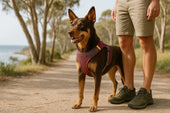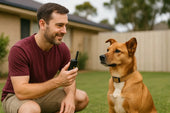

Key Takeaways
- Extendable (retractable) dog leads can be useful in the right setting, but they are not a “set and forget” tool. They require training, active handling, and a suitable environment.
- Australian leash rules are often governed by local council laws and state regulations, with many areas requiring dogs to be on lead and commonly limiting lead length (often around 1.5–2 metres, sometimes up to 3 metres). Always follow local signage and council rules. Some councils treat extendable leads as non-compliant when fully extended. Sources: Victorian Government Gazette notice on 3 m limit; council examples such as Whitehorse (1.5 m); West Torrens (2 m).
- Safety risks are real and well documented, including falls, lacerations, and eye injuries due to recoil or hardware failure; cord burns and severe finger injuries are a known hazard. A published medical review highlights injuries and recalls involving retractable leads.
- RSPCA guidance generally favours a fixed-length leash (often up to ~2 m) and a well-fitted harness, particularly in busy public areas, for better control and reduced risk of tangles.
- Tape-style retractable leads are generally safer than thin cord because they are more visible and less likely to cause cutting injuries if they contact skin under tension. (Visibility and injury risk are widely noted in safety discussions, including clinical and welfare commentary.)
- For active dogs in Australia, the best “flexible” solution is often a two-leash approach: a fixed-length leash for footpaths and busy areas, and a longer line (or carefully managed extendable lead) for open, low-risk environments.
From PetCareShed, with Love for Every Dog
Introduction
Australian dog owners often want the same thing: a walk that is safe, enjoyable, and practical. Yet Australian walking environments can be unusually variable. A single outing may include narrow suburban footpaths, a shared path with bikes and prams, a reserve with wildlife, and a beach access track with signage that changes by season. In this context, it is understandable that extendable dog leads (also called retractable leads) remain popular. They offer a simple promise: give a dog more freedom to explore without going fully off lead.
However, extendable leads sit at the intersection of convenience, compliance, and control. They can be helpful in certain conditions—particularly for calm, trained dogs in open spaces where you can maintain distance from others. At the same time, they can introduce risks that fixed-length leads do not, including delayed stopping distance, tangles, sudden jerks, and injury from recoil.
This guide is written for Australian dog owners who want practical, Australia-specific advice on choosing and using an extendable lead responsibly. It explains what to look for, when to avoid them, how to use them safely, and what alternatives may better suit high-energy dogs.
From PetCareShed, with Love for Every Dog
What “Extendable Dog Lead” Means (and How It Differs from a Long Line)
An extendable dog lead is a housing with an internal spring-loaded mechanism that releases and retracts a tape or cord. The dog can move away from you until the lead reaches its maximum length. A thumb-operated brake/lock can stop further extension.
A long line, by contrast, is a simple fixed-length line (often 5–15 metres) made from webbing or biothane-style material. It has no recoil mechanism and is usually used for recall training or controlled freedom.
The difference matters because the risks and handling style are not the same:
- Extendable lead: variable distance, delayed stopping, potential recoil, mechanical failure risk.
- Long line: consistent handling, predictable length, no recoil, but can tangle if poorly managed.
For many “active dog” households, the best outcome is not choosing one tool for all situations, but selecting the tool that matches the environment and the dog’s training level.
Australian Reality Check: Leash Laws, Lead Length, and “Effective Control”
Across Australia, dogs are commonly required to be on lead in public places unless you are in a designated off-lead area. Councils set and enforce many of the practical rules through local laws and signage. Importantly, even where a dog is “on lead”, the law often expects the dog to be under effective control.
Typical length limits you will see in Australia
Lead length limits vary. Some jurisdictions and councils specify:
- 2 metres maximum in certain public places (common council requirement, and specified in several areas, including examples such as West Torrens).
- 1.5 metres maximum in some high-use council areas (for example, City of Whitehorse defines effective control using a leash not exceeding 1.5 metres).
- Up to 3 metres in some Victorian legal instruments and other jurisdictional references (for example, Victorian Government Gazette notices specifying a leash not greater than 3 metres).
These limits matter for extendable leads because a retractable lead that extends to 5–8 metres may be treated as unsuitable or non-compliant in an on-lead zone when fully extended.
Queensland note: product bans can exist
Queensland has previously banned a specific retractable leash model following a serious injury (a product-specific ban rather than a blanket ban on all retractable leads).
Practical compliance guidance
In day-to-day practice, Australian dog owners can reduce risk and improve compliance by adopting a simple rule:
- In on-lead areas, keep your dog close enough to maintain immediate control and comply with signage.
If you choose to use an extendable lead in an on-lead public area, it should typically be locked short whenever there are people, dogs, bikes, traffic, or tight paths nearby.
Are Extendable Dog Leads Safe? What the Evidence and Welfare Guidance Say
Extendable leads are not inherently “bad”, but they are less forgiving than a fixed lead. Medical literature, product recalls, and welfare guidance highlight that injuries do occur and are often linked to:
- Recoil and hardware failure (clip breakage can cause the line and clip to strike the handler).
- Falls when a dog changes direction quickly or the handler trips over the line.
- Lacerations or burns from thin cords under tension.
A medical review in Canadian Medical Association Journal described injuries and highlighted recall issues related to retractable leads and clasp failures, including eye injuries and facial trauma.
RSPCA guidance on leash-walking equipment generally favours non-retractable leads and a harness for better control and safety in public settings. RSPCA South Australia, for example, recommends a lead up to about two metres in conjunction with a harness. RSPCA Australia also emphasises using equipment that supports safe, controlled walking and discourages tools that increase risk in busy environments.
The practical takeaway is this: safety depends on context and competence. A calm, trained dog on a tape retractable lead, used at partial extension in a low-risk open area, is a different scenario from a strong, reactive dog on a cord retractable lead in a crowded shared path.
When an Extendable Lead Makes Sense (and When It Does Not)
Suitable situations
Extendable leads are most defensible when the environment gives you time and space:
- Quiet, open reserves where dogs are permitted on lead and you can maintain distance
- Low-traffic beach walking tracks where signage permits dogs and you can keep the line out of others’ way
- Large oval perimeters early in the morning when few people are around
- Controlled sniff walks where the goal is exploration, not speed
In these settings, the extendable lead can support a dog’s wellbeing by allowing more choice and sniffing behaviour while still maintaining a connection.
High-risk or unsuitable situations
Extendable leads are generally a poor choice for:
- Crowded footpaths and shared paths (bike and scooter traffic changes the risk profile)
- Near roads and carparks where stopping distance matters
- Busy dog beaches during peak times where lines can tangle
- Reactive dogs (barking, lunging, barrier frustration) where consistent, close control is needed
- Puppies without reliable leash skills (equipment should not substitute for training)
If the dog is likely to sprint to the end of the lead, lunge, or change direction suddenly, a retractable mechanism increases the chance of sudden jerks and falls.
What to Look for in the Best Extendable Dog Leads in Australia
“Best” should be interpreted as best matched to the dog, handler, and environment, not the longest length or most features. The following criteria are genuinely practical for Australian conditions.
1) Tape vs cord: why tape is usually the better choice
Tape-style extendable leads are typically:
- More visible to other path users
- Less likely to cut or burn skin if contact occurs under tension
- Often stronger for the same rated weight class
Cord-style leads may be lighter, but thin cord is more likely to cause friction injuries if it wraps around fingers or legs under tension. Medical and safety discussions routinely warn against grabbing a tensioned line due to injury risk.
2) Realistic weight rating (with a safety margin)
Choose a lead rated above your dog’s body weight. This is not only about the line strength; it is about the internal mechanism, the housing, and the hardware.
A practical approach:
- Dog 12 kg: consider a model rated 20–25 kg
- Dog 28 kg: consider a model rated 40–50 kg
A margin helps compensate for sudden dynamic load when a dog hits the end of the line.
3) Brake/lock you can operate under stress
In real life, you may need to stop extension quickly because:
- a dog is approaching a cyclist
- another dog appears from behind a parked car
- you step onto a narrow track
A good brake has a positive feel (clear “on/off”), and the lock should hold without slipping.
4) Handle ergonomics and drop risk
If you drop the handle, many dogs panic when the plastic housing clatters and “chases” them as the line retracts. This scenario is commonly reported and is a key reason handlers should use a wrist strap (if present) appropriately and practise secure grip.
Look for:
- A handle that fits your hand size
- Non-slip grip
- Comfortable contouring for longer walks
5) Hardware quality: clip, swivel, attachment point
Clip failure is one of the most serious potential events because it can create a recoil hazard and an escaped dog. The medical review literature references injuries and recalls involving clasp failure.
Prefer:
- Robust metal clip
- Smooth swivel to reduce twisting
- Secure attachment point on the housing
6) Reflective or high-visibility tape for dawn/dusk
Australian dog walking often happens early or late due to heat. Reflective tape improves visibility near driveways and shared paths.
7) Length: more is not automatically better
Many models extend 5–8 metres. In Australian suburbia, long extension is often unnecessary and may be inappropriate in on-lead areas with length limits.
A shorter maximum length can be easier to manage, particularly if your council expects close control.
Choosing the Right Extendable Lead by Dog Type (Practical Scenarios)
Different dogs create different risks. The following scenarios help match equipment choices to real households.
Active but stable adult dogs
If your dog is energetic but calm and responsive, an extendable lead may support “sniff and explore” walks in quiet areas. The handler’s job is to manage extension proactively.
Best match:
- Tape retractable lead
- Back-clip harness (to reduce neck strain)
- Strong recall training and focus cues
Strong pullers
If your dog routinely pulls hard, the extendable lead can become a training and safety problem. The dog learns that tension is normal because the lead constantly “gives”. RSPCA training guidance commonly focuses on loose-lead walking and harness selection rather than equipment that encourages pulling.
Best match:
- Fixed-length leash for most walking
- Front-attach harness for training (where appropriate)
- Long line for controlled freedom in open areas
Reactive dogs or dogs with barrier frustration
Leash reactivity is often driven by frustration and fear when the dog is restricted and cannot create distance or greet appropriately. Consistent handling, predictable distance, and slack management are important. Sources describing reactivity management emphasise threshold distance and avoiding leash tension.
Extendable leads can worsen this because:
- your dog may reach triggers sooner
- the lead often stays under tension
- you may not be able to shorten distance quickly
Best match:
- Fixed-length leash
- Behaviour plan with a qualified trainer
- Controlled environments and structured setups
Sighthounds (greyhounds, whippets) and escape artists
Dogs with narrow heads or slim necks can slip collars. For these dogs, a well-fitted harness (and sometimes a safety backup connection) is often safer.
Best match:
- Secure harness
- Fixed-length leash for public areas
- If using an extendable lead at all, do so only in low-risk environments and consider a secondary safety connection.
Puppies
Puppies benefit from safe exploration, but they also need predictable boundaries. Extendable leads can confuse early training because the distance and pressure are inconsistent.
Additionally, in Australia, puppy walking must consider infectious disease risk. Vaccination is the most effective protection against canine parvovirus, and many veterinary sources advise avoiding high-risk public areas until the vaccination series is complete. RSPCA Queensland’s Chief Veterinary Officer states, “Vaccination is the most effective way to protect your dog from parvovirus.”
Best match:
- Short fixed leash for early walking skills
- Controlled socialisation and safe surfaces
- Post-vaccination: consider a long line for recall training
How to Use an Extendable Lead Safely (Step-by-Step Handling Protocol)
Safe use is a skill. The goal is to prevent the most common problems: sudden end-of-line jerks, tangles, and delayed response.
Step 1: Start with fixed-lead skills
Before an extendable lead is introduced, the dog should already understand:
- walking without constant pulling
- coming back when called (recall foundations)
- “leave it” for hazards
- “wait” at kerbs and crossings
Training guidance for retractable leads consistently notes that they require a dog that is already leash trained and responsive.
Step 2: Choose the environment intentionally
Use an extendable lead only where you can create space.
Avoid:
- narrow footpaths
- café strips
- school pickup times
- markets and weekend foreshore crowds
Step 3: Set your default length (and lock early)
A practical rule:
- Default to short/locked in any built-up area.
- Allow extension only when you have scanned and confirmed the path is clear.
This approach aligns with the AKC-style safety advice that too much slack becomes a hazard and extension should be controlled.
Step 4: Prevent full-speed extension
Do not allow the dog to sprint to full extension. This is where injuries happen: the dog hits the end, you hit the brake, or the mechanism stops abruptly.
Instead:
- keep the dog moving at walking pace
- call the dog back frequently for rewards
- practise “check-ins” (dog returns, you shorten, then allow exploration again)
Step 5: Never grab the tape/cord under tension
If you attempt to “catch” the line with your hand while the dog is moving, you risk burns or lacerations. This warning appears in multiple safety discussions and is consistent with injury reports.
Use the brake and your verbal cues instead.
Step 6: Use a harness (in most cases)
A harness can reduce risk of neck strain if the dog reaches the end of the line. RSPCA guidance frequently supports harness use for leash walking.
Step 7: Create a “close” cue
Train a cue that means “come to my side and stay there” (for example, “close” or “with me”). This is essential for:
- passing other dogs
- crossing driveways
- navigating narrow tracks
Step 8: Manage the line around others
When you see people or dogs approaching:
- lock short early
- step to the side
- keep the line off the ground to reduce tangles
- allow others to pass with space
This is considerate and reduces conflict, particularly around dogs that may be anxious.
Extendable Leads and Harnesses: Getting the Pairing Right
The attachment point matters.
Back-clip harness (common choice)
A back-clip harness is often comfortable and reduces strain on the neck. It suits calm walkers and sniff walks.
Front-clip harness (training focus)
A front-clip harness can help reduce pulling by redirecting the dog’s body. However, when paired with an extendable lead, it can create awkward angles if the dog moves laterally at distance.
Practical guidance:
- Use front-clip harnesses primarily with a fixed-length leash for training.
- Use back-clip harnesses if an extendable lead is used in low-risk areas.
Collar use
Using an extendable lead clipped to a collar is generally not ideal for dogs that pull or lunge due to neck loading. A harness is usually a safer default.
Australian Conditions That Change the “Best Lead” Choice
Heat and hot surfaces
Australian summer walking often means early mornings and late evenings, increasing the value of reflective gear.
Pavement heat is a serious welfare issue. RSPCA advice commonly recommends testing pavement temperature; RSPCA WA’s guidance is that if you cannot hold your hand on the surface comfortably for five seconds, it is too hot for a dog’s paws.
In practical terms, if it is hot enough to change your walking route, it is often also hot enough to make long, wandering extension on a retractable lead less desirable. Shorter, shaded routes and controlled pacing become more important.
Wildlife, including snakes
In many Australian regions, snake season coincides with warmer months. Multiple Australian sources advise keeping dogs on a short lead in bushland and high-risk areas to reduce snake encounters.
This is a clear scenario where an extendable lead should be locked short or swapped for a fixed leash. A dog moving ahead into grass, logs, or rocky edges increases exposure.
Beaches, dunes, and soft sand
Soft sand increases effort and can exacerbate shoulder strain in dogs that pull, and it can also increase the chance of tangles when multiple dogs are present.
If you use an extendable lead at a dog-friendly beach:
- keep it short near access points
- avoid crossing lines with other dogs
- watch for hooks or debris in sand
Shared paths and pram traffic
Shared paths change quickly. A cyclist can appear in seconds. If your dog is 6–8 metres ahead, stopping distance may be too long.
A fixed leash is often the safer choice in these environments.
Alternatives That Often Work Better Than an Extendable Lead
For many Australian households, an extendable lead is bought to solve a real need: “My dog needs more room.” Often, a safer solution exists.
1) A long line for freedom with control
A 5–10 metre long line provides exploration without a recoil mechanism. It is particularly useful for:
- recall training
- decompression walks in quiet areas
- building confidence in timid dogs
It does require handling skill (to prevent tangles) and is not suitable in crowded areas.
2) A double-ended leash for training and control
A double-ended leash can attach to two points (for example, front and back of a harness). RSPCA Queensland recommends a front-attaching harness with a double-ended lead for loose-lead training.
3) Fixed-length leash plus structured sniffing
Many dogs do not need 8 metres of distance to have a mentally satisfying walk. They need time.
A structured sniff walk can be done on a 1.5–2 metre leash by:
- slowing down
- allowing the dog to choose direction at safe junctions
- pausing at scent points
- rewarding calm behaviour
4) Secure fenced areas for true off-lead exercise
Where legally permitted and safe, fenced dog parks or private enclosed spaces provide the freedom retractable leads try to imitate—without lines crossing and without recoil risks. Off-lead time should still be used thoughtfully, particularly for dogs that struggle with social interactions.
A Practical Decision Framework: Is an Extendable Lead Right for Your Dog?
Use the following checklist before buying.
Suitable if most are true:
- Dog walks calmly and does not lunge at triggers
- Dog responds reliably to “come” and “wait” in low distraction
- You mostly walk in quiet, open areas
- You are willing to lock short often and manage distance actively
- You can hold the handle securely for the entire walk
Not suitable if most are true:
- Dog is reactive, anxious, or aggressive on lead
- Dog is a strong puller and hits the end of the line
- You frequently walk on shared paths, near roads, or in crowds
- Your local council requires short lead lengths in most walking areas
- Your dog is still learning basic leash manners
If unsure, start with a fixed-length leash and revisit the idea later.
Recommended Related Products from PetCareShed
The most effective walking setup is usually a small “kit” rather than a single lead for every situation. The following product categories (available from PetCareShed) are commonly relevant when choosing or safely using an extendable lead.
- Extendable dog lead (tape style): Suitable for calm dogs in open areas, where you can control extension and maintain distance.
- Fixed-length dog leash (1.5–2 m): Useful for footpaths, shared paths, busy locations, vet visits, and anywhere your council expects close control.
- Long training line (5–10 m): Helpful for recall training and controlled freedom in quiet open areas.
- Dog harness (back-clip): Often preferable to collar attachment for comfort and reduced neck strain.
- Front-attach training harness: Supports loose-lead walking training for pullers when used with a fixed-length leash.
- Collar (everyday ID): Suitable for holding identification; if used for walking, ensure fit is secure and appropriate for your dog’s build.
- Poop bag holder and waste bags: Essential for compliance and hygiene in public spaces.
- Reflective walking accessories: Helpful for dawn/dusk visibility during warmer months.
Comparison Guide: Extendable Lead vs Fixed Leash vs Long Line (Australia-focused)
| Feature | Extendable lead | Fixed-length leash | Long line |
|---|---|---|---|
| Best use | Open, low-traffic sniff walks | Public footpaths, shared paths, busy areas | Recall training, controlled freedom |
| Control in emergencies | Moderate to low (distance delay) | High | Moderate (depends on handling) |
| Injury risk | Higher (recoil, tangles, burns) | Lower | Moderate (tangles if unmanaged) |
| Compliance with short lead rules | Only if locked short | Usually compliant | Often not suitable in public on-lead zones |
| Training impact | Can encourage pulling if misused | Supports loose-lead training | Excellent for recall practice |
Common Mistakes Australian Owners Make with Extendable Leads
Many problems blamed on retractable leads are actually predictable handling errors. The following are the most common issues seen in everyday walking.
- Using full extension by default in suburban streets
- Letting the dog reach driveways and crossings first, increasing road risk
- Using cord leads with strong dogs, increasing burn and cut risk
- Expecting the brake to “reel the dog in” rather than simply stopping further extension
- Walking with the lead under constant tension, which can worsen pulling and reactivity
- Allowing children to hold the handle when they cannot reliably control the dog
A useful mindset is to treat an extendable lead as a tool requiring constant supervision, not as a way to “switch off” during the walk.
Maintaining and Inspecting an Extendable Dog Lead
Mechanical devices need routine checks, especially in Australia where sand, salt, and dust are common.
Before each walk
- Inspect the tape/cord for fraying
- Check the clip for deformation and the spring gate for smooth operation
- Test the brake/lock function
Weekly (or after beach walks)
- Wipe down the tape and housing exterior
- Remove sand and debris from crevices
- Rinse and dry if exposed to salt spray (follow manufacturer instructions)
When to replace
Replace immediately if:
- the tape is torn or significantly frayed
- the brake slips under load
- the clip is damaged
- the housing has cracks
A lead that fails under tension can cause serious injury or a loose dog.
A Safer Walking Routine for Active Dogs (That Does Not Rely on Maximum Distance)
Active dogs usually need a combination of physical movement and mental engagement. A well-planned walk can be more satisfying than simply giving more line.
A balanced routine may include:
- 5–10 minutes of loose-lead walking near home (skill building)
- 10–20 minutes of sniffing in a quiet area (decompression)
- short training bursts (sit, wait, touch, recall games)
- cool-down on a short lead near roads or crossings
In summer, adjust timing and surfaces. Follow RSPCA hot weather guidance and avoid the hottest parts of the day; use the pavement hand test.
FAQ: Best Extendable Dog Leads in Australia
Are extendable dog leads legal in Australia?
Extendable leads are generally not “illegal” as a category, but their use must comply with state and council rules. Many councils require dogs to be on lead in public areas and often limit lead length (commonly around 1.5–2 metres in some council areas, and sometimes up to 3 metres depending on jurisdiction). If your retractable lead is extended beyond the permitted length in an on-lead area, you may be in breach.
What lead length is allowed in public places?
It depends on your state and council. Examples include:
- Some councils define effective control using a lead not exceeding 1.5 metres (e.g., Whitehorse).
- Some areas specify up to 2 metres (e.g., West Torrens guidance).
- Some Victorian instruments reference up to 3 metres.
Always follow local signage and council information.
Are retractable leads safe for strong dogs?
They can be risky. Strong dogs generate high force when they accelerate and hit the end of the line. This increases the chance of:
- handler falls
- sudden jerks to the dog
- hardware failure
For strong pullers, a fixed-length leash and training-focused harness often provide better control.
Tape or cord: which is better?
In most everyday Australian walking settings, tape is the safer choice due to better visibility and reduced risk of cutting injuries if contact occurs under tension. Safety literature and injury discussions highlight cord-related burn and cut risks and warn against grabbing tensioned lines.
Can a retractable lead cause injuries?
Yes. Documented injuries include lacerations, falls, and eye injuries associated with recoil or clasp failure. A medical review notes retractable leash injuries and recall events linked to clasp breakage and resulting trauma.
Should a retractable lead be attached to a collar or harness?
A harness is often preferred, especially for dogs that pull or lunge, because it reduces neck loading if the dog hits the end of the line. RSPCA guidance commonly supports harness use for leash walking.
Are extendable leads suitable for reactive dogs?
Usually not. Reactive dogs need consistent, predictable distance and calm leash handling. Extendable leads can increase distance unpredictably and make it harder to manage triggers and maintain slack.
How do you stop a dog pulling on an extendable lead?
First, consider switching to a fixed-length leash for training. Pulling is often reinforced by retractable leads because the dog learns that tension produces forward movement.
If you continue using an extendable lead in limited contexts:
- practise frequent “check-ins” and reward returns
- lock short when the dog starts to build speed
- do not allow the dog to reach full extension at a run
For structured training, RSPCA Queensland recommends a front-attaching harness with a double-ended lead.
Are retractable leads appropriate near roads?
Generally, no. The stopping distance is longer, and a dog can reach the road edge before you can lock and recover the line. Use a fixed-length leash near traffic.
Can children use extendable dog leads?
Only if the child can reliably hold and operate the brake, maintain awareness, and physically control the dog’s strength. In practice, many children cannot safely manage the forces and reaction time required.
What is the safest way to use an extendable lead in Australia?
A safe protocol includes:
- use a tape model rated well above your dog’s weight
- attach to a well-fitted harness
- keep the lead locked short in public/busy areas
- allow extension only in open, low-risk spaces
- avoid full-speed extension and do not grab the line
- maintain equipment and replace at first sign of wear
Should I avoid walking my puppy in public before vaccination is complete?
Follow your veterinarian’s advice. In general, vaccination is the most effective protection against parvovirus, and many veterinary and welfare sources advise avoiding high-risk public areas until the puppy vaccination course is complete. RSPCA Queensland’s Chief Veterinary Officer notes: “Vaccination is the most effective way to protect your dog from parvovirus.”
What about hot pavement in Australian summer?
Avoid the hottest part of the day and test the ground temperature. RSPCA WA advises that if you cannot hold your hand on the surface comfortably for five seconds, it is too hot for dog paws.
How should dogs be managed around guide dogs or assistance dogs?
Keep your dog on lead and under control and avoid approaching or distracting the working dog. Guide dog organisations stress not touching or distracting assistance dogs and keeping pet dogs controlled in public.