
Key Takeaways
- Hands-free dog leads (often worn as a waist belt or cross-body strap) can make walks and runs more stable and comfortable, but they should be matched to your dog’s size, pulling strength, and training level.
- In most Australian public places, dogs must be on lead unless signage states an off-lead area. Requirements vary by council, so local rules and beach/park signs matter. The NSW Office of Local Government outlines legal responsibilities for dog owners and councils’ requirement to provide off-lead areas. Sources also emphasise that leash laws apply broadly unless an area is designated off-lead.
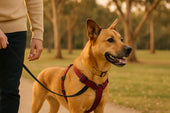
- The safest hands-free setup usually combines a well-fitted harness (often front-clip for pullers) with a belt/lead that has a “quick-release” safety feature. This reduces neck strain and provides a controlled exit option if something goes wrong.
- Shock-absorbing (“bungee”) sections can reduce jarring, but they can also introduce a slingshot effect if a dog lunges; they are best used when the dog already has good lead manners and the handler understands how to manage momentum.
- Australian heat and hot surfaces change what “safe exercise” looks like. RSPCA guidance recommends exercising in the cooler parts of the day and avoiding extreme heat. Hot pavement can burn paws; choose grass and shaded paths.
- A hands-free lead is not a substitute for training. Loose-lead walking improves safety for both dog and handler, and positive reinforcement methods are widely recommended by welfare-focused organisations.
From PetCareShed, with Love for Every Dog
Introduction
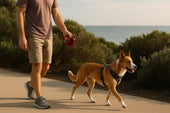
Hands-free dog leads have become a practical option for Australian dog owners who want more comfortable daily walking, steadier control while carrying items, or a safer way to jog with a dog. Rather than gripping a standard handle lead for the entire walk, hands-free designs typically connect your dog to a padded waist belt or cross-body strap, allowing your arms to swing naturally and helping distribute load through your core.
For some owners, the appeal is convenience. For others, it is about managing physical limitations such as wrist or shoulder pain, or balancing a dog walk with a pram, groceries, or mobility aids. However, hands-free walking also changes the mechanics of control. When a dog pulls suddenly, the force transfers to your hips and lower back rather than your hand and forearm. That can be a benefit if the system is set up well and the dog is appropriately trained, but it can also be a risk if the dog is powerful, reactive, or prone to lunging.
This guide focuses on Australia-specific considerations (including heat, common public walking environments, and leash-law realities) and explains how to choose a hands-free dog lead that suits your dog, your body, and your lifestyle. It also explains where hands-free systems can create hazards and how to manage them responsibly.
What Is a Hands-Free Dog Lead (and How It Works)
A hands-free dog lead is any lead designed to be worn on the body rather than held in the hand. The most common styles include:
- Waist-belt leads: A padded belt wraps around the waist (sometimes sitting lower on the hips). The lead clips to the belt via a ring or sliding attachment.
- Cross-body (over-the-shoulder) leads: A strap runs diagonally across the body. Some can be adjusted to sit around the waist.
- Convertible/multi-way leads: A longer lead with multiple rings/clip points that can be configured as hands-free, double-ended, tether, or standard handle lead.
Most hands-free systems have three functional parts:
- Your anchor point (belt or strap)
- The lead line (fixed, adjustable, or with a bungee section)
- The dog connection (usually a clip to a harness or collar)
A well-designed system allows the dog to move naturally without constantly tightening the lead. Many also include a traffic handle (a short handle near the dog end) so you can quickly switch to close control near roads, cyclists, or crowded footpaths.
From PetCareShed, with Love for Every Dog
Why Australians Are Switching to Hands-Free Leads
Australians often walk dogs in mixed-use spaces: suburban footpaths with driveways, shared paths with cyclists, off-lead reserves with signage rules, and beaches where conditions can shift quickly. A hands-free setup can help in these environments when used appropriately.
Benefits in everyday Australian conditions
More stable handling on uneven ground Australia’s walking environments often include gravel tracks, coastal boardwalks, and bushland paths with steps or sand. By keeping both hands free for balance, a hands-free lead can reduce falls.
Less wrist and shoulder strain Standard leads concentrate load in one hand, particularly if the dog forges ahead. With a belt, force distributes through a wider contact area. For some people, that improves comfort and reduces fatigue.
Practical for running and fitness walking Hands-free leads can support a more natural running gait. They also reduce the “arm tug-of-war” that happens when a dog changes pace.
Useful for multi-tasking (without compromising attention) In reality, many owners walk while managing a phone, a child, a pram, or training treats. While attention must remain on the dog and the environment, hands-free systems can make essential tasks (like picking up waste safely) easier.
When hands-free is not the best choice
Hands-free leads are not ideal for every dog-owner combination. They can be a poor match when:
- The dog is highly reactive to other dogs/people.
- The dog frequently lunges at wildlife (common in bushland and coastal areas).
- The dog’s weight and strength exceed the handler’s ability to stabilise via the hips.
- The handler has lower back injuries that can be aggravated by sudden load.
In these cases, a standard lead (or a hands-free system used in cross-body mode with a grab handle) may be safer until training and management improve.
Australian Leash Laws and “Effective Control”: What Matters for Hands-Free Leads
Australia does not have one national leash law. Requirements are set through state/territory legislation and enforced locally by councils and rangers, with signage playing a central role. A consistent theme across jurisdictions is that dogs must generally be restrained in public unless an area is explicitly designated off-lead.
RSPCA Queensland summarises the common position: leash laws require dogs to be on lead in public places unless in designated off-lead areas.
In NSW, the Office of Local Government outlines legal responsibilities for owners and notes that councils must provide at least one off-leash area where dogs can be exercised.
Why “hands-free” still counts as “on lead” (but control is the real test)
A hands-free lead generally meets the concept of being “on lead” because the dog is physically attached to the handler. However, being attached is not the same as being under effective control. Effective control is practical and situational: can you prevent your dog from reaching a passer-by, a child, a cyclist, another dog, or a nesting bird before the situation escalates?
Hands-free systems can help control (by giving you stable leverage), but they can also delay reaction time if:
- the lead attachment point slides around your waist,
- the dog suddenly accelerates and pulls you off-balance,
- you cannot quickly shorten the lead without a traffic handle.
Local rules that influence lead choice
Because councils set local restrictions, hands-free buyers should anticipate:
- Areas requiring short control: shopping strips, school zones, shared paths, and festival areas often demand close, predictable handling.
- Proximity rules near playgrounds and BBQ areas: some jurisdictions and councils enforce stricter rules around these locations.
- Off-lead areas with conditions: many off-lead reserves require dogs to remain under voice control; this is not the same as “anything goes.”
If your hands-free lead cannot shorten quickly, it may not be suitable for the places you walk most.
Who Should Use a Hands-Free Dog Lead (and Who Should Not)
A well-matched hands-free lead can be safe and comfortable for many dogs and owners, but suitability depends on behaviour, body mechanics, and environment.
Good candidates
Hands-free leads often suit:
- Medium to large dogs with reliable lead manners (walking with minimal pulling).
- Owners who walk long distances and want reduced arm fatigue.
- People who train consistently and want both hands available for rewards.
- Runners with dogs that maintain a steady pace and can respond to cues.
Higher-risk candidates (use caution)
Hands-free leads require extra caution for:
- Dogs that lunge (wildlife, other dogs, scooters).
- Dogs that zig-zag and cross in front of the handler.
- Dogs that are newly adopted and still settling.
- Dogs that are fearful, as sudden triggers can cause bolt attempts.
Dogs and owners who may need alternatives
Consider a standard lead or a controlled training setup if:
- The handler has balance issues or frequent lower back pain.
- The dog is very strong relative to the handler.
- The walking route includes narrow footpaths, heavy traffic, or dense crowds.
A hands-free system can still be used in some of these cases, but it should be configured to maximise safety (shorter effective length, reliable quick-release, and a harness with appropriate control points).
Hands-Free Lead Types Explained (Waist, Cross-Body, Convertible)
Waist-belt systems
Waist belts are often preferred for running because they keep the connection near your centre of mass. This can reduce arm strain, but it can increase twisting forces through the hips when a dog changes direction.
Look for:
- wide, padded belt
- secure buckle and stitching
- a sliding ring that moves smoothly (or a fixed ring if you need predictability)
- a secondary safety attachment
Cross-body systems
Cross-body leads distribute load across the torso. Many people find this more comfortable for walking than running, especially when they want the lead connection slightly higher.
Cross-body leads can also be useful in crowded settings because you can shift the strap position and keep the dog closer to your side.
Convertible/multi-way leads
Convertible leads can be used hands-free or as a standard lead. For Australian owners who visit different environments (suburban footpaths one day, bush track the next), versatility can be a major advantage.
However, the trade-off can be complexity. If clips and rings are confusing, mistakes happen—particularly under stress.
Key Features That Matter (and Why)
Many hands-free leads look similar at a glance. The differences that matter are usually in the belt design, the attachment system, and safety features.
1) Quick-release safety mechanism
A quick-release allows you to detach the lead quickly from the belt if you are being pulled off-balance or if the dog becomes tangled. This is a safety feature, not a convenience.
A practical quick-release should be:
- accessible with one hand
- reliable under tension
- resistant to accidental release
2) Shock-absorbing section (bungee)
Shock absorption can reduce sudden jarring forces for both handler and dog. It may be useful when:
- the dog’s pace varies slightly during runs,
- you occasionally encounter sudden stops,
- you want to reduce “snap” on the line.
Limitations: shock absorption can allow the dog to gain momentum before you feel full tension. In reactive or prey-driven dogs, that extra stretch can make lunges more forceful.
3) Adjustable lead length
For Australian walking environments, adjustability is not a luxury; it is often essential.
- Short length suits footpaths, crossings, and shared paths.
- Medium length can suit park loops and wider tracks.
- Longer length may suit low-traffic open spaces where legal and safe.
4) Traffic handle
A traffic handle near the dog end is one of the most underappreciated safety features. It allows immediate close control near:
- busy road crossings
- cyclists and scooters
- other dogs passing closely
- cafes and queues
5) Reflective elements and night visibility
Australian dog owners often walk at dawn or after dark to avoid heat. Reflective stitching, reflective panels, and high-visibility webbing improve safety.
6) Hardware strength and corrosion resistance
Coastal Australia is hard on metal hardware. Salt air and beach walks increase corrosion risk.
Prioritise:
- solid clips with smooth action
- quality stitching at load points
- corrosion-resistant finishes
7) Belt comfort and stability
A belt should sit flat and resist twisting.
- Too narrow: digs in under load.
- Too wide and poorly shaped: can ride up or chafe.
- Poor adjustability: may loosen mid-walk.
Sizing and Fit: Getting the System Right
Hands-free systems can fail in practice because of fit issues rather than “bad products.” A belt that shifts, a harness that rubs, or a lead that is too long can turn a calm walk into a constant struggle.
Belt sizing checklist
- The belt should sit securely without restricting breathing.
- You should be able to rotate your torso without the belt sliding.
- If the belt rides up, try a lower-hip fit (if designed for that) or a cross-body style.
Harness fit checklist (recommended for hands-free use)
A harness is often safer than attaching a hands-free lead to a collar, especially for pullers.
A good harness fit usually means:
- two-finger space under straps
- no rubbing behind elbows
- chest piece sitting correctly (not riding into the throat)
If your dog is between sizes, fit and adjustability matter more than the label size.
Harness vs Collar for Hands-Free Walking (and Why Front-Clip Often Helps)
For hands-free walking, the connection point affects both safety and handling.
Why a harness is often the safer default
If a dog lunges while attached to a collar, the force transfers to the neck. For many dogs, particularly those that pull, this can be uncomfortable and potentially harmful over time. A harness distributes load across the chest and shoulders.
Front-clip harnesses for pullers
Front-clip harnesses are commonly recommended for dogs that pull because the attachment at the chest helps redirect the dog’s body back toward the handler when tension occurs.
The Animal Humane Society provides loose-leash walking guidance that aligns with positive reinforcement training and appropriate handling and equipment choices.
Important nuance: a front-clip harness is not a magic solution. It is a management tool that works best when paired with training.
When a collar can be acceptable
A collar connection can be appropriate for dogs that already walk politely and do not lunge. Many owners still use a harness as the primary attachment and keep the collar as an ID and backup point.
Safety and Biomechanics: Reducing Risk for You and Your Dog
Hands-free walking changes where force goes. Instead of being absorbed by your arm, pulling force transfers into your core and hips. That can be more sustainable in gentle, steady conditions, but it can also create higher risk in sudden events.
Common risk scenarios
1) Sudden lunges toward wildlife In Australian suburbs and bushland, this can include possums at dusk, ducks near wetlands, or lizards on tracks.
Mitigation:
- use a shorter effective length in high-risk zones
- choose a lead with a traffic handle
- train emergency cues (stop, turn, “leave it”)
2) The “clothesline” effect on shared paths If the dog drifts wide and the lead crosses a path, it can create a hazard for cyclists and runners.
Mitigation:
- choose a system that naturally keeps the dog close (shorter length, side attachment)
- use a clear walking position (left or right)
- move off the path when others approach
3) Falls on uneven surfaces A strong pull can twist your hips and compromise balance.
Mitigation:
- avoid hands-free on steep or technical tracks unless the dog is reliable
- keep your dog on the same side consistently
- choose footwear with traction
Subtle but important technique changes
Small handling habits make a real difference:
- Keep the dog slightly behind your hip line rather than forging ahead.
- Avoid long, stretchy leads in busy environments.
- Use your body to turn rather than letting the dog pivot you.
Running With a Dog in Australia: Practical Considerations
Running with a dog can be rewarding, but it requires extra attention to environment and pacing.
Heat, humidity, and safe timing
RSPCA guidance advises avoiding exercise in extreme heat and walking dogs early morning or late evening on hot days.
In many parts of Australia, especially in summer, running after sunrise can quickly become risky. Conditions that matter include:
- temperature
- humidity
- radiant heat from pavement
- lack of shade
Paw safety on hot surfaces
Hot bitumen and concrete can burn paws. When in doubt, choose grass, dirt tracks, or shaded paths.
Hydration and recovery
For longer sessions, carry water and offer frequent breaks. Dogs do not sweat like humans and rely heavily on panting for cooling, which becomes less effective in heat and humidity.
Breed and body-type considerations
Some dogs are better suited to running than others.
Use extra caution with:
- brachycephalic breeds
- older dogs
- dogs carrying excess weight
- dogs with known joint issues
If a dog struggles to keep pace, lags, or pants excessively, end the session and cool down.
Choosing the Best Hands-Free Dog Lead: A Decision Framework
The “best” hands-free dog lead in Australia is the one that fits your dog’s behaviour, your walking environment, and your comfort needs.
Step 1: Identify your primary use
- Suburban daily walking
- Running (road or trail)
- Hiking and bush tracks
- Multi-dog walking
- Training and socialisation outings
Step 2: Assess your dog’s pulling and reactivity
Be honest. If your dog still pulls hard, prioritise:
- front-clip harness compatibility
- traffic handle
- short length control
- quick-release
Step 3: Map your typical route
Consider:
- shared paths and cyclists
- schools/playgrounds
- wildlife hotspots
- beach/salt exposure
Step 4: Choose the configuration
- Waist belt for stable running
- Cross-body for comfortable walking and easy reach
- Convertible lead if you need flexibility
Comparison Table: Hands-Free Lead Styles (What Suits Which Situation)
| Style | Best for | Main advantage | Key risk | What to prioritise |
|---|---|---|---|---|
| Waist-belt lead | Fitness walking, steady runners | Stable centre-of-mass control | Hip/lower-back twist during lunges | Wide padded belt, quick-release, traffic handle |
| Cross-body lead | Urban walking, variable pace | Comfort across torso, easy to shorten | Can slide if poorly adjusted | Non-slip strap, adjustable length, grab handle |
| Convertible multi-way | Mixed environments, travel | Versatile configurations | Complex clips/incorrect setup | Clear ring layout, durable hardware, simple adjustments |
| Bungee/shock-absorbing lead | Experienced walkers/runners | Less jarring under mild tension | Extra momentum during lunges | Moderate stretch, strong hardware, use with trained dogs |
Training for Hands-Free Success: Loose-Lead Walking That Protects Bodies
A hands-free lead performs best when the dog understands where to walk and how to keep slack in the line. Without that, even the best belt can become uncomfortable.
The Animal Humane Society’s guidance for teaching loose-leash walking emphasises positioning and consistency.
Practical training principles
Reward the position you want When your dog is near your chosen side with slack in the lead, reward promptly. That builds a habit.
Stop moving when the lead goes tight This is a clear, consistent consequence: pulling does not lead to forward progress.
Change direction calmly If your dog surges, turn and walk the other way. The dog learns that staying with you is what keeps the walk flowing.
A simple hands-free training plan (two weeks)
- Days 1–3: short indoor sessions; reward walking beside your hip; practise gentle turns.
- Days 4–7: quiet outdoor area; stop for tight lead; reward slack.
- Days 8–14: gradually add distractions (quiet park edges first); incorporate a traffic handle hold near crossings.
Keep sessions short and end on success. A calm dog learns faster than an exhausted, overstimulated one.
Multi-Dog Walking: Is Hands-Free Ever Appropriate?
Walking two dogs hands-free can be done, but it is not automatically safer or easier. It depends on training, dog compatibility, and the hardware setup.
When it can work
- both dogs walk politely and do not compete
- both dogs respond to cues
- you use a belt with stable attachment points
When it should be avoided
- dogs tangle leads often
- one dog is reactive
- large strength difference between dogs
A practical compromise is to walk one dog hands-free and the other with a standard lead until both have reliable manners.
Australian Environment Factors: Beaches, Bush Tracks, and Wildlife
Beach walking
Beach conditions change lead performance:
- sand increases drag and fatigue
- salt accelerates hardware corrosion
- crowds can appear quickly near access points
Use shorter control near entrances and consider rinsing gear after beach use.
Bush tracks and national parks
Wildlife is a realistic trigger. Even well-trained dogs may react to sudden movement.
In addition, some reserves and national parks have restrictions on dogs. Always check signage and relevant park rules.
Suburban wildlife at dusk
Possums and cats are common triggers in many Australian neighbourhoods. Dusk walks are also popular for avoiding heat, which can create a “perfect storm” for sudden lunges. This is where traffic handles and short control options matter most.
Selecting Materials and Hardware for Australian Conditions
Webbing and stitching
- Look for dense, abrasion-resistant webbing.
- Inspect stitching at load points (multiple rows are preferable).
Clips and rings
- Choose clips that operate smoothly.
- Avoid lightweight hardware for strong dogs.
Cleaning and maintenance
A basic maintenance routine improves safety:
- rinse after beach or muddy trails
- air dry out of direct sun
- check stitching and clips monthly
Small failures (like a slightly bent clip spring) can become serious failures under load.
Recommended Related Products from PetCareShed
The following product categories are commonly paired with hands-free leads to improve comfort and safety. Selection should be based on your dog’s size, behaviour, and the environments you use most.
- Hands-free waist-belt dog lead (adjustable length): useful for fitness walking and steady running, particularly when paired with a harness.
- Convertible multi-way dog lead: suitable for owners who move between busy footpaths and open park trails, allowing quick reconfiguration.
- Shock-absorbing dog lead: can reduce jarring for trained dogs that maintain a steady pace.
- Front-clip dog harness: often helpful for dogs that pull, supporting better steering and reducing strain.
- Back-clip dog harness with handle: useful for hiking, car transitions, and controlled movement through crowds.
- Reflective dog lead and harness accessories: valuable for early morning and evening walking.
- Portable travel bowl and water bottle: supports hydration during longer walks and warm weather.
- Cooling mat: helpful for post-walk recovery in warm months, especially in homes without strong air circulation.
- Dog paw balm: may help support paw pad condition for frequent walkers (not a substitute for avoiding hot surfaces).
Hands-Free Lead Setup: A Safe Starting Configuration
For many Australian households, a conservative and practical starting setup looks like this:
- Dog wears a well-fitted harness (front-clip if pulling is an issue).
- Lead clips to the harness (primary connection).
- Belt attachment includes a quick-release (or a simple method to detach quickly).
- Lead has a traffic handle and can shorten near roads.
If your dog is strong or unpredictable, start by using the hands-free setup in low-distraction areas. In busy places, hold the traffic handle or use the system as a standard lead.
Common Mistakes to Avoid
- Using hands-free with an untrained puller in busy areas. This often leads to falls and frustration.
- Choosing too much length “for freedom.” In urban areas, extra length often creates hazards.
- Relying on bungee stretch to manage pulling. Stretch is not training.
- Attaching to a collar for a dog that lunges. This can increase neck strain.
- Ignoring belt fit. A twisting belt increases discomfort and reduces response time.
Troubleshooting: If Hands-Free Walking Feels Hard
Problem: The belt rides up and twists
Possible fixes:
- tighten and reposition lower
- switch to a wider belt
- try cross-body configuration
Problem: The dog crosses in front and tangles you
Possible fixes:
- train a consistent side (“left” or “right”)
- shorten the lead
- reward position near your hip
Problem: You feel lower back strain
Possible fixes:
- reduce tension by improving loose-lead skills
- avoid bungee if it increases surging
- try cross-body distribution
- consider a lighter dog-handling strategy until conditioning improves
Problem: The dog lunges at triggers
Possible fixes:
- stop using hands-free in high-trigger zones
- work on distance-based training
- use management: shorter lead, traffic handle, calmer routes
Where reactivity is significant, professional training support is often the safest path.
FAQ
Are hands-free dog leads legal in Australia?
Generally, a hands-free lead still counts as having your dog “on lead” because your dog is physically attached to you. However, legal compliance is not only about attachment; it is about effective control and following local signage. RSPCA Queensland notes that leash laws require dogs to be on lead in public places unless in designated off-lead areas.
Because rules vary by council and location, check local signage and council information for the areas you use.
Do councils allow hands-free leads on shared paths?
In many areas, yes—provided your dog is on lead and under control. The practical issue on shared paths is whether the setup creates a hazard for cyclists and runners. A shorter lead length and keeping your dog close to one side helps reduce risk.
Is a waist-belt lead better than a cross-body lead?
Neither is universally “better.” Waist belts tend to suit steady movement and running because they anchor near your centre of mass. Cross-body straps often feel more comfortable for walking and may reduce twisting for some people. The best choice depends on your body, your dog’s movement patterns, and your environment.
Should a hands-free lead attach to a collar or harness?
For most dogs, especially pullers, a harness is the safer option because it distributes load away from the neck. A collar attachment may be acceptable for dogs that already walk politely and do not lunge.
Are shock-absorbing (bungee) leads safer?
They can reduce jarring when the dog’s pace varies slightly, but they can also allow extra momentum before the lead tightens. For dogs that lunge, that can worsen the force of a sudden pull. Many owners find bungee sections most helpful when the dog already has good lead manners.
What lead length is best for Australian footpaths?
A shorter effective length is usually safest for footpaths, crossings, and busy suburban areas. Adjustable leads are useful because you can shorten near hazards and lengthen slightly in quieter, open areas.
Can you run with a dog in the Australian summer?
Sometimes, but it requires strict management. RSPCA Australia advises avoiding exercise in extreme heat and walking dogs early morning or late evening on hot days.
If conditions are hot, humid, or the ground is very warm, it is often safer to skip the run and provide indoor enrichment instead.
How can you tell if the pavement is too hot for paws?
If the surface feels uncomfortably hot to your hand, it can be too hot for paws as well. Choose grass and shaded routes, particularly in summer.
Are hands-free leads suitable for puppies?
They can be, but puppies are unpredictable and may zig-zag or stop suddenly. A convertible lead used in standard-hand mode (with a short length) is often a safer starting point. As lead manners improve, hands-free can be introduced gradually.
Are hands-free leads suitable for reactive dogs?
They can increase risk if the dog lunges or spins quickly. Many reactive dogs benefit from a more direct, hand-held setup while training is underway, particularly in busy environments. If hands-free is used, keep the lead short, use a traffic handle, and avoid high-trigger locations.
What is the safest way to transition to hands-free walking?
- Start in a quiet area with minimal distractions.
- Use a harness and an adjustable lead.
- Practise stopping when the lead tightens and rewarding slack.
- Use the traffic handle near roads and when passing others closely.
How do you prevent being pulled over with a hands-free lead?
- keep the lead shorter in busy areas
- choose a stable belt that does not twist
- avoid high-stretch bungee for a dog that lunges
- train loose-lead walking consistently
If your dog’s strength is likely to overpower your balance, a hands-free system may not be appropriate until training improves.
What should you look for in hardware for beach use?
Coastal air and salt exposure can corrode metal components. Look for corrosion-resistant hardware, rinse after beach walks, and inspect clips regularly.
Can you use a hands-free lead with a pram?
It is sometimes used for this purpose, but it requires careful management. Risks include tangles, sudden pulls affecting pram stability, and limited ability to step aside quickly. If attempting this, keep the dog close, use a traffic handle, and choose quiet routes.
How often should you replace a hands-free lead?
Replace if you see:
- frayed webbing
- loose stitching
- cracks in buckles
- clip springs that do not close smoothly
Even without visible damage, high-use leads in sandy or salty conditions should be inspected frequently.
Is it safe to tether a dog to your body in an emergency?
If a dog panics (for example, from fireworks), being physically attached can prevent escape, but it can also create risk of you being pulled. A quick-release feature and calm handling are important. For known noise anxiety, plan ahead with secure management strategies.
Final Notes: What “Best” Really Means
The best hands-free dog lead in Australia is not simply the most padded or the most feature-rich. It is the one that supports effective control, suits Australian walking realities (heat, shared paths, wildlife), and feels comfortable enough that you can use it consistently.
Prioritise safe fundamentals—fit, hardware quality, quick-release capability, and training—then choose the configuration that matches how you and your dog actually move through the world.