
Key Takeaways
- Fit problems cause most “bad harness” reviews. In Australian households, many complaints about rubbing, chafing, refusal to walk, or “my dog pulls more” can be traced to sizing and strap placement rather than the harness style itself.
- Breed shape matters more than body weight. Two dogs of the same weight can need different harness shapes due to chest depth, shoulder width, neck thickness, coat density, and waist tuck.
- A harness should stabilise, not immobilise. Front straps that sit too close to the armpit, or panels that cross the shoulder, can affect comfort and may alter gait during longer walks.
- Brachycephalic dogs need throat clearance. Flat-faced breeds already work harder to breathe; a harness that rides up onto the neck undermines the key benefit of harness use.
- Australia’s heat changes the rules. Heavy padding, thick neoprene, and dark fabrics can trap heat; fit checks should include heat and skin checks after walks.
- A “two-finger check” is necessary but not sufficient. It helps prevent tightness, but you also need to confirm strap location, symmetry, and whether the harness rotates during movement.
- The best harness is the one your dog can move naturally in. Look for free shoulder movement, stable back panel position, and no rubbing under the front legs during a normal walk.
Shop the PetCareShed Dog Collection
Introduction
Dog harness reviews in Australia are often polarised. One owner will describe a harness as life-changing, while another calls the same style “useless” or “cruel”. In many cases, both opinions are sincere—and both are explainable. Harness performance depends heavily on fit, and fit is influenced by breed anatomy in ways that standard size charts cannot fully predict.
Australian dogs also live and exercise in conditions that amplify small fitting errors. Heat, humidity, sandy coat contamination, high UV exposure, and common outdoor hazards (bindis, grass seeds, hot pavements and rough bush tracks) can turn a minor rub point into a skin injury. When a harness twists, rides up, or pinches, the dog may pull harder, freeze, scratch at the straps, or develop aversion to being harnessed.
This guide reviews dog harness fit problems through a practical, breed-informed lens. It focuses on the most common mistakes seen in real-world reviews—particularly the issues that are frequently misdiagnosed as “poor quality” when the underlying cause is adjustment, style mismatch, or an incorrect measurement.
How to Read Dog Harness Reviews (So They Actually Help)
Harness reviews can be useful, but only if they are interpreted correctly. Many reviews describe outcomes (“it rubs”, “my dog escaped”, “stopped pulling”) without describing the dog’s body shape, coat type, or how the harness was adjusted.
When assessing reviews for your own dog, look for:
- Dog profile details: breed (or mix), weight, age, and whether the dog is lean, barrel-chested, deep-chested, or has a thick neck.
- Coat notes: short coat, double coat, or long coat—important for overheating and friction.
- Activity type: quick suburban toilet walks, long bush walks, running, hiking, or training.
- Behaviour context: fearful dogs, leash-reactive dogs, or strong pullers may load the harness differently.
- Fit and adjustment evidence: reviewers who mention measurements, strap placement, and re-adjustments tend to provide more reliable insights.
A recurring pattern in negative reviews is that the harness was fitted once, over clothing or a thick coat, and never rechecked as the dog’s weight, coat, or conditioning changed.
Your Dog’s Happiness Starts Here — at PetCareShed
Harness Basics: Styles and What They Mean for Fit
In Australian retail, you will most commonly see these harness families:
- Y-front (often called “Y-shape” or “Y chest”): Straps form a Y on the front of the chest.
- H-front (sometimes “Roman”, “Norwegian”, or “strap harness”): A horizontal strap crosses the front of the chest with another strap behind the front legs.
- Step-in harness: The dog steps into two loops; typically suitable for calmer dogs and short, controlled walks.
- Vest harness: More fabric coverage; can help with sensitive skin but can also trap heat and sand.
- No-pull / training harness variants: Usually a front-clip configuration, sometimes with additional control points.
Style alone does not guarantee comfort. Even a well-regarded style can be a poor match if the chest plate sits too low, the girth strap sits too close to the armpit, or the back panel is too short for the dog’s proportions.
What “Good Fit” Looks Like (Beyond the Two-Finger Rule)
Australian animal welfare guidance commonly recommends the two-finger space check to ensure a harness is not overly tight. For example, RSPCA South Australia advises that a harness should be adjusted comfortably and that you should be able to fit two fingers beneath it for comfort and safety (and it provides practical guidance on fitting steps). Sources like this are useful, but fit requires more than strap tightness alone. (Citation: https://www.rspcasa.org.au/fitting-walking-harness-dogs/)
A well-fitted harness should meet these functional checkpoints:
- Neck strap sits low at the base of the neck (not up near the throat).
- Chest pieces sit on bone and muscle, not across the soft throat area.
- Girth strap sits behind the front legs with enough clearance to avoid armpit rub.
- Harness does not rotate when the dog turns or leans.
- Full range of shoulder movement without straps cutting into the shoulder joint.
- Hardware placement avoids pressure points, especially on the spine.
Quick Fit Checklist (Practical)
- After fitting, walk your dog at a normal pace for 3–5 minutes.
- Check these areas immediately after removal:
- Armpits
- Chest sternum
- Behind elbows
- Top of shoulders
- Along the spine where clips sit
- Watch for:
- Redness
- Hair breakage
- Warm, damp patches (heat build-up)
- The dog licking or scratching one area repeatedly
The Most Common Fit Mistakes Seen in Australian Harness Reviews
Mistake 1: Measuring the Wrong Parts of the Dog
The most frequent source of incorrect sizing is measuring mid-neck instead of the base of neck, or measuring chest too far forward. Harness sizing generally relies on:
- Neck girth at the base of neck (near shoulders)
- Chest girth at the widest point behind the front legs
If measurements are taken too high on the neck, the harness may ride up and press the throat. If the chest is measured too far forward, the girth strap ends up in the armpit zone.
Mistake 2: Buying by Weight or Breed Alone
Reviews often say: “I bought a Medium because my dog is 20 kg.” Unfortunately, weight doesn’t describe:
- chest depth
- shoulder width
- neck thickness
- coat thickness
- waist tuck
A deep-chested 20 kg dog can need a very different harness shape from a stockier 20 kg dog.
Mistake 3: Straps Sit Too Close to the Armpit
Armpit rub is one of the most common complaints in reviews and one of the easiest to prevent. It typically happens when:
- the girth strap sits too far forward
- the harness back panel is too short
- the dog has a long stride and the strap intersects movement
Even “soft” webbing can abrade skin when combined with sand, moisture, and repetitive motion—conditions common in coastal Australia.
Mistake 4: The Harness Rides Up Onto the Neck
A harness that rides up defeats the purpose for dogs with airway sensitivity, small breeds, and brachycephalic breeds. Some reviewers interpret riding up as “it’s too small”, but it can also mean the chest strap is too low or the design is not suited to that chest shape.
Mistake 5: Uneven Adjustment (Twist and Drift)
If one side is tighter than the other, the harness will rotate. Rotation increases escape risk and creates concentrated friction points.
A practical adjustment method:
- Tighten each side one step at a time, alternating left and right.
- Recheck after a short walk.
- Confirm the back panel remains centred.
Mistake 6: Confusing “Snug” with “Restrictive”
A harness should be snug enough to prevent rotation and escape, but not so tight that it compresses tissue or restricts rib expansion. Dogs need chest expansion for normal breathing during exercise.
Mistake 7: Ignoring Seasonal Coat and Weight Changes
In Australia, coat thickness can change markedly across seasons, and many dogs fluctuate in weight. A harness that was comfortable in winter can become tight in summer if the dog gains weight, or it can become loose if the dog loses weight due to increased activity.
Breed-by-Breed: Common Harness Fit Mistakes (Australian Context)
Breed categories below are based on body shape tendencies. Individual dogs vary, especially crossbreeds.
Brachycephalic Breeds (French Bulldogs, British Bulldogs, Pugs, Boston Terriers)
Brachycephalic dogs are over-represented in harness reviews because small fit mistakes can quickly show up as breathing noise, reluctance to walk, or over-heating.
Common mistakes in reviews:
- Harness sits high and loads the throat when the dog leans
- Neck opening is too small, forcing the harness to be pulled over the head tightly
- Chest plate sits too low and pushes back during movement
Fit guidance:
- Aim for a harness that sits low on the neck (base of neck near shoulders), leaving clear space around the throat.
- Ensure the chest piece rests on the sternum rather than soft throat tissue.
- Choose materials that do not trap heat.
Why this matters:
Neck pressure can worsen coughing and breathing difficulty in dogs with airway sensitivity. General canine guidance notes that collars concentrate pressure on the neck, while harnesses distribute force across the body, which is one reason harnesses are often preferred for dogs prone to pulling. (Citation: https://gentlemodernschoolofdogtraining.com.au/Collar-vs-Harness)
Sighthounds and Deep-Chested Lean Breeds (Greyhounds, Whippets, Salukis)
Sighthounds commonly appear in “escape” harness reviews. Their anatomy—deep chest, narrow waist, comparatively small head—means a harness can slide backwards or rotate if not designed to stabilise on a narrow frame.
Common mistakes in reviews:
- Back panel too short; girth strap creeps into the armpit
- Neck opening too large; the dog slips out when reversing
- Step-in harness shifts sideways due to narrow chest
Fit guidance:
- Prioritise anti-rotation stability: wide back contact and well-positioned girth strap.
- Confirm the harness remains centred during turns.
- For anxious dogs that reverse or “back out”, consider additional security features (such as a second strap design) if appropriate.
Bull Breeds and Muscular Stocky Dogs (Staffies, AmStaffs, American Bulldogs)
Muscular, barrel-chested dogs frequently generate “rubs under arms” and “hard to fit the neck” reviews. Many have thick necks with a chest that expands quickly behind the legs.
Common mistakes in reviews:
- Neck opening too tight because the dog’s neck is thick
- Straps twist under load due to narrow webbing
- Chest strap sits too high and interferes with the shoulder area
Fit guidance:
- Seek wide, stable straps that resist twisting.
- Make sure the girth strap sits far enough back to avoid elbow/armpit interference.
- Recheck fit after exercise, because muscular dogs often “fill out” through the shoulders and chest over time.
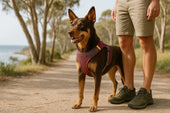
Herding Breeds (Border Collies, Kelpies, Australian Cattle Dogs)
These breeds are often athletic, high-drive, and prone to repetitive, fast movement. A harness that is “fine on a short walk” can cause problems on longer sessions or training days.
Common mistakes in reviews:
- Harness restricts shoulder reach during running
- Back clip sits too far forward and causes twisting during sharp turns
- Owners choose heavy padded styles that trap heat
Fit guidance:
- Confirm full stride range: the front straps should not cut into the shoulder joint.
- Use breathable materials suitable for Australian heat.
Heat risk is not theoretical. Australian research and guidance show that dogs are vulnerable to heat stress, and risk rises with hotter days. UNSW reporting on veterinary data notes that mortality risk increases with temperature, and that extreme heat days substantially elevate risk. (Citation: https://www.unsw.edu.au/newsroom/news/2025/07/extreme-heat-linked-to-increased-pet-dog-deaths)
Retrievers and Medium-Large Family Dogs (Labradors, Golden Retrievers)
These dogs often have broad chests and strong pulling capacity, which can magnify small fit errors.
Common mistakes in reviews:
- Harness rotates when dog pulls due to loose neck or uneven straps
- Girth strap too loose, allowing “backing out”
- Owners use a front-clip without training, leading to frustration and awkward gait
Fit guidance:
- Focus on symmetry and stability.
- If using a front-clip configuration, introduce it gradually and combine with leash skills.
Small Breeds and Toy Dogs (Cavoodles, Maltese, Chihuahuas, Mini Dachshunds)
Small dogs are at higher risk of neck injury from collar pressure and leash jerks because their neck structures are small and delicate. Harnesses are often recommended, but only when fit prevents rubbing and spinal loading.
Common mistakes in reviews:
- Harness too bulky; dog overheats or “shuts down”
- Straps sit across fragile shoulder areas
- Dachshund-style long backs cause back panel mismatch
Fit guidance:
- Choose light, breathable designs.
- Ensure back hardware does not sit directly on the spine.
- For long-backed dogs, ensure the harness length suits the body and the girth strap sits in the correct position.
General guidance on tracheal risk indicates that collar pressure can contribute to coughing and neck strain, and harnesses can reduce direct neck loading by distributing pressure over the chest and back. (Citation: https://gentlemodernschoolofdogtraining.com.au/Collar-vs-Harness)
Giant Breeds (German Shepherds, Great Danes, Mastiffs)
Large dogs often create reviews focused on durability and control. Fit remains crucial because a poorly placed strap can create significant force on a small area.
Common mistakes in reviews:
- Harness too loose “for comfort”, which increases rotation and escape risk
- Front chest straps rub due to long stride
- Back clip sits too far forward, pulling the harness into the shoulders
Fit guidance:
- Aim for a snug, stable fit without pressure points.
- Confirm strap placement during normal walking and during turns.
A Practical Fit Diagnostic: What the Complaint Usually Means
| Review Complaint | Most Likely Fit Cause | Quick Check | Typical Fix |
|---|---|---|---|
| “It rubs under the arms” | Girth strap too far forward; back panel too short | Look for redness behind elbows | Reposition/resize; adjust rearward |
| “It rides up and chokes” | Neck strap too high; chest strap too low | Does the front sit near throat? | Lower neck position; style change |
| “My dog escaped” | Loose neck; rotation; narrow frame mismatch | Try gentle reverse step test | Tighten evenly; more secure design |
| “It twists sideways” | Uneven strap length; wrong size | Is back panel off-centre? | Reset adjustments; re-measure |
| “My dog walks weird in it” | Shoulder restriction; front strap placement | Watch front leg reach | Adjust; choose less restrictive cut |
| “Too hot / sweaty” | Heavy fabric; poor ventilation; tight fit | Warm damp patches post-walk | Breathable material; lighter coverage |
Australia-Specific Considerations: Heat, Sand, Burrs, and Water
Australian conditions can make harness choice and fit more consequential than many overseas guides acknowledge.
Heat Stress and Exercise Timing
Government and veterinary guidance in Australia consistently advises avoiding exercise during hot, humid conditions and walking dogs during cooler times of day. Animal Welfare Victoria warns against forcing pets to exercise in hot, humid weather and notes dogs can heat up quickly due to proximity to hot surfaces. (Citation: https://agriculture.vic.gov.au/livestock-and-animals/animal-welfare-victoria/dogs/health/heat-and-pets)
Harness implications:
- Dark, thick materials can contribute to heat build-up.
- A too-tight harness can limit normal chest expansion during panting.
- Brachycephalic and overweight dogs require extra caution.
Coastal Sand and Salt
Sand trapped under straps can cause abrasive rubbing. Saltwater can stiffen some materials if not rinsed.
Practical steps:
- Rinse harnesses after beach use.
- Check armpits and sternum for gritty residue.
- Allow harness to dry fully to reduce skin irritation.
Grass Seeds and Burrs (Seasonal)
In many regions, grass seeds and prickly burrs can lodge under straps, especially in long-coated dogs. Fit that is “slightly loose” increases the chance of debris collecting.
How to Fit a Harness Step-by-Step (Reliable Method)
- Measure correctly
- Neck girth: base of neck near shoulders
- Chest girth: widest point behind front legs
- Choose the closest size based on measurements, not weight.
- Fit the harness and set a baseline
- Even strap lengths left and right
- Perform a movement check
- Walk forward, turn, stop, and gently step backwards
- Check contact points
- Armpits, sternum, shoulders, and spine
- Recheck after 3–5 days
- Minor adjustments are normal as straps settle
RSPCA South Australia’s fitting guidance supports the idea of an initial fit plus comfort checks, including the two-finger space principle. (Citation: https://www.rspcasa.org.au/fitting-walking-harness-dogs/)
When a Harness Is the Wrong Tool (And What to Do Instead)
Harnesses are not automatically better for every situation. A dog that panics when restrained, has untreated pain, or has severe skin disease may need a different approach.
Consider veterinary advice if:
- your dog shows pain when harnessed
- there is persistent coughing, gagging, or noisy breathing
- skin lesions appear under straps
- the dog’s gait changes significantly
For some dogs, a combination of:
- a properly fitted harness
- calm desensitisation to wearing gear
- leash training and reinforcement of loose-lead walking
will produce safer outcomes than switching products repeatedly.
Recommended Related Products from PetCareShed
The following product categories are commonly useful alongside harness fitting and adjustment, particularly under Australian conditions:
- Adjustable dog harness (multiple adjustment points): Helps achieve symmetry and reduce rotation for deep-chested and muscular breeds.
- Breathable mesh dog harness: Useful for warm climates and for dogs prone to overheating or skin irritation.
- Front-clip training dog harness: Can support loose-lead training when introduced gradually and fitted to avoid shoulder restriction.
- Long training leash: Allows controlled practice of loose-lead walking without constant tension that can distort harness fit.
- Reflective dog leash and reflective accessories: Helpful for early morning or evening walks during hotter months.
- Cooling mat: Supports post-walk cooling on warm days, particularly for brachycephalic and thick-coated dogs.
- Portable water bowl: Encourages hydration on longer walks and outings.
- Dog grooming brush and de-shedding tools: Coat maintenance reduces matting under straps and improves airflow near the skin.
What a “Good” Harness Review Should Mention (A Template)
If writing or evaluating a review, these details make the feedback meaningful:
- Dog’s breed, weight, and body shape (deep chest, narrow waist, thick neck)
- Measurements used (neck base and chest girth)
- Harness style and where the front strap sits
- How the dog behaves in it (normal walk, run, turn)
- Any skin or coat issues after a 20–30 minute walk
- Climate conditions (hot day, beach, wet weather)
This level of detail helps other Australian owners select a harness that suits their dog’s anatomy rather than relying on generic sizing assumptions.
Detailed FAQ: Dog Harness Fit Mistakes by Breed (Australia)
FAQ
1) How tight should a dog harness be?
A harness should be snug enough that it does not rotate or allow escape, but not tight enough to compress tissue. A common comfort guideline is being able to fit two fingers under the straps, as reflected in RSPCA South Australia’s fitting advice. (Citation: https://www.rspcasa.org.au/fitting-walking-harness-dogs/)
2) Why does my dog’s harness rub under the arms?
Most armpit rubbing happens because the girth strap sits too far forward or the harness back panel is too short for your dog’s body. Sand, moisture, and repetitive motion can worsen rubbing quickly in Australia. Re-measure chest girth, adjust the harness rearward if possible, and check after a short walk.
3) My dog can back out of the harness—what does that mean?
It often indicates the neck opening is too loose, the harness rotates, or the harness is not designed to stabilise on a narrow frame (common in sighthounds and some mixes). Perform a controlled “reverse step” test in a safe area and adjust evenly. If the dog regularly reverses when startled, a more secure design may be needed.
4) Are harnesses better than collars for dogs that pull?
Harnesses can reduce direct pressure on the neck by distributing force across the chest and back, which is why they are often chosen for pullers and dogs with airway sensitivity. Guidance discussing collar pressure and tracheal strain supports the general principle that concentrated neck pressure can be problematic, particularly with jerking or persistent pulling. (Citation: https://gentlemodernschoolofdogtraining.com.au/Collar-vs-Harness)
5) Why does the harness ride up and look like it is choking my dog?
Riding up usually means the neck strap is sitting too high, the chest piece is positioned too low, or the design does not match your dog’s chest shape. This is a frequent issue in brachycephalic breeds. Refit with the neck strap lower at the base of the neck and confirm the chest piece sits on the sternum.
6) Can a harness affect the way my dog walks?
Yes. If straps cross too close to the shoulder joint or pinch behind the elbows, some dogs shorten their stride or move awkwardly, especially during longer walks or running. A proper fit should allow natural shoulder extension and a centred, stable back position.
7) What harness is best for a French Bulldog or Pug in Australia?
Prioritise throat clearance, stability (to prevent riding up), and breathable materials to reduce heat build-up. Walk during cooler times and monitor for overheating signs. Extreme heat risk is well documented in Australia, including increased risk on hotter days. (Citation: https://www.unsw.edu.au/newsroom/news/2025/07/extreme-heat-linked-to-increased-pet-dog-deaths)
8) Should I stop walking my dog in hot weather if they wear a harness?
In hot and humid conditions, reduce or avoid strenuous exercise regardless of gear. Animal Welfare Victoria advises never forcing pets to exercise in hot, humid weather and highlights how quickly dogs can heat up near hot surfaces. (Citation: https://agriculture.vic.gov.au/livestock-and-animals/animal-welfare-victoria/dogs/health/heat-and-pets)
9) How often should I recheck harness fit?
Recheck fit:
- after the first 2–3 walks (straps settle)
- after grooming or coat changes
- after weight change
- before long hikes or holiday travel
A monthly quick check is sensible for most dogs.
10) My dog hates the harness—does that mean it doesn’t fit?
Not always. Poor fit is common, but aversion can also come from:
- fear of being handled
- discomfort from past rubbing
- painful joints or skin conditions
- the harness being put on roughly or too quickly
Improve the experience by introducing the harness gradually, pairing it with calm reinforcement, and ensuring the dog can move naturally once it is on.
11) Can I leave a harness on all day?
It is usually better to remove harnesses when the dog is unsupervised. Constant wear can increase matting, rubbing, and moisture build-up, particularly in warm or humid Australian conditions.
12) What is the single biggest mistake owners make with harnesses?
Buying the wrong size or shape based on weight or breed label, then attempting to “make it work” by overtightening. Measuring correctly and choosing a design suited to your dog’s chest and shoulder structure prevents most issues.