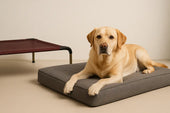

Key Takeaways
- Prioritise joint support first, then durability. Labradors are a large, active breed and are predisposed to orthopaedic conditions such as hip and elbow dysplasia, which can progress to arthritis over time. A bed that keeps the spine level and reduces pressure points is a practical investment in comfort.
- Correct sizing prevents most “my dog won’t use the bed” problems. Measure your Labrador and choose a bed that is roughly 10–25% longer than their nose-to-tail-base length, then match the bed style to how they sleep (curl, lean, sprawl).
- In Australian conditions, temperature and hygiene matter as much as cushioning. Breathable covers, moisture control, and easy washability reduce odour and skin irritation risk—especially in humid coastal areas and during wet winters.
- Look for construction details that survive real Labrador behaviour. Strong seams, dense foam that resists flattening, non-slip bases, and replaceable covers typically outperform “soft and fluffy” beds for daily use.
- Choose the bed type to match the dog’s life stage. Puppies need accident-friendly materials; adults benefit from resilient support; seniors often do best with orthopaedic or low-entry designs.
Recommended by PetCareShed: Smart Choices for Every Dog Owner
Introduction
Labrador Retrievers have earned a strong reputation in Australia for good reason. They tend to be affectionate, social, family-oriented, and ready for activity at almost any time of day. That same enthusiasm, however, has practical consequences for bedding. Labradors are typically medium-to-large dogs with substantial body weight, strong shoulders and hips, and a habit of throwing themselves down to rest after play. Over years, that combination can flatten poorly designed beds, stress joints that are already vulnerable, and create hygiene issues when coats are damp from beach walks, rain, or backyard sprinklers.
Choosing the best dog bed for a Labrador is not about finding the softest surface. A bed should support the body evenly, help the dog rise and lie down with minimal strain, remain stable on Australian flooring, and cope with the wear-and-tear of daily life—mud, shedding, drool, and the occasional enthusiastic “dig” before settling.
This guide explains what “supportive and durable” means in real-world terms for Labradors in Australia. It also provides a practical framework for selecting bed types based on age, size, climate, and behaviour, plus cleaning guidance and a detailed FAQ.
Why Labradors Need Supportive, Durable Beds (Not Just a Soft Cushion)
A Labrador’s bed does more than provide a resting spot. It influences sleep quality, skin comfort, joint load, and even how easily the dog transitions from lying to standing. These factors become more important as the dog ages, gains weight, or develops orthopaedic changes.
Labrador joint risks and why bedding matters
Labradors are widely recognised as predisposed to hip and elbow dysplasia. Large-scale analyses report high prevalence figures in Labrador populations; for example, a study of Rottweilers and Labrador retrievers reported hip dysplasia prevalence in Labradors of 31% and elbow dysplasia prevalence of 19% in the evaluated population.
Additionally, the Universities Federation for Animal Welfare (UFAW) notes that fragmented medial coronoid process (a form of elbow dysplasia) is a common disease in Labradors and is thought to affect 17–21% of the breed in the referenced context.
These conditions can contribute to discomfort, altered gait, and secondary osteoarthritis. While a bed cannot prevent dysplasia, appropriate support can reduce daily mechanical stress during rest and can make it easier for a sore dog to settle and to stand up.
The Labrador “wear profile”: strength, weight, and habits
Even healthy Labradors tend to be:
- Heavier than they look under coat (especially desexed adults and “food-motivated” individuals)
- Energetic, meaning they often drop onto the bed with momentum
- Strong chewers and diggers, particularly during adolescence
- Frequent shedders, which increases hygiene workload
A bed that works for a small companion breed can fail quickly under Labrador use. Flattened cushioning increases pressure points over elbows and hips, and poor fabrics may tear at seams long before the filling wears out.
What “support” actually means for a Labrador
Support is not the same as softness. A supportive bed should:
- Keep the spine close to neutral (not banana-shaped)
- Prevent the hips and shoulders from “bottoming out” onto the floor
- Spread body weight over a larger surface area
- Maintain its shape after repeated loading
In practice, this usually means dense, resilient foam or a structured sleeping platform rather than light polyfill.
Because Every Dog Deserves the Best — from PetCareShed
How to Choose the Right Bed Size for a Labrador (Step-by-Step)
Size errors are common. A bed that is too small encourages half-on/half-off sleeping, which reduces support and increases wear. A bed that is too large can be difficult to place, may not fit in crates, and can reduce the sense of security some dogs prefer.
Step 1: Measure your Labrador properly
For most beds, focus on the dog’s resting length and typical sleep style.
- Length: Measure from the tip of the nose to the base of the tail (not the tail tip).
- Width: Measure across the widest point (often shoulders or hips).
- Height (optional but useful): Shoulder height helps when selecting bolster height and entry height for seniors.
A commonly shared sizing rule is to choose a bed that is around 10–25% longer than your dog’s measured length. Several pet industry sizing guides recommend adding extra length; for example, Blue Buffalo states the bed should be about 20% longer than the dog.
Step 2: Match size to sleep style
Labradors commonly switch positions through the night. Observe what they do most often:
- Sprawlers (side sleeping, legs stretched): need a mattress-style bed with generous length.
- Curlers (tight circle): can use a slightly smaller footprint, but still need enough room to change position.
- Leaning sleepers (head on edge): often prefer bolsters.
Step 3: Account for growth and weight changes
If your Labrador is:
- A large male, tall and long-bodied: plan for a larger bed even if weight is “average”.
- A young dog: expect adult size and choose a bed that will still fit comfortably at maturity.
- A senior: allow extra space for slower, stiffer turning movements.
Practical sizing guide (general)
Use your measurements as the primary guide. If you need a starting point, the following ranges are a practical fit for many Australian Labradors:
| Labrador type | Typical bed internal length | Notes |
|---|---|---|
| Smaller adult / petite female | 90–100 cm | Often suits mattress or bolster “Large” sizes |
| Average adult | 100–110 cm | Allows side sleeping with legs extended |
| Large adult / tall male | 110–120+ cm | Consider “XL” footprint, especially for sprawlers |
Note: Bed sizing labels (“L”, “XL”) vary between manufacturers. Always compare to actual centimetre dimensions.
Best Dog Bed Types for Labradors (Pros, Cons, and Who They Suit)
The “best” bed type depends on comfort needs, temperature, behaviour, and cleaning realities. Below are the main bed styles that suit Labradors in Australian homes.
Orthopaedic mattress beds
What they are: A flat, thick mattress using higher-density foam (often described as orthopaedic foam, memory foam, or supportive foam layers).
Why Labradors benefit: A large, even surface helps distribute weight and reduces pressure on elbows and hips.
Best for:
- Adult Labradors who sprawl
- Seniors or dogs with stiffness
- Heavy dogs that flatten cheap fillings
Watch-outs:
- Low-quality foam can “dish” in the centre.
- Some memory foams retain heat; breathable covers are important in warm Australian climates.
Bolster beds (three-sided or four-sided)
What they are: Mattress base with raised sides.
Why Labradors benefit: The bolster supports head and neck, and many Labradors enjoy leaning on edges.
Best for:
- Dogs that like to curl or lean
- Dogs that settle better with boundaries
Watch-outs:
- Very high bolsters can be awkward for older dogs with reduced mobility.
- Bolsters are often the first area to tear if your dog “digs” to nest.
Donut (nest) beds
What they are: Round beds with a continuous raised rim.
Why Labradors may benefit: Some Labradors find the enclosed shape calming.
Best for:
- Curlers
- Dogs that seek security
Watch-outs:
- Many donut beds rely on polyfill that compresses over time.
- The shape may not suit long-bodied Labradors that prefer to stretch.
Elevated (raised) beds
What they are: A taut fabric sleep surface on a raised frame.
Why Labradors may benefit: Excellent airflow underneath, stays cooler, and keeps the dog off damp ground. This style can be useful in hot climates or for dogs that dislike thick bedding.
Best for:
- Warm or humid areas
- Outdoor undercover use
- Dogs with allergies (less dust accumulation than plush beds)
Watch-outs:
- Frame chewing is possible in young dogs.
- Some dogs need a short adjustment period.
Waterproof or moisture-resistant mats
What they are: Slimmer, easy-clean mats designed for high hygiene.
Why Labradors benefit: Useful for wet coats, beach visits, boating, camping, or crates.
Best for:
- Puppies in toilet training
- Post-swim drying zones
- Travel and car boots
Watch-outs:
- Thin mats may not provide enough cushioning for older Labradors.
Cooling beds and summer covers
What they are: Breathable beds, cooling gel layers, or cooling toppers/covers.
Why Labradors benefit: Labradors can overheat, especially in humid conditions or when resting after exercise.
Watch-outs:
- Gel layers may be prone to puncture in dogs that dig.
- Cooling products should complement, not replace, core support.
What Makes a Dog Bed “Supportive” for a Labrador?
Support should be assessed like a piece of furniture rather than a cushion. If the bed cannot hold its shape under load, it cannot do its job.
Key support features to prioritise
1) High-resilience, higher-density foam
Dense foam is more likely to resist permanent flattening. For Labradors, the most common failure mode is the dog “bottoming out” so the hips and shoulders contact the floor.
2) Adequate thickness and structure
As a general principle, thicker beds reduce bottoming out risk, but thickness without density can still fail. A well-built multi-layer design (support core + comfort layer) is often more stable than a single soft slab.
3) Stable surface and non-slip base
Australian homes often have tiles, floating floors, or polished timber. If the bed slides, your Labrador may hesitate to use it or may strain when standing. A grippy base improves confidence.
4) Low-entry option for seniors
Older Labradors with stiffness benefit from a bed that does not require a high step up. A supportive mattress with a low profile can be easier than a deep, high-sided nest bed.
Simple at-home support tests
- Knee test: Press your knee into the bed. If you can feel the floor easily, your Labrador likely will too.
- Edge stability: Sit on the edge. If it collapses completely, the perimeter support is weak.
- Recovery: After pressure, does the foam rebound consistently or stay dented?
These tests are not perfect, but they help screen out beds that are unlikely to last.
What Makes a Dog Bed “Durable” for a Labrador?
Durability is partly about materials, but it is equally about construction and maintenance.
Durability features that matter most
1) Reinforced stitching and seam design
Seams are common failure points. Double stitching, binding, and well-designed zips (with zip garages) reduce early tearing.
2) Replaceable covers
A removable, washable cover extends bed life because you can maintain hygiene without soaking the entire foam core.
3) Fabric selection for Labrador reality
A Labrador bed cover should tolerate:
- Shedding and dander
- Repeated washing
- Occasional dampness
- Digging and nesting
Common durable choices include heavy-duty canvas-like weaves and tightly woven synthetics. Plush fabrics can be comfortable but can show wear sooner.
4) Chew risk management
No fabric is truly “chew-proof” for a determined dog. For chewers, durability is improved by:
- Choosing simpler designs with fewer loose edges
- Selecting tighter weaves
- Using elevated frames if appropriate
- Supervising early use and addressing boredom chewing
Australia-Specific Considerations: Heat, Humidity, Sand, and Winter Damp
Australian conditions shape bedding performance. What works in a dry, cool inland climate may be uncomfortable or unhygienic on the coast.
Hot weather and heat retention
Labradors can struggle in heat, especially after exercise. Bedding choices can help by reducing heat trapping.
Practical strategies include:
- Breathable covers (cotton blends or technical meshes)
- Elevated beds for airflow
- Cooling toppers used on top of supportive mattresses
- Avoiding thick, shaggy “winter” covers in summer
Humidity and odour control
In humid areas, moisture can become trapped in bedding. This increases odour and can aggravate skin irritation.
Helpful bed features:
- Quick-dry covers
- Removable covers washed frequently
- Foam cores protected by an internal waterproof liner
Sand, salt, and outdoor lifestyle
Beach visits are common in Australia. Sand is abrasive and salt can irritate skin if trapped in fur and bedding.
A practical routine is:
- Rinse paws and underside after beach visits
- Dry the coat as much as possible before bed
- Use a wipeable mat near entrances and reserve the main bed for indoor rest
Cold floors in winter
Even in milder climates, tiles can be cold in winter. Labradors often sleep wherever the family is, including near drafty doors.
To reduce cold stress:
- Choose beds with insulation from the floor (thicker mattress or slightly raised base)
- Place the bed away from draughts
- Use washable winter covers that can be swapped seasonally
Selecting Beds by Life Stage: Puppy, Adult, Senior
Puppies (0–12 months): hygiene and safety first
Puppies chew, scratch, and have accidents. Support is still important, but practicality matters.
Priorities:
- Removable, washable covers
- Moisture-resistant liners
- Minimal loose piping or tassels
- Size that allows growth, without being so large it discourages settling
A common approach is a durable, washable mat for the early months, then upgrading to an orthopaedic mattress once chewing risk reduces.
Adults (1–7 years): durability and temperature control
Adult Labradors often show their true bed preferences.
Priorities:
- Resilient support core
- Non-slip base
- Cover that handles frequent washing
- A bed shape that suits sleep style (bolster for leaners, mattress for sprawlers)
Seniors (7+ years): joint comfort and low effort movement
Older Labradors can be slower to lie down and stand. A supportive bed can reduce stiffness after rest.
Priorities:
- Stable, supportive foam that prevents bottoming out
- Low-entry profile or one lowered side
- Traction around the bed (non-slip base; consider additional non-slip matting under the bed)
- Easy-clean materials for dogs with incontinence
If your Labrador struggles to rise, consult your veterinarian. Bedding helps comfort, but it does not replace medical management.
Beds for Common Labrador Sleep Styles
Matching bed shape to behaviour improves usage and reduces frustration.
The “sprawl and stretch” Labrador
These dogs sleep on their side with legs extended, often rotating positions. They do best with:
- Orthopaedic mattress beds
- Large rectangular beds with enough length
- Cooling covers in summer
The “leaner” Labrador
These dogs place their head and shoulders against something. They often prefer:
- Bolster beds
- Beds positioned near a wall for extra support
The “curler” Labrador
These dogs tuck tightly. They often prefer:
- Donut beds (if large enough)
- Bolster beds with supportive perimeter
The “floor-seeker” Labrador
Some Labradors choose tiles or concrete, often due to heat. Consider:
- Elevated beds
- Cooling mats placed near their preferred area
- A breathable cover rather than plush
Where the Bed Will Live: Indoors, Outdoors, Crate, Car
Indoors (family areas)
If the bed sits in a high-traffic zone:
- Non-slip base is essential
- Durable fabric resists snagging
- A slightly raised edge can protect walls from coat oils and drool
Outdoors (undercover)
Outdoor use increases exposure to dirt and moisture.
Look for:
- Weather-resistant covers
- Elevated bed frames to avoid dampness
- Materials that can be hosed or wiped
Avoid leaving foam beds exposed to rain; wet foam can degrade and can develop persistent odour.
Crate bedding
Crate beds should fit snugly without bunching.
Priorities:
- Thin-to-medium profile to maintain space
- Easy-wash cover
- Low chew risk (particularly for puppies)
Car and travel
For beach trips, camping, and long drives:
- Use a wipeable travel mat or water-resistant bed cover
- Consider a dedicated “car bed” to keep the main bed cleaner
Materials and Construction: What to Look For (and What to Avoid)
Common bed fillings and their practical performance
| Filling / structure | Support level | Durability for Labradors | Best use case |
|---|---|---|---|
| High-density foam core | High | High | Everyday indoor bed, seniors |
| Memory foam comfort layer | Medium–high | Medium | Comfort topper over supportive core |
| Polyfill (fluffy fibre) | Low–medium | Low | Occasional use; curlers; not ideal for heavy dogs |
| Raised fabric platform | Medium | Medium–high | Hot climates, outdoor undercover, airflow needs |
| Cooling gel layer | Varies | Medium | Heat management (needs protective cover) |
Cover materials: practical pros and cons
- Tightly woven synthetic fabrics: often resist scratching and wash well.
- Canvas-style covers: generally durable and breathable.
- Plush/fleece: comfortable but can trap heat and show wear sooner.
For many Australian homes, the most workable approach is:
- A durable everyday cover, plus
- A removable seasonal topper (cooling in summer, warmer in winter)
Zip and seam design
A durable bed usually includes:
- Hidden or protected zips (reduces chewing access)
- Stitching that does not sit on an exposed, high-tension ridge
- Internal liners to protect foam from moisture
Practical Cleaning and Hygiene for Labrador Beds
A Labrador bed is a hygiene asset when cleaned routinely and a hygiene problem when left too long. Odour, dampness, and allergens build gradually, so many owners underestimate how often washing is needed.
A realistic cleaning schedule
- Weekly: remove hair, shake outside, vacuum thoroughly.
- Fortnightly to monthly: wash cover (more often in humid climates or during heavy shedding).
- As needed: spot-clean after muddy paws, drool, or wet coats.
Washing tips that extend bed life
- Follow the cover’s washing temperature guidelines.
- Avoid harsh detergents with strong fragrances if your dog has sensitive skin.
- Ensure the cover is fully dry before reassembly to reduce mildew risk.
Managing odour at the source
Odour often comes from moisture and skin oils. Helpful habits include:
- Drying the coat after swimming or rain
- Washing the dog’s paws and underside when needed
- Keeping a “mud mat” near doors so the main bed stays cleaner
How to Tell When It’s Time to Replace Your Labrador’s Bed
A bed can look “fine” and still fail in support.
Signs it may be time to replace:
- The centre is permanently flattened or dished
- Your Labrador sleeps beside the bed rather than on it
- Your dog seems stiffer after rest
- Odour persists despite washing
- The cover is torn or the filling is accessible (ingestion risk)
For Labradors with joint sensitivity, replacing a bed before complete failure is often kinder than waiting until discomfort is obvious.
Supportive & Durable “Picks”: How to Choose the Best Option for Your Labrador
Because PetCareShed serves a broad range of households and dogs, the most helpful approach is to choose a “best pick” category based on your Labrador’s needs.
Pick 1: Best all-round everyday bed for most adult Labradors
Choose: A supportive mattress-style bed with a resilient foam core, removable washable cover, and non-slip base.
Why it works: Most Labradors switch sleep positions. A flat supportive mattress suits sprawl, curl, and side sleeping and tends to be easy to place in living areas.
Pick 2: Best option for older Labradors or those with stiffness
Choose: An orthopaedic foam bed with a stable support core and low-entry design.
Why it works: Reduces pressure points and makes it easier to get up. Also simplifies bedding changes and cleaning.
Pick 3: Best option for hot climates (QLD, NT, humid coastal areas)
Choose: An elevated bed or a breathable orthopaedic mattress with a cooling topper.
Why it works: Airflow and reduced heat retention support comfort in warm weather.
Pick 4: Best option for Labradors that lean and nest
Choose: A robust bolster bed with reinforced seams and a supportive base.
Why it works: Neck support and boundary comfort, without forcing a donut shape that may be too restrictive.
Pick 5: Best option for puppies and young chewers
Choose: A simple, low-profile mat or tough crate pad with washable, moisture-resistant materials.
Why it works: Easier hygiene management and fewer chewable edges. Upgrade once chewing reduces.
Recommended Related Products from PetCareShed
The right bed performs best when it is supported by practical accessories that improve hygiene, stability, and seasonal comfort. The following product categories (available from PetCareShed) are commonly useful for Labrador households:
- Orthopaedic dog bed (large/extra-large): Suitable for Labradors needing consistent support, particularly adults and seniors.
- Durable bolster dog bed (large/extra-large): Helpful for Labradors that lean or curl, especially in living rooms.
- Elevated dog bed: Useful in warm Australian climates and for undercover outdoor lounging due to airflow.
- Water-resistant dog bed liner or protector: Helps protect foam cores from damp coats, accidents, and odour.
- Cooling mat or cooling bed topper: Works well in summer when used over a supportive base.
- Non-slip pet mat: Can be placed under the bed on tiles or timber floors to reduce sliding.
- Grooming brush and deshedding tool: Reduces hair accumulation on bedding and improves cleanliness between washes.
- Pet-safe cleaning wipes and coat towels: Practical after beach walks and rainy outings to keep the bed drier.
Common Mistakes When Buying a Labrador Bed (and How to Avoid Them)
Mistake 1: Choosing softness over support
Very soft beds can feel pleasant to the hand, but heavy dogs often sink through them. A Labrador needs the floor to feel “far away” under hips and shoulders.
Avoid it by: prioritising resilient support and doing a simple pressure test before committing.
Mistake 2: Under-sizing
A too-small bed forces awkward positions and reduces joint comfort.
Avoid it by: measuring your dog and choosing a bed length roughly 10–25% longer. If in doubt, go up a size.
Mistake 3: Buying an unwashable bed
If the cover cannot be removed, regular hygiene becomes difficult, especially with Labradors.
Avoid it by: choosing a removable cover and ideally an internal liner to protect foam.
Mistake 4: Ignoring temperature
Many Labradors avoid thick plush beds in summer.
Avoid it by: using breathable covers, elevated options, or cooling toppers during hot months.
Mistake 5: Assuming “chew-proof” means risk-free
Destructive chewing can expose foam and zips, creating ingestion hazards.
Avoid it by: selecting sturdier designs, supervising early use, and addressing boredom with enrichment and appropriate toys.
When to Seek Veterinary Advice
A bed can improve comfort, but it is not a medical treatment. Consider speaking with your veterinarian if your Labrador:
- Has persistent lameness
- Struggles to rise, climb stairs, or jump into the car
- Shows pain when touched around hips, elbows, or spine
- Has a rapid change in mobility or behaviour
Given Labradors’ predisposition to hip and elbow dysplasia, early assessment helps inform appropriate management.
Relevant background on prevalence and common elbow disease in Labradors can be found in published research and UFAW’s breed information.
FAQ: Best Dog Beds for Labradors in Australia
What size bed does a Labrador usually need?
Most adult Labradors suit a large to extra-large bed, but sizes vary widely. Measure your dog from nose to tail base and choose a bed around 10–25% longer than that length. A commonly referenced guideline is about 20% longer.
Is an orthopaedic bed worth it for a Labrador?
For many Labradors, yes—particularly adults that are heavy, very active, or prone to stiffness. Labradors are predisposed to hip and elbow dysplasia, which can contribute to arthritis over time. A supportive bed can reduce pressure on joints during rest, which often improves settling and comfort.
Do Labradors overheat on memory foam beds?
Some can, especially in humid or warm climates. Memory foam may retain heat depending on formulation and cover material. If your Labrador seeks cool tiles, consider a breathable cover, a cooling topper, or an elevated bed style.
What is the best bed for a Labrador that sheds heavily?
A bed with a removable, machine-washable cover and a fabric that releases hair easily (tightly woven) is usually the most practical. Regular vacuuming and routine washing make a noticeable difference.
How often should I wash my Labrador’s bed cover?
A sensible baseline is every 2–4 weeks, more often during heavy shedding, after rain/beach outings, or if your dog has allergies or skin issues. Weekly hair removal (vacuuming) helps maintain hygiene.
My Labrador chews beds. What should I buy?
Choose simpler designs with fewer exposed edges, reinforced seams, and protected zips. Consider an elevated bed if your dog is not a frame chewer. Most importantly, address chewing behaviour with appropriate enrichment and supervision; no bed is completely chew-proof.
Are donut beds suitable for Labradors?
They can suit Labradors that curl tightly, but many donut beds compress under larger dogs if they rely on polyfill. For Labradors, ensure the bed is truly large enough and has a supportive base rather than only fluffy filling.
Is an elevated bed good for older Labradors?
It can be, if the height is modest and the dog can step up comfortably. Elevated beds provide airflow and keep the dog off damp ground. However, some seniors prefer a low-entry orthopaedic mattress for easier access.
What bed is best for a Labrador with elbow calluses?
Elbow calluses are often linked to pressure and hard resting surfaces. A supportive foam bed that reduces pressure points, combined with a smooth, non-abrasive cover, is typically helpful. If calluses crack, bleed, or become infected, consult your veterinarian.
Can I put a Labrador bed outside?
Yes, if the area is undercover and the bed is designed for outdoor use. Elevated beds often cope well outside. Foam beds should be protected from rain and persistent dampness.
Why does my Labrador prefer the floor instead of the bed?
Common reasons include heat retention, a bed that is too small, insufficient support (it bottoms out), or the bed being placed in a noisy/traffic-heavy location. Try moving the bed, switching to a cooler surface, or choosing a larger and more supportive design.
How long should a good Labrador bed last?
It depends on the dog’s weight, activity, and behaviour, and on cleaning frequency. A well-constructed supportive bed with replaceable covers typically lasts longer than polyfill beds. Replace the bed if it becomes flattened, torn, or persistently smelly despite cleaning.
If my Labrador has hip or elbow dysplasia, is a bed enough?
A supportive bed can improve comfort, but it is only one part of management. Dysplasia and arthritis often benefit from veterinary assessment, weight management, appropriate exercise, and other interventions as advised by your veterinarian.