
Key Takeaways
- A double dog leash is best suited to dogs that already walk politely on lead. It can reduce the “two leads in two hands” problem, but it can also amplify pulling, tangling, and reactivity if either dog lacks loose-lead skills.
- In Australia, most public areas require dogs to be on a leash unless signed as off-leash. Rules vary by state and council, and some jurisdictions set maximum lead lengths and other conditions. Always check local signage and council rules before assuming a double leash will be appropriate.
- Prioritise welfare and safety over convenience. RSPCA guidance for lead walking supports equipment that avoids neck pressure and encourages calm, reward-based training, including the use of a front-attaching harness and (for training) a double-ended lead setup rather than equipment that encourages pulling
- Heat and hot surfaces are a major Australian risk factor when walking two dogs. Walk at cooler times and check ground temperature with the “palm test” (if it is too hot for you, it is too hot for paws).
- “Best” depends on your dogs’ size, strength, and behaviour. The right double leash style (coupler, Y-lead with swivel, double-ended training lead, or hands-free system) changes with dog compatibility, the walking environment, and handler strength.
From PetCareShed, with Love for Every Dog
Introduction
Walking two dogs can be one of the most enjoyable parts of dog ownership—two sets of noses working the same scents, two different personalities negotiating the same path, and often a stronger sense of routine for the household. It can also be the moment when small issues become big: a sudden lunge at a bird, a disagreement over a smell, or a pair of dogs pulling in opposite directions at a busy crossing.
A double dog leash (often called a double lead, coupler, or Y-lead) is designed to connect two dogs to one handler. When chosen and used well, it can make everyday walking more manageable. When chosen poorly—or used before the dogs are ready—it can increase tangles, reduce control, and create safety risks for dogs and people.
This guide explains how double dog leashes work, what to look for, which styles suit common Australian walking conditions, and how to train and manage two dogs with confidence. It also covers Australia-specific concerns that deserve more attention than they usually get, including state and council leash rules, heat and pavement risk, wildlife and reactive triggers, and equipment choices aligned with welfare guidance.
What Is a Double Dog Leash (and How It Differs From Similar Gear)
The term “double dog leash” is used for several different products. Understanding the differences matters, because each one changes how force is distributed and how easily dogs can cross, swap sides, or pull.
A double dog leash may refer to:
- Coupler (two-dog splitter): A short device that attaches to a single handle leash via a central ring and splits into two short leads, each ending in a clip.
- Integrated Y-lead: A single product with one handle and two arms in a “Y” shape, typically with swivels to reduce twisting.
- Double-ended training lead (two clips, no “split”): A long lead with clips at both ends, commonly used to connect to both the front and back rings of a harness for training, or used as a temporary coupler when paired with another lead.
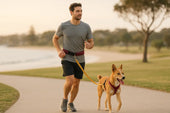
- Hands-free system with coupler: A waist belt lead or cross-body lead combined with a splitter.
A “double leash” is not the same as:
- Two separate standard leashes (one per dog): Offers maximum independence and can be safer during training, but requires more skill and hand management.
- Tie-out or tethering line: Intended for stationary supervision, not walking; it can be unsafe if used like a walking system.
The best approach is to choose the style that matches the dogs’ behaviour and your walking environment—not the style that looks simplest.
From PetCareShed, with Love for Every Dog
Are Double Dog Leashes Safe and Humane?
A double dog leash is neither inherently “good” nor inherently “bad”. Safety depends on the dogs’ behaviour compatibility, the handler’s ability to maintain control, and the equipment design.
When a double dog leash can be a sensible choice
A double system is most appropriate when both dogs:
- Walk with a slack leash most of the time
- Are comfortable walking close to each other without tension
- Do not frequently lunge at triggers (dogs, bikes, wildlife, children)
- Are similar enough in pace that one is not constantly towing the other
- Can recover quickly from surprises (a sudden noise, a jogger appearing, a magpie swooping)
These points align with mainstream welfare and training guidance that treats loose-leash walking as the “gold standard” and recommends reward-based training methods.
When a double dog leash is a poor fit
A double leash is often the wrong choice when:
- One dog pulls strongly and the other is smaller or less confident
- Either dog is reactive (barking/lunging) or fearful in public
- The dogs compete for space, scents, or resources on lead
- You frequently walk in narrow shared paths where dogs must be kept tidy
- You need to walk near roads with frequent stops, crossings, and tight corners
In these cases, a double leash can increase the chance of tangling, falls, or a dog being dragged off balance.
Welfare note: neck pressure and equipment selection
RSPCA guidance for walking equipment generally favours setups that avoid pressure on the neck, especially when a dog pulls. RSPCA South Australia recommends a front-attaching harness and lead as a preferred walking combination, and RSPCA Queensland similarly recommends using a front-attaching harness with a double-ended lead for training loose-lead walking.
For two-dog walking, this is highly relevant: if a double leash increases pulling even slightly, that increased force is best directed through a well-fitted harness rather than the neck.
Double Dog Leash Styles Explained (and Who Each One Suits)
Choosing a “best double dog leash” in Australia starts with selecting the right style. Below is a practical comparison.
| Leash Style | What it is | Best for | Common drawbacks |
|---|---|---|---|
| Coupler (splitter) | Short Y/V attachment added to a standard leash | Two dogs with similar pace and calm behaviour | Dogs feel “locked together”; can increase pulling and crowding |
| Integrated Y-lead with swivel | Single handle lead with two arms, often adjustable | Everyday suburban walks; handlers wanting fewer tangles | Still limits independence; can be hard in narrow paths |
| Double-ended training lead | Two clips; can connect front+back of a harness or improvise a coupler | Training one or two dogs; extra control points | Requires more setup knowledge; can snag if too long |
| Hands-free belt lead + coupler | Waist belt distributes load; coupler attaches for two dogs | Steady walkers; people needing hands for pram/bag | High risk if dogs lunge suddenly; can pull handler off balance |
| Two separate standard leashes | One lead per dog, each independently controlled | Training, reactive dogs, mismatched sizes | More hand management; greater chance of leash crossing |
As a rule, the more the system physically “binds” the dogs together, the more you rely on them behaving as a coordinated pair.
What “Best” Means in Australia: The Selection Criteria That Matter Most
Australian walking conditions are not uniform. A double lead that feels ideal on a quiet suburban loop may become risky near an off-leash beach entrance, a shared cycling path, or a bush track with wildlife. Consider the criteria below as a checklist.
1) Strength and hardware reliability
Two dogs can generate surprisingly high peak force when startled. For safety, pay close attention to:
- Clip type and strength: Solid, well-made clips with smooth gates reduce accidental opening.
- Stitching and webbing quality: Look for reinforced stitching at stress points.
- Central ring quality (for couplers): This is a single point of failure.
A practical habit: inspect clips, stitching, and swivel function weekly, and replace equipment after visible fraying, corrosion, or persistent sticking.
2) Swivels and anti-tangle design
Swivels reduce twist when dogs swap sides. They are especially valuable in Australia where:
- Many popular walking routes are shared paths with frequent passing traffic
- Dogs are often allowed (and encouraged) to sniff, which can involve circling
No swivel removes all tangles, but a good swivel can prevent the “rope braid” effect that shortens the system over the course of a walk.
3) Adjustability and length control
RSPCA guidance commonly references leads of around two metres as a practical length for allowing exploration without encouraging pulling.
For two dogs, length becomes more complex:
- Too short: dogs feel compressed, frustration increases, and the risk of stepping on one another rises.
- Too long: tangles increase, and you may struggle near roads and crossings.
Adjustable arms on a Y-lead can help you match each dog’s preferred position (for example, a confident dog slightly ahead, a nervous dog slightly behind).
4) Reflective elements for low-light visibility
Many Australians walk dogs early to avoid heat, or later after work. Reflective stitching is a genuine safety feature for:
- Dawn and dusk suburban streets
- Shared paths with cyclists
- Winter walking when evenings darken early
5) Handle ergonomics and secondary control
If your double leash includes:
- Padded handle, it reduces hand fatigue on longer walks.
- Traffic handle (short second handle near the clip), it gives quick control when passing narrow points or managing distractions.
For walking two dogs, a secondary control point is often more useful than people expect.
6) Compatibility with a harness-based setup
Given welfare guidance favouring harnesses for pulling dogs, it is sensible to choose a double leash system that works cleanly with:
- Two harnesses (one per dog), each correctly fitted
- Front and/or back attachment points
RSPCA also stresses correct harness fit, including allowing normal movement and avoiding restriction; a poorly fitted harness can cause discomfort and altered gait.
Australian Leash Rules: Practical Compliance for Two-Dog Walking
Australia does not have one single national leash law. Rules are typically set by states/territories and implemented or refined by local councils. In most public places, dogs must be on a leash unless in a designated off-leash area.
A practical approach for PetCareShed readers is:
- Treat “on-leash unless clearly signed off-leash” as the default
- Follow posted signage for the specific park, beach, or reserve
- Check your local council website for lead length limits and multi-dog restrictions
Some commonly referenced rules include maximum lead lengths and conditions in certain places (for example, requirements near shared paths or playgrounds). Public summaries of “state-by-state” rules are widely published, but councils can and do vary; always prioritise the local rule in the location you are walking.
If you are using a double leash, ensure you can still demonstrate “effective control”. In practice, that means you can:
- Keep both dogs close when required
- Prevent them from approaching others uninvited
- Prevent lunging into bike paths, roads, or sensitive wildlife areas
If you cannot reliably do these things, use two separate leads and build skills before moving to a coupled system.
Preparing Your Dogs: The Training Foundation Before You Clip In
A double dog leash is best treated as a “graduation” tool, not the starting point. RSPCA describes loose leash walking as walking with a slack leash and no tension, and supports reward-based methods to build that skill.
Step 1: Train loose-leash walking individually
Before walking as a pair, each dog should be able to:
- Walk near you with a slack lead for most of the walk
- Respond to their name and a simple cue (for example, “this way”)
- Pause calmly while you stop
Reward-based training methods are widely recommended: reward the dog for walking close to you on a loose leash, and stop moving when pulling occurs so the dog learns that pulling does not reach the goal faster.
Step 2: Confirm calm proximity at home
Many conflicts on double leads come from proximity pressure rather than “aggression”. Practise calm side-by-side walking in a low-distraction environment:
- In a backyard or driveway
- On a quiet footpath at off-peak times
Reward both dogs for:
- Walking parallel
- Checking in with you
- Allowing the other dog to sniff without barging
Step 3: Add predictable structure: positions and corners
Two-dog walks become safer when dogs understand “where they belong”:
- Choose a preferred side for each dog (left/right)
- Practise slow corners and direction changes
- Teach a brief “wait” at kerbs
Structure reduces weaving, and weaving is one of the main causes of tangling.
Step 4: Proof the skills before adding complexity
Only move to busier environments when your dogs can do the basics in quiet areas.
A helpful benchmark: if either dog regularly pulls you off line or you cannot stop and reorient them calmly, a double lead is premature.
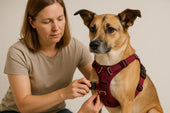
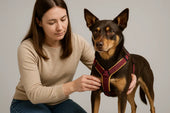
Fitting and Attachment: Harness, Collar, and Clip Placement
Harness fitting
RSPCA guidance stresses that harnesses must be properly fitted for comfort and normal movement.
As a general check:
- You should be able to slide two fingers under straps without forcing
- Straps should not rub in the armpits
- The dog should show a natural stride and not “short-step”
Collar use
For many dogs, a collar is best reserved for identification. For walking two dogs, collars can become a higher-risk attachment point if pulling surges occur. If a collar is used at all, prefer a well-fitted flat collar, and keep ID tags appropriate to your local registration requirements.
Where to clip when using a double system
- If you use a coupler/Y-lead, attach each clip to each dog’s harness ring (commonly the back ring for calm walkers).
- If one dog pulls, consider a harness with a front attachment option and use a setup that improves steering and reduces pulling (for example, a double-ended lead used front+back during training), as suggested by RSPCA resources discussing double-ended lead use for training.
Avoid attaching a double system to a single collar ring for a dog that lunges. Sudden force and twisting can be significant.
Handling Skills: How to Walk Two Dogs Without Tangles and Stress
Equipment helps, but handling skills determine whether two-dog walking feels controlled or chaotic.
Start with a “quiet exit” routine
Many leash problems begin at the front door. Aim for:
- Leash and harness put on calmly
- Dogs waiting briefly before exiting
- A short pause outside to settle
This reduces the likelihood that the first 30 seconds become a pulling contest.
Use the “lane” concept on shared paths
Australian shared paths can be busy with joggers and cyclists. Adopt a consistent pattern:
- Keep dogs on the side away from passing traffic
- Shorten the lead before a cyclist passes
- Ask for a brief “wait” or “close” and reward compliance
If you rely on a double leash, plan ahead. The coupled system can make it harder to “tuck in” quickly.
Avoid mid-walk “crossings” between dogs
Many tangles happen when dogs swap sides around a pole, tree, or sign. Practical strategies:
- Step to the outside of obstacles so the dogs stay on one side
- If a dog tries to cross, stop, cue them back, then proceed
Manage sniffing fairly
Sniffing is normal canine behaviour and can be calming. Problems arise when one dog is repeatedly prevented from sniffing because the other drags them on.
Build “sniff breaks” into your routine:
- Pause and allow both dogs to sniff
- Reward calm waiting
- Move on together
This reduces frustration and leash tension.
Prepare for the “two directions” moment
Even well-matched dogs sometimes choose opposite directions. When this happens:
- Stop immediately
- Bring both dogs back to centre (shorten the lead or use traffic handle)
- Reset with a cue and reward
Avoid being pulled into a split stance. Falls and wrist/shoulder injuries are a real risk when two dogs pull away from each other.
Matching Two Dogs: Size, Strength, Age, and Temperament
A double leash assumes the dogs can operate as a pair. Compatibility is more than “they live together”.
Size and strength
Large mismatches create leverage. If one dog is much stronger:
- The stronger dog can pull the smaller dog off balance
- The smaller dog may develop lead anxiety or defensive behaviour
In mismatched pairs, two separate leads or a more controlled training setup is usually safer.
Age and stamina
Young dogs may want to surge, while older dogs may need a steadier pace. A coupled system can force the older dog to keep up or force the younger dog into frustration.
If you are managing a senior dog and an adolescent dog, consider:
- Short separate walks for training and enrichment
- A paired walk only for calm, short distances
Temperament and triggers
Some dogs are socially neutral and comfortable passing others. Others are reactive due to fear, frustration, or over-arousal.
With reactive dogs, coupling can:
- Increase arousal (the other dog becomes part of the “storm”)
- Reduce your ability to create distance from a trigger
In these cases, the best “double dog leash” may be no double leash at all—at least until training is well established.
Australia-Specific Walking Risks (That Influence Double Leash Choice)
Heat and hot pavement
Hot weather is not just uncomfortable; it can be dangerous. RSPCA advises avoiding exercise in extreme heat and walking early morning or late evening.
RSPCA WA also recommends checking the ground temperature by placing your palm on it—if you cannot hold your hand down comfortably, it is too hot for paws.
Walking two dogs can increase heat risk because:
- You may move faster to “keep them together”
- You may be less able to quickly pick up or assist a dog showing early heat stress
Practical heat-safe habits:
- Walk at sunrise/sunset
- Choose grass and shaded routes
- Carry water and a collapsible bowl
- Watch for early signs such as heavy panting, slowing down, seeking shade, drooling, or disorientation
If any heat stress signs appear, stop immediately and cool the dog while arranging veterinary advice. RSPCA Pet Insurance guidance discusses cooling strategies such as applying cool/tepid water and using airflow to maximise heat loss.
Wildlife and environmental triggers
In many Australian suburbs and regional areas, dogs may encounter:
- Possums and cats at dusk
- Waterbirds near lakes
- Kangaroos or wallabies in peri-urban bush corridors
- Snakes in warmer months
A double lead can reduce your ability to separate dogs quickly if one fixates on wildlife. If wildlife encounters are common on your route, consider a system with:
- Strong hardware
- A traffic handle
- Enough length control to keep dogs close promptly
Magpies and sudden surprises
Magpie swooping season is a predictable hazard in many parts of Australia. Two dogs may react unpredictably (one may freeze, one may lunge). In swooping areas, avoid narrow paths and keep the walk calm and short.
“Best Double Dog Leashes” Feature Checklist (Use This to Compare Options)
Rather than naming external brands, the most useful approach is to compare products by specifications.
Look for:
- Swivel(s): preferably at the central junction and/or at each clip
- Adjustable arms: to suit different dog sizes and walking positions
- Reflective stitching: for low light
- Comfort handle: padded or ergonomic
- Traffic handle: short control handle for close passing
- Durable webbing: appropriate width for dog size
- Reliable clips: smooth gate action, corrosion resistance
Avoid (for two-dog walking):
- Retractable systems, which provide less control and encourage pulling behaviour; RSPCA resources caution against retractable leads for these reasons.
- Excessive bungee stretch if it turns every distraction into a “slingshot” effect
Recommended Related Products from PetCareShed
The following PetCareShed product categories are commonly useful when walking two dogs with a double leash system. These are suggested as supporting tools to improve comfort, control, and safety.
- Front-attach dog harnesses: helpful for dogs that pull, aligning with welfare-oriented guidance that favours harness-based walking rather than neck pressure.
- Double-ended training leads: useful for training loose-lead walking with front-and-back harness attachment, and for flexible handling options.
- Double dog leash couplers / Y-leads with swivel: suitable for well-matched dogs that already walk calmly.
- Reflective dog leads and accessories: valuable for early morning/evening walking.
- Portable water bottles and travel bowls: practical for Australian heat management and longer walks.
- Treat pouches: supports reward-based loose-lead training and polite passing on shared paths.
- Grooming wipes: useful after beach walks, muddy reserves, or high pollen days.
How to Introduce a Double Dog Leash: A Practical Step-by-Step Plan
Step 1: Do a gear check indoors
Before the first walk:
- Check clip gates open and close smoothly
- Ensure swivels rotate freely
- Confirm harness fit and comfort
- Confirm each dog can stand calmly while clipped in
Step 2: First session is not a “walk”
Make the first outing short (5–10 minutes) in a quiet area. The goal is to evaluate:
- Whether one dog crowds the other
- Whether tangles occur immediately
- Whether you can stop, reset, and continue calmly
Reward calm behaviour frequently.
Step 3: Build duration before difficulty
Increase time first, then increase complexity:
- Longer in the same quiet area
- New quiet streets
- Busier routes with more passers-by
Step 4: Maintain an “exit option”
If you notice persistent problems (dragging, crowding, vocal reactivity), revert to:
- Two separate leads, or
- Individual training walks for a period
This is not a failure. It is a safety decision.
Common Problems (and Fixes) When Using Double Dog Leashes
Problem: Dogs tangle constantly
Likely causes:
- Dogs swap sides frequently
- Arms are too long
- You are walking near too many obstacles
Fixes:
- Assign each dog a side and reward staying in position
- Shorten the arms slightly
- Practise in open spaces before narrow tracks
Problem: One dog drags the other
Likely causes:
- Pace mismatch
- Training mismatch
- Stronger dog is over-aroused
Fixes:
- Train separately until both can loose-lead walk
- Consider a harness setup that improves steering for the pulling dog (front-attach)
- Use two separate leads for safety
Problem: Dogs argue on lead
Likely causes:
- Leash tension creates frustration
- One dog blocks the other from sniffing
- The dogs are uncomfortable being forced close
Fixes:
- Increase space by using longer arms (where safe)
- Build structured sniff breaks
- Walk separately if conflict persists
Problem: Handler feels off balance
Likely causes:
- Dogs pulling in opposite directions
- Using a hands-free system with dogs that lunge
Fixes:
- Use a standard hand-held system with a strong handle and traffic handle
- Keep walks shorter and calmer while training improves
Choosing the Right Setup by Scenario (Australia-Focused)
Suburban footpaths with school traffic
Prefer:
- Two harnesses
- A Y-lead with swivel and traffic handle, or two separate leads if dogs are still learning
Key reason: narrow footpaths, frequent stops, and unpredictable movement.
Shared paths (cyclists, runners)
Prefer:
- Reflective lead elements
- A setup that can be shortened quickly
Key reason: passing traffic speed requires fast, tidy control.
Beach and foreshore walks
Prefer:
- Corrosion-resistant hardware
- Easy-rinse webbing
Key reason: sand and salt can reduce clip reliability over time. Rinse gear after beach use and dry thoroughly.
Bush tracks and peri-urban reserves
Prefer:
- Strong hardware and robust webbing
- Shorter control capability (traffic handle)
Key reason: wildlife triggers and narrow tracks can be challenging for coupled dogs.
Maintenance and Replacement: Keeping Double Leash Gear Safe
Equipment failures are preventable in most cases. Adopt a maintenance routine:
- After each walk: quick check for sand, grit, stuck swivel movement
- Weekly: inspect stitching, webbing wear, clip spring tension
- After water/beach: rinse in fresh water and air dry
- Replace immediately if:
- stitching is frayed
- clips stick, bend, or corrode
- webbing is thinning or cut
If you walk two medium-to-large dogs, replacement should be conservative. Hardware is inexpensive compared with the consequences of failure.
FAQ: Double Dog Leashes in Australia
Are double dog leashes legal in Australia?
In most places, yes—provided both dogs remain under effective control and you comply with any local lead length rules and area restrictions. Because regulations vary by state and council, check local signage and council guidance for the area you are walking.
What is the difference between a double dog leash and a double-ended lead?
A double dog leash is designed to walk two dogs at once (usually a Y-lead or coupler). A double-ended lead has two clips and is commonly used to connect to two points on one dog’s harness (front and back) for training, or to create flexible setups.
Can puppies be walked on a double dog leash?
It is usually better to train puppies individually first. Puppies are still learning leash manners and impulse control, and a coupled system can create frustration and tangling. Once each puppy can walk on a loose lead and remain calm near the other, a double leash can be trialled in short sessions.
Is a harness better than a collar for walking two dogs?
For many dogs, a harness is the safer choice, particularly if pulling occurs. RSPCA resources commonly recommend harness-based walking (including front-attach harnesses) to discourage pulling in a force-free way and avoid neck pressure.
Should the two dogs be the same size for a double lead?
Similar size and strength makes a coupled system easier and safer. Large mismatches can result in the smaller dog being pulled off balance, particularly if the larger dog lunges.
What leash length is best for walking two dogs?
There is no single length that suits all situations. As general guidance, RSPCA has referenced leads around two metres for everyday walking.For two-dog systems, choose a length that allows sniffing without creating excessive slack near roads and shared paths. Adjustable arms can help.
Are retractable leads suitable for walking two dogs?
Generally no. Retractable leads reduce control and can encourage pulling; welfare guidance commonly discourages their use for these reasons.
How do you stop two dogs from tangling on a double lead?
Use a swivel-based system, assign each dog a side, and practise structured walking with frequent rewards for staying in position. Avoid allowing dogs to circle each other around poles and trees.
One dog is reactive—can a double dog leash help?
A coupled system usually makes reactivity harder to manage because it reduces your ability to create distance and increases overall arousal. In most reactive cases, separate leads and structured training are safer.
Is a hands-free double leash safe?
It can be safe for steady, well-trained dogs. It can be risky if either dog lunges because the force transfers to your body and can pull you off balance. If you are unsure, start with a hand-held lead and a traffic handle.
How should walks change in hot Australian weather?
Walk at cooler times and avoid hot surfaces. RSPCA advises avoiding exercise in extreme heat and walking early or late. RSPCA WA recommends checking the ground with your palm; if it is too hot for your hand, it is too hot for paws. Carry water and stop if a dog shows signs of overheating.
What are signs my dogs are not suited to a double leash?
Common signs include persistent pulling, crowding, frequent tangling, growling or snapping on lead, or one dog repeatedly trying to escape the other’s proximity. If these occur, revert to separate leads and rebuild training.
Can I attach both dogs to one collar each with a coupler?
It is not recommended for dogs that pull or lunge. Collars can concentrate force on the neck. Harness-based attachment is often safer, and welfare-oriented guidance frequently favours harnesses for walking and training.